














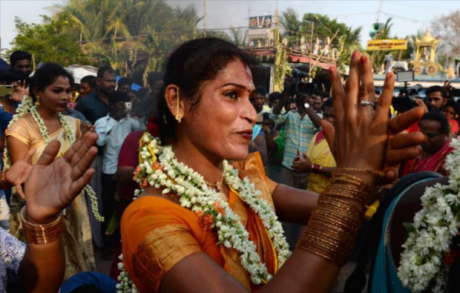
Despite a section of society refusing to accept gender-diverse communities, every May to July, vast numbers of indigenous gender-variant and diverse communities in south India honour their patron deities at temples such as those for Koothandavar Aravan in Tamil Nadu, and for Ellamma, Bhagavati and Mariamman across the region. – Gopi Shankar Madurai
In a landmark ruling delivered earlier this month, the Madras High Court affirmed that same-sex couples can form families without legal marriage. It marked a major milestone for LGBTQIA+ rights in India, particularly in Tamil Nadu. Emerging from a habeas corpus petition, the ruling addressed the case of a 25-yearold lesbian woman detained by her natal family. Her partner sought her release so that they could live together. While securing her freedom, Justices G.R. Swaminathan and V. Lakshminarayanan expanded the definition of family under Indian law, emphasising personal autonomy and right to self-determination.
It comes decades after the 2002 suicide of two lesbian women in Erode’s Satyamangalam forest after facing societal rejection of their relationship. Despite this, the 2025 verdict builds on Tamil Nadu’s progressive legacy rooted in both legal reforms and Indic traditions fostering wider acceptance of diverse identities. The verdict signals progress while recognising the concept of a “chosen family” under Article 21 of the Constitution, which guarantees life and personal liberty. The court’s assertion that “marriage is not the sole mode to found a family” validates non-traditional relationships and offers hope where despair once prevailed.
Despite a section of society refusing to accept gender-diverse communities, every May to July, vast numbers of indigenous gender-variant and diverse SOGIESC (sexual orientation, gender identity, expression, and sex characteristics) communities in south India honour their patron deities at temples such as those for Koothandavar Aravan in Tamil Nadu, and for Yellamma, Bhagavati and Mariamman across the region. These communities enact gender-specific Hindu rituals, which have historically provided sacred spaces for early LGBTQIA+ activism. This cultural acceptance, though not universal, has helped shape a more inclusive societal framework and complemented the legal efforts.
The court’s legal reasoning in the latest case was meticulous. The detainee confirmed her lesbian identity and desire to live with her partner, exposing familial coercion. The judges, referencing the Supreme Court’s 2023 ruling in the Supriyo @ Supriya Chakraborty case, noted while same-sex marriage remains unrecognised, same-sex couples can still form families. The court criticised police inaction and directed law enforcement to protect the couple, reinforcing the judiciary’s role in safeguarding individual rights against societal and familial pressures
Tamil Nadu’s history of activism and legal milestones has been crucial in reaching this point. In 1994, former Chief Election Commissioner T.N. Seshan granted voting rights to transgender individuals, setting a precedent for inclusion. In 2004, advocate G.R. Swaminathan, now a judge, secured voter identity cards for transgender people, prompting the state to publicise their voting rights. By 2006, a government order aimed to improve transgender living conditions, promoting counseling to prevent disownment and ensure educational access.
In 2008, Tamil Nadu established a transgender welfare board, and in the early 2000s, it introduced one of India’s first transgender welfare policies, offering free gender-affirming surgeries and socio-economic benefits. Asia’s first Genderqueer Pride Parade and Education Fest for school children and college students were organised in 2012. Anjali Gopalan of Naz Foundation flagged off the event in Madurai.
In 2019, the Madurai bench of the Madras High Court led by Justice Swaminathan banned forced sex-selective surgeries on intersex infants, making Tamil Nadu the first state to do so. It also became the first to recognise and register marriages of transgender and intersex persons under the Hindu Marriage Law, amend police guidelines to prevent harassment of the LGBTQIA+ community, ban conversion therapy, and include LGBTQIA+ issues in curriculums in 2017.
Organisations like Srishti Madurai and Orinam Collective have supported these efforts through legal petitions, providing shelters, funds and organising workshops, pride parades, embedding queer rights within Tamil Nadu’s cultural and legal fabric. Today, the Tamil has native terminologies for diverse SOGIESC identities, which is missing in many Indian languages.
Festivals and rituals at temples like Koothandavar Aravan, where gender-diverse individuals are celebrated, has provided a foundation for LGBTQIA activism. These sacred spaces, where GIESC communities perform rituals honoring deities associated with fluid gender identities, have historically challenged societal norms, fostering a sense of belonging and resistance against discrimination. This cultural acceptance, though not without resistance, has been a catalyst for legal victories, like the latest ruling, which resonates with the communal spirit of these traditions.
Despite these advancements, challenges persist. The 2002 suicide underscores the personal struggles behind legal battles. Activists say societal acceptance often lags behind legal progress, with financial hardships and exclusion remaining prevalent.
The latest verdict complements rulings by former Chief Justice D.Y. Chandrachud and Justice Venkatesh of Madras High Court, creating an ecosystem where personal identity and relational freedom are upheld as matters of dignity and public interest, the ruling has sparked broader discourse on queer rights, inviting debate on legal recognition of diverse family structures. It signals a future where all, regardless of sexual orientation, can live with integrity and autonomy.
The ruling is a testament to the enduring power of activism. Activists are continuing to push for comprehensive legal recognition, including same-sex marriage, and cultural acceptance to address ongoing discrimination. Building on decades of progress, the latest judgement ensures that love in all its forms is protected, offering a path towards an inclusive future where past tragedies are not repeated. – The New Indian Express, 27 June 2025
› Gopi Shankar Madurai is the South Regional Representative for the National Council for Transgender Persons and Executive Board Member at ILGA Asia.

Filed under: india | Tagged: aravanis, hijras, LGBTQIA+ rights, madras high court, transgender | 1 Comment »











