













 Though Hamas is entirely to blame for starting this war, Netanyahu is a major obstacle to even hypothetical efforts to stop it. Nearly every observer says that a settlement must include some plan to solve the fundamental puzzle: creating some peaceful, enduring way for Israelis and Palestinians to share or divide the land that they all claim as their own. – Fred Kaplan
One month has passed since the Israel-Hamas war began, and no end seems to be in sight. There are three reasons why.
First, both sides have maximalist goals: Hamas, to wipe the state of Israel off the map; Israel, to destroy Hamas as a political force that rules Gaza and as a military force that can threaten Israel ever again. Neither goal is achievable. Israel isn’t going anywhere, and even if the Israeli army kills every Hamas commander, others will rise to take their place. This is especially true given the steep death toll in Gaza, a product of the high explosive power of Israeli bombs, the density of Gaza City, and Hamas’ use of civilians as human shields to protect their rocket sites and command posts.
Second, neither side’s leaders are inclined to compromise. Israelis view Hamas as an existential threat. Its Oct. 7 attack killed 1,400 people, the great majority of them civilians—more Jews killed in one day than at any time since the Holocaust. “Never again” has become a more urgent imperative than at any time since the creation of Israel as a state. Hamas’ commanders, having achieved what they see as a glorious success, which has roused global support for Palestinians on a scale never before seen, may see the conflict as the last chance to strike a big blow.
Third, only outside pressure can moderate the two combatants’ goals, much less stop the fighting, but there are limits on what outsiders can—or want to—do. The United States, which is fast becoming Israel’s only powerful ally, has held back Prime Minister Benjamin Netanyahu and his unity wartime Cabinet to some degree, but just some: Netanyahu refuses to declare a “humanitarian pause” in the bombing (though he and the Egyptian leaders have opened the borders to let in some food, water, and medical supplies). President Joe Biden has said repeatedly that Israel has a right to defend itself; he is sending, with congressional approval, an additional $14.5 billion in military aid, but he has also urged Israel to do more to reduce Gazan civilian casualties (the overall death toll in Gaza is now topping 10,000). At some point, the number of dead may soar so high that Biden dials back his support—though it is not at all clear where that point will, or should, be drawn.
Meanwhile, the neighboring Arab nations make grand declarations of support for Palestinians, but they aren’t doing very much to help them, and never have. Egypt has blockaded Gaza’s southern border as fervently, and for as long, as Israel has blockaded from the north. Its leaders have no interest in hosting Gazan refugees from Israel’s bombing. Neither do the rulers of Saudi Arabia, Lebanon, Jordan, or the others. In recent years, they have all been more interested in forming an alliance with Israel against their common enemy, Iran (which, by the way, supports Hamas). Signs that the Saudis were about to hold talks with Israel were probably what spurred Hamas’ attack. The terrorists wanted to reassert the fate of the Palestinians as the prime issue in the region and to assert themselves as the prime movers of that fate. For now, they succeeded. Even though their Arab neighbors would like to get their dealings with Israel back on track, they can’t—lest they anger their own people—as long as Israel is killing Palestinian civilians.
Biden and Secretary of State Antony Blinken have been pressuring Netanyahu and his Cabinet to back down on the bombing—to little avail. Blinken, in a crisscross of “shuttle diplomacy” not seen in the Middle East since Henry Kissinger’s days, has been pressuring the Sunni Arab leaders to crack down on Hamas or at least help the Palestinians—also to little avail.
When Biden was in Tel Aviv earlier this month, he sat in on an Israeli Cabinet meeting and asked the ministers what plans they had for the day after the war ended. The ministers, it turned out, had no plans. Biden stressed, as he has in public speeches as well, that the U.S. responded to the 9/11 terrorist attacks with rage—just as the Israelis are understandably doing now—and got justice (killing Osama bin Laden), but also made terrible mistakes (invading Iraq with no post-war plan, a move that destabilized the entire region for decades to come). Biden was telling them, “Don’t make the same mistake we made.”
Yet they seem to be doing just that.
The impulse is, in many ways, understandable. Israelis can’t just stand by and let Hamas get away with murdering and kidnapping so many of their citizens. It would be worth great sacrifice to mete out justice and prevent such a catastrophe from ever happening again.
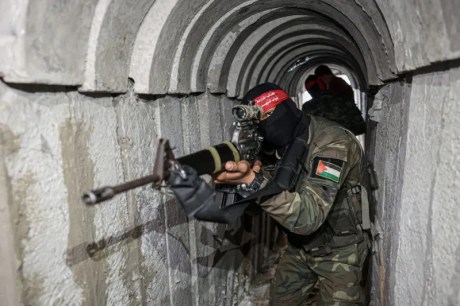
In order to destroy Hamas, Israel has been bombing its vast and impressive network of tunnels, where the group’s fighters are hiding and from which they mount attacks. Many of these tunnels are built under houses, hospitals, schools, and the like. Israel has been warning people in northern Gaza to leave, but many—perhaps hundreds of thousands—haven’t been willing or able.
But the more Palestinian civilians that are killed in this war (regardless of who is at fault), the more Israel will lose favor in the rest of the world—it has already lost more favor than, perhaps, any time in its history—and the more difficult it will be to restore good relations with Sunni Arab countries.
Though Hamas is entirely to blame for starting this war, Netanyahu is a major obstacle to even hypothetical efforts to stop it. Nearly every observer says that a settlement must include some plan—at minimum, some resumed negotiations—to solve the fundamental puzzle: creating some peaceful, enduring way for Israelis and Palestinians to share or divide the land that they all claim as their own. One way to do that is to convince Palestinians that they have something to gain—and thus nullify the appeal of Hamas’ leaders, who argue that violent resistance is the only way. (Hamas is an acronym for Harakat al-Muqawama al-Islamiya, meaning Islamic Resistance Movement.)
The European Commission on Monday presented five principles for the day after the war ends: Gaza cannot be a haven for terrorists; Hamas cannot rule in Gaza; there cannot be a long-term Israeli security presence, nor forced displacement of Palestinians from Gaza; and there must not be a continuous siege of Gaza.
Sounds good. Does anyone have an idea of how to pull off and enforce these principles for longer than the time it takes to recite them, much less many years?
It is all much easier said than done. Formulas for peace have been negotiated and presented over the decades, but one side or the other has walked away each time. Netanyahu—who has been prime minister from 1996–99, 2009–21, and since December 2022—is not only Israel’s longest-serving head of state, but the only one who has relentlessly opposed any sort of solution, even on principle. Most cynically of all, he has built up Hamas’ rule in Gaza, mainly by letting Qatar furnish it with supplies—precisely in order to weaken the Palestinian Authority in the West Bank, thus giving the PA’s leaders less leverage in demanding negotiations. (He has also allowed a massive buildup of Jewish settlements in the West Bank, thus radicalizing the Palestinians there and reducing the popular appeal of compromise with Israel.)
Israel’s leaders no doubt realize this. But at least some of them think it’s worth risking those political objectives to destroy Hamas—even if they’re not entirely clear on how incessant bombing does accomplish that. The eruption of worldwide protests, many of them against not just Israel, but Jews—and in sympathy with not just the Palestinian people, but Hamas—will continue, and likely escalate, for as long as the war continues. Netanyahu and others may look at these protests and think, “If the world doesn’t give us support and sympathy even after Hamas murdered 1,400 of us, then to hell with the world, we’ll do what we think needs to be done.” This is understandable, but the dynamic will, more and more, reduce political support for Israel. Polls show young Americans, who have no memory of Israel’s origins as a struggling refuge for Jews after the Holocaust, are increasingly disenchanted with Israel. The rise of revenge killings against Palestinians by settlers in the West Bank—which Netanyahu has done nothing to crack down on, despite urgings from Biden and Blinken—only intensifies this opposition.
Even if Israel wins the short-term battle, it may lose the long-term war. And for now, it’s not entirely clear how it will win the battle. – Slate, 7 November 2023
› Fred M. Kaplan is an American author and journalist. His weekly column for Slate magazine covers international relations and U.S. foreign policy.
Filed under: gaza, israel, palestine, USA | Tagged: asymmetric warfare, civilian hostages, geopolitics, hamas, israel-palestine conflict | Comments Off on Why there is no end in sight for the Israel-Hamas war – Fred Kaplan