






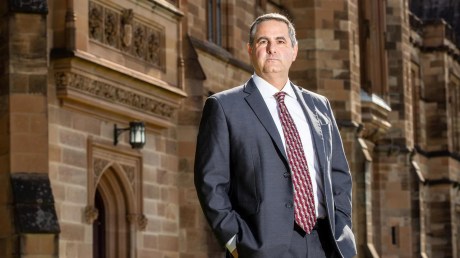
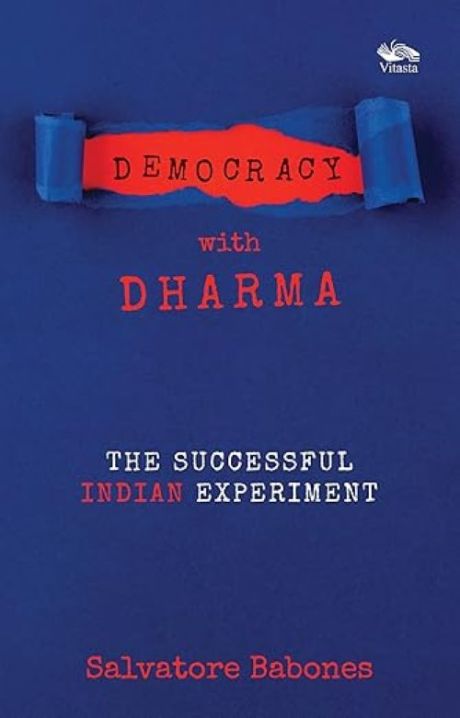
In this exclusive interview with Firstpost, sociologist and author Salvatore Babones, who has just come out with a new book, Democracy with Dharma: The Successful Indian Experiment, offers a stimulating reassessment of Indian democracy and its uneasy relationship with Western liberal norms. Challenging dominant narratives in global academia and think tanks, Babones argues that India can be best described as a “dharma democracy”—institutionally liberal, yet culturally rooted in a deeply religious and civilisational ethos. He also questions global democracy indices and their methodological biases, and explains why India is often judged more harshly than other postcolonial states. – Utpal Kumar
The following is an edited extract from the interview:
Q : In your book, you describe India as a “dharma democracy”. What do you mean by this concept, and how does it differ from Western liberal democracy?
A : India is very much a Western liberal democracy—but one with a thoroughly traditional, highly religious electorate. The main distinction between Western democracies and Indian democracy lies not in the state institutions, but in the character of the nation. The Indian nation is a dharmic nation, Hindu in thought and personality. I use the shorthand “dharma democracy” for India because the main determinant of democratic success, especially in developing countries, is the level of national unity. India’s national unity was built in the late 19th and early 20th centuries by Hindu intellectuals and reformers.
Meanwhile, most Indians of other religions largely kept to themselves, and did not actively participate in the formation of the modern Indian nation. As a result, the Indian nation today is centred on the majority Hindu community. This is both the greatest strength of Indian democracy, and its greatest challenge, since it has left many—particularly Muslim—Indians outside the national mainstream. Muslim Indians are full citizens of the Indian state, but often they do not participate fully in the life of the Indian nation.
Q : India has been a democracy, in some form, since Independence in 1947. Yet many Western scholars label it an “electoral autocracy” or an “authoritarian vigilante state”. Why is Indian democracy so frequently derided, especially in Western think tanks and academia?
A : Westerners did not “know” that Indian democracy fell short of Western liberal democratic standards until 2016, when Sweden’s Varieties of Democracy Institute (V-Dem) published its first annual evaluation of the world’s democracies. Until then, Western evaluations of Indian democracy were largely positive. But V-Dem introduced a new methodology, relying on in-country experts to evaluate each country’s democracy. For India, that meant asking Indian political scientists to rate India’s institutions. And it was these Indian intellectuals who rated India so low. Western scholars have since accepted this appraisal, but ironically it actually originated in India.
Q : V-Dem data suggests Indian democracy peaked in 1998—a period marked by political instability and weak coalition governments. Many observers argue Indian democracy has strengthened since then. Do such indices reflect methodological or ideological biases?
A : The (mostly) Indian political scientists who populate V-Dem’s expert panel for India seem to have romanticised the Nehru era—which most of them know only from history books—and preferred living in the coalition era. The latter should come as no surprise: political scientists, in general, seem to prefer weak coalition governments to strong majority governments. But that is more a reflection of the subjective preferences of intellectuals than the objective quality of democracy. On objective indicators, Indian democracy is as healthy now as it has ever been, with the entire period 1999–2026 showing similar levels of institutional strength. The 1990s represented a different configuration of India’s party system, but comparable levels of democracy. The entire period since 1991 represents a consolidation of Indian democracy after the turbulent (and violent) 1970s and 1980s.
Q : When countries like the Maldives rank above India in democracy indices, or when institutions predict India as highly prone to “mass killings”, does this point to systemic flaws in global democracy rankings?
A : There are systematic flaws in the rankings, and most of these flaws affect India more than any other major country. This is because, unlike almost every other poor, postcolonial country, India actually is a well-consolidated democracy. As a result, Indians are free to criticise their own country’s institutions in ways that intellectuals in other countries are often prevented from doing. What a political scientist from Nepal or Sri Lanka—or indeed the Maldives—might whisper quietly in closed circles, an Indian political scientist can proclaim openly in a daily English-language newspaper. In rankings that are based on exactly these kinds of open criticisms, India fares very poorly—not because the problems are worse in India, but because Indians can discuss their problems without fear.
Q : In the book, you appear relatively charitable towards the RSS, BJP, and Prime Minister Narendra Modi. Is Western criticism of Indian democracy largely driven by a bias against these actors?
A : Western criticism of Indian democracy has been pinned on the BJP because the party has been in government since the publication of the first V-Dem report, but I always warn Congress supporters that if they win office, they will face all the same criticisms. In 2013, when the UPA was in government, the World Press Freedom Index already ranked India 140th in the world (compared to 151st today), and the Pew Research Center placed India in the worst ten countries for social hostility to religion—in the same range as today. The indices are an Indian problem, not a BJP problem. I strongly caution supporters of the INC or any other party against using the indices to vilify the BJP. It will only come back to bite them when they someday regain government.
Q : You argue that the BJP is not “Westernising” India but modernising it—and in doing so, making it more liberal. What evidence or trends led you to this conclusion?
A : The BJP has introduced modern methods into Indian politics in multiple ways, from meritocratic organisation to leveraging IT. But the most fascinating aspect of the BJP for a Western observer is its tendency to advocate liberal reforms. The best example of this is the BJP’s focus on implementing a uniform civil code, which even some of its bitterest enemies admit is necessary—they just do not want the BJP to be the one to do it. Other liberal reforms include the implementation of electronic benefit transfers, the 2016 reform of bankruptcy laws, and the 2020 attempt to introduce new flexibilities for farmers—though this was withdrawn. Looking forward, the single most important liberal reform required to improve Indian democracy is to rebalance the Lok Sabha to reflect current state population levels. The government seems committed to letting the 84th Amendment expire, which will prompt this very basic return to the fundamental principle of equal representation.
Q : You describe Yogi Adityanath as a “uniquely Indian phenomenon”. What makes him distinct in India’s political landscape?
A : The Yogi is somewhat distinct in Indian politics—he is, after all, an actual yogi—but he is extraordinarily exceptional in the international context. Other bona fide democracies simply do not elect priests or clerics to high political office. The fact that Indians have, by and large, grown accustomed to seeing the Yogi as a major national politician speaks volumes about the difference between the Indian electorate and Western electorates. The Yogi may be an unlikely chief minister in India, but he would be an inconceivable head of government in any Western democracy.
Q : In discussing the legacies of Partition, you engage with Hinduism, Hindutva, and the idea of a future Hindu rashtra. How do you respond to liberal critiques that see the notions of Hindutva and Hindu rashtra as inherently divisive or anti-Muslim?
A : The idea of a Hindu rashtra is inherently anti-Muslim, but that does not make it anti-democratic. For good and for bad, India today is a fundamentally Hindu nation (rashtra), just as most Western countries are Christian nations. India is not, however, a Hindu state (rajya) in the way that Israel is a Jewish state. From a liberal perspective, the greatest challenge facing Indian democracy is the challenge of finding an inclusive role for Muslim Indians to play in the life of the Indian nation. Sikh Indians already play meaningful roles in the Indian nation, and in some states Christian Indians do as well. But Muslim Indians remain largely outside India’s political community, connecting with it from the outside only as Muslims, not as Indians. When Muslim Indians come to be represented mainly by secular Muslim intellectuals, and not by Muslim clerics, we will know that they have become part of the Indian mainstream. For now, Muslim Indians enjoy full political rights, but suffer serious social exclusion. – Firstpost, 20 January 2026
› Utpal Kumar is the Opinion Editor at Firstpost and News 18.
Filed under: australia, EU, india, UK, USA, world | Tagged: dharma democracy, electoral autocracy, indian democracy, indian political scientists, salvatore babones | Comments Off on The Salvatore Babones Interview – Utpal Kumar