








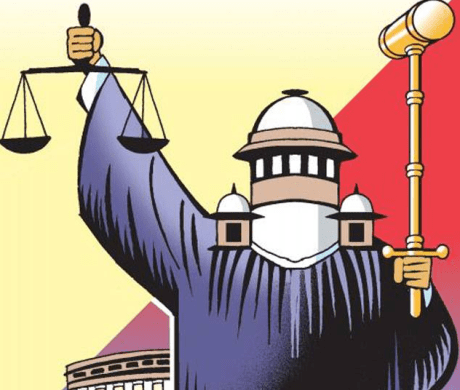
 Blocking of road by Shaheen Bagh protesters unacceptable, says a SC Bench led by Justice Sanjay Kishan Kaul. – Krishnadas Rajagopal
The Supreme Court on Sept. 7th found the indefinite “occupation” of a public road by the Shaheen Bagh protestors unacceptable.
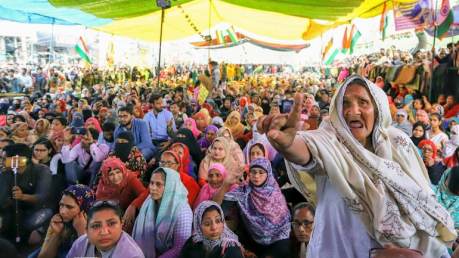
The court said the protest, considered an iconic dissent mounted by mothers, children and senior citizens of Shaheen Bagh against the Citizenship (Amendment) Act (CAA), became inconvenient to commuters.
The 13-page judgment upheld the right to peaceful protest against a law but made it unequivocally clear that public ways and public spaces cannot be occupied, and that too indefinitely.
“Democracy and dissent go hand in hand, but then the demonstrations expressing dissent have to be in designated places alone. The present case was not even one of protests taking place in an undesignated area, but was a blockage of a public way which caused grave inconvenience to commuters”, Sanjay Kishan Kaul, who authored the verdict for a three-judge Bench, observed.
The court suggested that the outcry may have even gone out of hand for the women protesters. It referred to reports about how women were ensconced inside a tent while a “huge periphery” of “male protesters, volunteers and bystanders”, who wanted the blockade to continue, milled around.
While the tent occupied half the road, the other half was blocked by a three-dimensional map of India, a large model of India Gate and even a library. Factors like the absence of leadership and many “influencers” and groups working at cross-purposes saw the movement slip out of the hands of the women of Shaheen Bagh.
“Thus, the Shaheen Bagh protest perhaps no longer remained the sole and empowering voice of women, who also appeared to no longer have the ability to call off the protest themselves. There was also the possibility of the protesters not fully realising the ramifications of the pandemic, coupled with a general unwillingness to relocate to another site”, the court observed.
‘Leaderless’ dissent
It later noted that Shaheen Bagh seemed typical of the many digitally-fuelled “leaderless” dissent seen in modern times. Technology and social media could both empower and weaken mass movements.
“The ability to scale up quickly, for example, using digital infrastructure has empowered movements to embrace their often-leaderless aspirations and evade the usual restrictions of censorship. However, the flip side is that social media channels are often fraught with danger and can lead to the creation of highly polarised environments, which often see parallel conversations running with no constructive outcome evident”, Justice Kaul ruminated.
It was finally the gaining pandemic, which intervened like the “hand of God”, that led the protesters to relent and end the blockade, the court said. They were removed by the police from the site on March 24.
The seeds of protest and dissent were sown deep during the freedom struggle. But dissent against the colonial rule cannot be equated with dissent in a self-ruled democracy, Justice Kaul reasoned.
In a democracy, the rights of free speech and peaceful protest were indeed “treasured”. They were to be encouraged and respected, the court said.
Reasonable restrictions
But these rights were also subject to reasonable restrictions imposed in the interest of sovereignty, integrity and public order. Police regulations also weighed in.
“Fundamental rights do not live in isolation. The right of the protester has to be balanced with the right of the commuter. They have to co-exist in mutual respect.”
The judgment, based on a petition filed by advocate Amit Sahni, said the Delhi High Court should have intervened positively and not left the situation fluid. The administration too should have talked to the protesters.
“Unfortunately, despite a lapse of a considerable period of time, there was neither any negotiations nor any action by the administration, thus warranting our intervention,” the Supreme Court observed.
The court held it was entirely the responsibility of the administration to prevent encroachments in public spaces. They should do so without waiting for courts to pass suitable orders.
“The courts are not meant to give shoulder to the administration to fire their guns from,” Justice Kaul observed. – The Hindu, 7 October 2020
› Krishnadas Rajagopal is the legal correspondent for The Hindu in New Delhi.
Filed under: india, new delhi | Tagged: civil disobedience, nonviolent resistance, shaheen bagh protest, supreme court orders | Comments Off on Public places cannot be occupied indefinitely: Supreme Court – Krishnadas Rajagopal