












 “But the negatives still outweigh the positives. Just as you would not buy an expensive house just because interest rates are lower or someone offered you a freebie, the bullet train will not make economic sense just because the loan for it comes at almost no cost to us. The idea runs counter to commonsense economics.” – Swarajya Staff
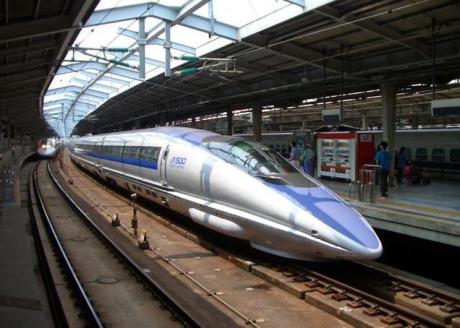
 Narendra Modi talked about bullet trains in his pre-election vision for the country’s progress. On Wednesday (9 December), the Union cabinet decided to award the first bullet train—Mumbai to Ahmedabad—to Japan. It’s not a good idea.
But let’s first discuss the positives.
It makes sense to cement trade and geopolitical ties with Japan by giving them the deal. Giving it to China, which may well have given us even better terms, would not have looked good politically. But China can be given the message that big deals depend on taking our border and security concerns into account.
The massive investment planned—Rs 98,000 crore at current estimates—will help Japanese industry more than Indian ones, but it will still have substantial spinoff benefits for development along the Ahmedabad-Mumbai corridor. Gujarat and Maharashtra, two of India’s most industrialised states, will be drawn into a tighter economic embrace as business travel between the two state capitals, and stops in-between, will now be done in a jiffy.
Then there is the soft advantage. Big deals send a strong signal to investors abroad that India is a big market—and open to mouth-watering deals when the rest of the world is struggling to revive growth. And let’s not forget that the first bullet train will be a huge chest-thumping opportunity for us.
The sweeteners in the deal are near-zero loan rates (0.1 percent) and the promise of technology transfer and local manufacturing at a later date.
There is also a hint that the line can be extended to Delhi, but we cannot be sure that will happen anytime soon.
But the negatives still outweigh the positives. Just as you would not buy an expensive house just because interest rates are lower or someone offered you a freebie, the bullet train will not make economic sense just because the loan for it comes at almost no cost to us. The idea runs counter to commonsense economics.
First, the project cost appears to have bloated from the initially indicated Rs 60,000 crore to Rs 98,000 crore. Even with an interest-free loan, this level of capital cost to connect two cities is enormously expensive.
Second, at such costs, in which land alone will cost nearly Rs 15,000-20,000 crore, ticket fares will have to be extortionate—probably higher than current air fares. For the  convenience of probably starting and terminating closer to city centres, is a bullet train really worth, say, one-way fares of Rs 5,000 or more?
A bullet train will shave two hours off journeys compared to a reasonably fast train running at, say, 200 kmh. Isn’t upgrading track between the two metros, to enable trains to run at 200 kmph over a 550-km distance, be a more economic proposition than trying to run a bullet train?
Most important, the real trade-off is between time and money in any project of this magnitude. In the internet age, a three-hour journey between Ahmedabad and Mumbai can be productively used with wifi, business centres and other in-train facilities. So even travel time need not be unproductive for busy people. So where is the justification for this kind of extravagance just to bring down journey times from three hours to one-and-a-half?
The only way the project would make sense is if the Japanese are given the whole job on a BOT basis—they build, they operate, and then transfer after they have collected their returns. But one doubts the Japanese are looking for that kind of risk. It may take them 20 years to turn in a profit.
There is a time for building bullet trains, and that time would be when India becomes a genuine middle-income country with average incomes in the $2,500-4,000 per annum. Right now, says the World Bank, it is somewhere around $1,600.
We need another five or 10 years of robust growth before we can think of bullet trains. Maybe Narendra Modi should plan for one in his next term of office, assuming he gets one. – Swarajya, 10 December 2015

Filed under: india, japan | Tagged: bullet trains, development, economic development, economy, india, india-japan relations, indian economy, japan, narendra modi, trains | Leave a comment »