














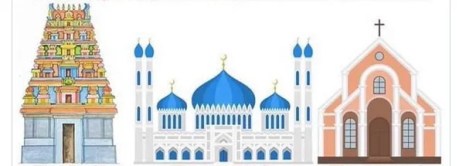
 A Hindu temple is a sacred space that seeks personal contact on a one-to-one basis with the supreme Brahman, as a step forward in attaining the final liberation or moksha. – Monidipa Bose Dey
The basic fundamental concept of a Hindu temple (as per the old texts and scriptures) is strikingly different from the concept behind shrines and worship places of the Abrahamic faith. Let us have a look at the basic difference in the meaning behind a temple, a church, and a mosque.
Temple
A Hindu temple is not essentially only a place to perform religious rites; conceptually as per the scriptures it is more of a teerth, a place where one goes to seek union with the supreme consciousness or divinity and attain moksha. In Hinduism and other Indic religions, life is itself viewed as a journey (a teerth) from birth to death, where death is not an end but just a part of a longer journey that ultimately ends in moksha. While the great rishis can hope to achieve release in their lifetime (jivan mukti) or in death, for the common people there are other ways to help them move towards the Centre or moksha.
Going for a teerth is one such way, which helps the devotee to take a step forward towards the divine union. A visit to a temple is a spiritual journey, a pilgrimage or teerth that seeks union with the supreme divinity, with the temple acting as a medium to help the devotee unite with his preferred God.
Thus, a teertha is not the end goal by itself; it is where the journey to the Centre starts, and it is here that the temples are built and Gods installed, and whose towering shikharas step by step and level by level lead the devotee’s eyes and mind from this world to the other divine worlds above.
While temple architectural styles may vary based on time, location, and ruling dynasties, there is one factor that remains unchanged: the plan, known as the Vastupurushamandala.
Vastupurushamandala is the ritual diagram that regulates the site and ground plan, and is drawn on the ground before a temple construction starts, and over which the temple will stand. It is the metaphysical diagrammatic design of the cosmos, an artifice or mandala that converts the bhumi (ground) into the extent of the manifested universe.
In the centre of the Vastupurushamandala is the place of the unconditioned Brahman known as Brahmasthana, the dark source of all light, the superluminous darkness; the central point that is beyond all time. Radiating from the centre are the luminous celestial bodies, the suns (Adityas), moon, planets, and other naksatras that are representative of the cyclical ordered time.
Thus, a Hindu temple is also a representative of the entire cosmos, from the unmanifested Brahmasthana that is beyond all time to the cyclical ordered world of the celestial bodies that give rise to life (manifestation or existence).
Church
To understand the meaning of the English word church it is essential we take a look at the origin of the word. Interestingly the word “church” was not found in many of the early translations of the English bible. Wycliffe used it in his handwritten translation (1385) of the Latin Vulgate (Vulgate is the 4th century Latin translation of the Greek Bible), while Tyndale used the term “congregation” for church in his translation (1534).
The New Testament was written in Koine Greek, which was a common dialect popular in Greece in the ancient pre-Christian era.
The English Bible is a translation from this original language, and the English word “church” has roots in the Greek word “ekklesia,” which in Koine Greek, means “a gathering of the citizens” or an “assembly of people,” for some specific purpose, and is a secular word without any religious connotations.
Even today the French call their church as église, while the Spanish term for church is iglesia. While the root word is the Greek ekklesia, the English word “church,” however, seems to have originated from the Teutonic languages that had translated the root word ekklesia to kyriakon from around 3rd century CE, giving it a religious meaning for the first time. From kyriakon was derived the German word kirche, which later became the English word church (English belongs to the family of Germanic languages).
The Greek word kyriakon means “of the Lord” or “Master.” Thus, in simple terms, from around 3rd century CE kyriakons referred to the “House of the Lord/Master,” deviating from the original meaning of a gathering or congregation or assembly.
A church (an English word derived much later in the 13th-14th centuries) therefore got translated into the “House where Lord Jesus is worshipped as the Lord God/Master.” This is more or less the meaning that is now universally accepted across all Christian nations for the word church.
Very different to what a temple means for the Hindus.
Mosque
On the other hand if one looks at a mosque or masjid (an Arabic word) it means “a place of prostration” to God, with same connotations in Urdu and Turkish. It is a place for community or family gathering where one bows to Allah.
The first mosques were built based on the place of worship of the Prophet Muhammad, which was the courtyard of his house, thus turning out as simple sacred plots of ground. The Prophet’s house was a simple structure built of raw bricks, which opened out to an enclosed courtyard. It was the place where people gathered to hear him, and in 624 CE Muhammad directed that prayers must be facing Mecca.
For this he built a structure with a roof that was supported by pillars made of palm trunks, against the wall facing Mecca, known as the qiblah wall. On the opposite wall of the courtyard was built a roofed gallery for his followers, thus creating the first example of a prayer hall or mosque that became the model for later masjids.
In 628 CE a pulpit was further added in order to place the Prophet above the crowd; as he led the prayers for the congregation. Besides leading the prayers, it was from this pulpit that Muhammad ordained his new law, and acted as judge for various disputes among his followers. This set the precedence for later mosques that became the centre-stage or nodal point of religious, political, and judicial functions in an Islamic state. While architecturally mosques have undergone drastic changes; ideally a mosque building remains an open space with a roof, containing a mihrab (semicircular niche from where the prayers are led), a raised pulpit (a seat at the top of steps seen at the right of the miḥrab from where the imam delivers his sermons), and the qiblah. A mosque is essentially a place for a collective gathering where one bows and prostrates to the god.
Thus, a church and a mosque are similar in their basic meanings, which refer to a structure or space essentially for regular collective gatherings to bow to the Lord and Allah respectively.
A Hindu temple on the other hand is a sacred space that seeks personal contact on a one-to-one basis with the supreme Brahman, as a step forward in attaining the final liberation or moksha.
The Hindu temple art and architecture are all a part of this process where they aim at helping the devotee focus on the divinity and the impending brief union with the Brahman at the centre of the temple (sanctum).
A Hindu temple is also representative of the entire cosmos, from the unmanifested Brahman that is beyond all time, to the cyclical ordered world of the celestial bodies that help create Life. – Firstpost, 25 December 2022
› Monidipa Bose Dey is a well-known travel and heritage writer.
Filed under: india, world | Tagged: abrahamic religions, christian church, dharma religions, hindu temple, muslim mosque | Comments Off on How the concept of Hindu temples differs from Abrahamic shrines – Monidipa Bose Dey











