














 The miracle of democracy is that it endures not because of the people chosen to uphold it, but in spite of them. – Ravi Shankar
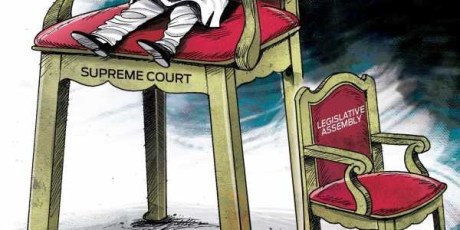
The Supreme Court of India faces a test of supremacy. Assert that it is a law unto itself or duck the fast balls of Law Minister Kiren Rijiju’s bodyline bowling. Going by the judicial mood, it is unlikely that Chief Justice D.Y. Chandrachud and his men in black will let the aliens into the hallowed premises on Tilak Marg. Note the words of Babasaheb Ambedkar, Independent India’s first law minister: “However good a Constitution may be, it is sure to turn out bad because those who are called to work it, happen to be a bad lot. However bad a Constitution may be, it may turn out to be good if those who are called to work it, happen to be a good lot.”
In a democracy, everywhere, the winning lot is considered the good lot. Democracy’s greatest flaw, and its greatest virtue, is the will of the people. A great mass of Indians, however, vote on the basis of caste, religion and ra ra rhetoric. They choose flawed men and women, who, in turn, choose flawed officials to do their bidding—it’s the human condition. The miracle of democracy is that it endures not because of the people chosen to uphold it, but in spite of them.
The nature of power, therefore, buttressed by the vox populi paradigm, is to appropriate more power; after all, isn’t power in the hands of the people a good thing? The stronger and more beloved the leaders, the greater their desire for control because they believe nobody knows better. Which is why democracy has inbuilt checks and balances, which, maybe, Justice Chandrachud’s court is defending by blocking the government’s grasp.
Geotag back 73 years and you’ll find that India’s judiciary and legislature were only separated after birth. It was just two days after India became a republic on January 26, 1950, that the Federal Court was renamed the Supreme Court in the Chamber of Princes situated in the parliament building. Parliament then consisted of the Council of State and the House of the People. The apex court continued to sit for 13 years in the Chamber from 1937 to 1950—the Privy Purse was abolished only in 1971. Perhaps, Narendra Modi’s new parliament building is meant to rewire its colonial legacy.
Irrespective of the current establishment’s grotesque gyrations attributing the origin of every Western institution to ancient Bharatiya wisdom, India’s present judicial system, the media and the democratic process were also Raj creations. As are its flaws. The freedom struggle was a multi-layered mosaic. For example, in 1908, Lokmanya Tilak was defended at a sedition trial by British barristers L.P. Evans Pugh and Garth, and Mohammed Ali Jinnah. He was sentenced by Indian judge Justice Davar at the Bombay High Court to six years in jail and the judge was rewarded with a knighthood. Then in 1916, the British police again charged Tilak with making seditious speeches, which claimed that there was more peace in India during the Peshwa rule than under the British. The prosecution harped on these words. Jinnah, representing Tilak, queried sarcastically, “Do you have personal knowledge to disprove this assertion?” The prosecutor retorted, “I’ve read my history.” Jinnah, in the presence of Magistrate C.W. Hatch, snapped, “Yes, you’ve read the history written by the British.”
History is, indeed, written by victors, but read by the losers. Both the Government and the Supreme Court are navigating the narrative of a new history. Only, the bibliography will matter. – The New Indian Express, 22 January 2023
> Ravi Shankar Etteth is an author, columnist, cartoonist and executive editor of The New Indian Express in New Delhi.

Filed under: india | Tagged: constitution of india, indian democracy, indian parliament, legislative assembly, supreme court of india | Comments Off on Judiciary, executive can’t be law unto themselves – Ravi Shankar











