














 What the Muslim and British invaders couldn’t do to ruin Indian religion was unleashed by the legal subjugation of the dharmic religions in independent India. – Jain Acharya Yugbhushan Suri Maharaj
As India assumes the presidency of the G20, it gets a unique opportunity to navigate the transitioning world order towards a free, fair and just order. To this end, India has selected the idea of ‘Vasudhaiva Kutumbakam’ (the whole world is one family) as the theme for its G20 presidency.
India, while promoting this theme has subtly indicated that it is a storehouse of soft power in the form of ancient scriptures, traditions and cultures brimming with wisdom capable of addressing all impending global issues. However, for India to truly be this storehouse, it needs to sharpen all its sources of soft power. One such major and powerful source of soft power are its religions.
Ever since independence, this source of soft power, especially the oriental religions, has been highly neglected and subjugated. The religions in India held a very revered and respected role and status. They had the critical task of presenting a framework that made its followers and society resilient and tolerant to the dynamic circumstances arising out of a changing ruling authority. The religions of India prescribe specific tolerable limits for every aspect of human life, which makes them adaptable, accommodative and inclusive to a great extent.
This is the very reason why Indians could maintain their ground and sustain their streams of religions, culture, traditions and civilization to the extent that no other civilization could. It is a historically undisputed fact that numerous civilizations were completely washed off leaving no trace in the tsunami of reformation induced by Western-style Christian colonisation. Even in such circumstances, the people of India safeguarded their civilization and identity, however tampered and injured. What disturbed the reformers most is that even when India was subjected to cruel civilizational reformational onslaught and imperialistic success was imminent, exactly at that time, innate civilizational samskars (mental impressions) began resurrecting. All this was possible because the ideas of religions were so finely ingrained in the Indian subconscious such that they could traverse across generations unnoticed only to become visible and flourish when the climate became conducive.
Therefore, the religions of India have been crucial to ensuring that Bharat survived as ‘Bharat’ even as it passed through the dark valley of first being ‘Hindoostan’ and then, ‘India’.
In 1853, despite widespread opposition, the legislative council of the East India Company enacted a law which in effect, meddled with Hindu religious customs. Thereafter, a group of Hindus petitioned against the law in the House of Commons. This is what they wrote while opposing the act:
“In this pervasive connexion between private right, and religious and moral obligation, consists the vitality and strength of Hindoo social organisation. It is a common bond by which society has been preserved from dissolution during several periods of war, anarchy, and convulsion, and is preserved in the present day under British rule. …”
Such were the words of those Hindu petitioners that speak all about the role of religions, customs, traditions and the entire civilization in sustaining India. This role which oriental religions have played for India, can be easily extrapolated to the world. This is even more possible because though India has a diverse population with numerous religions, languages, customs, cultures, and traditions, yet its civilization could find a common prescription that glued them as one entity.
India is considered a microcosm of the world, thereby providing a testing ground for any multicultural or civilizational prescription. This power of Indian religions and civilization is a promising Kalpavriksh, capable of giving them a competitive edge over many aspects of international relations. More lucrative than a political edge, is its real capability to uplift humanity morally and spiritually, to make the world order fair, just and free.
Unfortunately, this source of soft power in independent India is not positioned to perform its role. The real strength of any holistic institution to perform a major task is its independence and autonomy. Similarly, for religions to perform such a role, they need independence and immunity from any sort of interference; this was the structure of Indian civilization. Since time immemorial religions have existed in society, whereas the rulers kept changing, but these rulers never interfered in the matters of religion because they considered them sacrosanct. Thus, religions could play their pivotal roles. Ultimately, it was the British who breached the norm and broke the wall of separation. To address this overreach, the above petitioners argued in their latter part of the petition, “such act is not beyond the power and competence of legislative council (of the EIC)”.
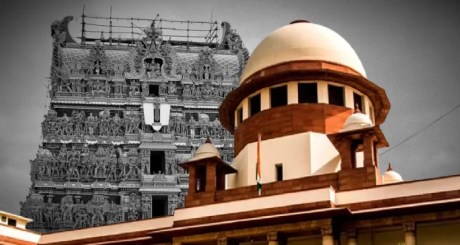
This trend of interference was then further legally cemented when India became independent and adopted the nation-state ideology. With Articles 25 and 26 of the Indian Constitution, religions were subjected to state jurisdiction and lost their autonomy in name of fundamental religious rights. What the Muslim and British invaders couldn’t do to the religion was unleashed by the legal subjugation of religions in independent India. This fact can be clearly observed from a series of Supreme Court judgments, that how through Articles 25 and 26 the temporal authority got the right to fiddle with religions and how over the period, religious rights were curtailed.
Today, this is an age of reform wherein major reforms are underway at the global and national levels. India is on its way to correct many of its historical wrongs, including ideological subversion. If India wants to maximise its influence at the global level, then it must be in sync with all its sources of strength. Hence, this is the right time to correct historical wrongs and resurrect the central idea in the argument of those petitioners i.e. “the sovereignty of religions”. – Firstpost – 30 March 2023
> Jain Acharya Yugbhushan Suri Maharaj is the 79th successor to Tirthankar Mahavir in the lineage of Sudharma Swami. He is mentor of an NGO Jyot and Gitarth Ganga (spiritual research institute). He has also conceptualized movies on moral subjects.

Filed under: india | Tagged: dharma religions, hindu civilisation, righting historical wrongs, sovereignty of religions, state control of religion | Comments Off on Sovereignty of religions – Yugbhushan Suri











