









 Temples razed by the Portuguese colonialists were not technically “Hindu” temples but belonged to independent cults and religions that were later assimilated into Hinduism, a Christian theologist has proposed in an academic paper. – Mayabhushan Nagvenkar
In BJP-ruled Goa, a leading Christian theologist from the influential Roman Catholic Church has claimed that “Hindus” did not exist in region during the pre-Portuguese era.
Fr. Victor Ferrao, a dean at the state’s most renowned Rachol Roman Catholic seminary, which trains and grooms budding priests has also said in his research paper that the scores of temples demolished by the Portuguese colonists from 15th century onwards were not Hindu temples, but instead belonged to different “independent cults and religions which were often at war with each other”.
Ferrao in his paper presented at a recent seminar, “Challenge of being a Goan Christian”, held [in Panaji], said that by painting of pre-colonial Goa as Hindu territory, “there is a direct attempt to turn the historical facts about conversion against the Church and the Christians of today”.
The renowned Church academic in his research paper even goes a step further and attributes political motives to the “reductionist and distortionist” appropriation of Goa’s history by Hindu-logists.
“I have described these attempts as Hindu-ology. In fact even the word Hindu does not exist in the entire sixteenth century Indo-Portuguese historiography,” his paper titled ‘The Other Orientalism and the Challenge and Opportunities for the Church in Goa’ reads.
 The revelations in the research paper come at a time when the BJP has been trying to cosy up with the Church in Goa, which is the spiritual and religious beacon to nearly one-third of Goa’s population which is Catholic and a key vote bank.
In fact, tacit support of the Goa Church, although its spokesperson later categorically denied any truck with the BJP in the 2012 assembly polls, was one of the key reasons why the BJP swept the elections, apart from an unprecedented eight Catholic candidates which the party had fielded.
The Catholic swing towards the BJP ensured that the party romp home with a majority on its own, an unheard of electoral feat in Goa, where a hotch-potch of results is the norm.
However, the issue of Goa’s chequered religious past before the advent of the spices and Christian-seeking Portuguese has also been a matter of debate.
A large section of authors and historians have insisted that Goa has been described in ancient texts as a land reclaimed by Sage Parshurama, an avatar of Lord Vishnu, from the sea and that the state known for beaches, booze, nightlife, sex tourism and drugs now, was once called “Konkan Kashi” or Benaras of the South.
A view which was endorsed by the Vishwa Hindu Parishad, which during a conclave held here in 2000, released a six page brochure on the subject.
 “Goa, even four decades after liberation, is misguidedly projected as the Rome of the East, particularly in tourism—by government and non-government agencies. But Goa is the Kashi of the west coast India. … The Portuguese are not the makers but destroyers of Golden Goa,” the brochure read.
Ferrao, in his research paper, a copy of which is available with Firstpost, however insists that such obfuscation stemming from political motives, was one of the key reasons why Christians in Goa now have to “lay claim to their own history” in the pre-Portuguese era.
“It important to assert that we have not come from Hinduism of today, but the then fragmented cults that today have been steadily assimilated into Hinduism of today,” Ferrao said, quoting noted historian Romila Thapar to back his treatise.
Ferrao said that the claims of forced conversions and demolishing of temples during the early Portuguese era were essentially to be found only in “narratives of the post-colonial historiography mainly authored by the Hindu historians in our days”.
“Though the temples that were demolished were not Hindu, but one(s) that belonged to different cults that have united into Hinduism of today, the Hindu community is certainly carrying the pain of this false impression,” the paper reads.
The paper further says that both the Hindu religion and nationalism are a product of colonisation, adding that to reduce pre-Hindu religions, cults or sects and their unification under Hinduism in the 19th century amounted to an “epistemological” error.
 Several other scholars, however, tend to disagree with Ferrao’s argument.
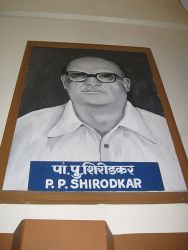
P. P. Shirodkar, who has authored several books on Goa’s history, says in research paper “Social and Cultural Life in Goa during the 16th Century” says: “At the time of the fall of Goa in the hands of the Portuguese, its population, majority of whom were Hindus, followed by the Muslims mostly on military duty continued to live in villages with its agricultural communities”. He further says that villagers in Goa followed the Hindu law of inheritance.
In a book Goa and Portugal: Their Cultural Links edited by Charles J. Borges and Helmut Feldmann and published by the Xavier Centre of Historical Research (XCHR), Archana Kakodkar argues that Hindus “were a very self-conscious community”.
“For historic reasons, Hindus in Portuguese India were a very self-conscious community. The impact of the Portuguese rule, destruction of Hindu temples and the subsequent policy of conversion further enhanced this awareness,” she says.
Paul Axelrod and Michelle A. Fuerch, scholars from Ripon College in Wisconsin write in Modern Asian Studies, a journal published by the Cambridge University Press in 1996 that there was a pronounced “Hindu resistance” to Portuguese colonial designs.
“The focus of this article will be on Hindu resistance to the policies that were applied by the colonial regime and its role in shaping of the regional culture: in face of over-whelming physical force, direct defiance revealed itself primarily in the religious life of Hindu Goa 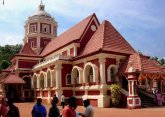 as archival records of the Portuguese rule and temple histories demonstrate,” the duo says in their research paper titled “Flight of Deities: Hindu Resistance in Portuguese Goa“.
Ferrao, however, claims that Christians living in Goa had forgotten their origins (that they were part of independent cults and religions) and “are wounded and continue to be victims of the aggression of their Hindu counterparts”.
Ferrao has also called for a therapeutic dialogue between the two communities living in Goa.
“There is an inevitable need of dialogue that can heal wounded memories in our society,” he said.
Christians account for nearly 30 per cent of Goa’s 15 lakh plus population. – Firstpost, 13 July 2013
› Mayabhushan Nagvenkar is an author and Indo-Asian News Service journalist covering events in Goa.

Filed under: goa, india | Tagged: casuistry, hindu, hinduism, psychological warfare, roman catholic church | 14 Comments »