










Make no mistake, Hindu unity, India’s civilizational resurgence, and the BJP’s political base are getting a sound beating from casteism enshrined in the Scheduled Castes and the Scheduled Tribes (Prevention of Atrocities) Act, 1989. The law is well-meaning in intent but highly divisive in its impact. … It is designed for misuse. – Virendra Parekh
A cauldron of anger is boiling among caste Hindus on discriminatory laws and rules directed against them. If the SC/ST Act is tilted heavily against them, its implementation is even more so. A Swatantra Bharadwaj is hauled over coal for intemperate remarks before the mike, while Nishu Azad, the girl who abused Hindu goddesses Durga and Saraswati and PM Modi in the filthiest language, and her father Sanjay Azad who led a murderous assault on Swatantra Bharadwaj, move scot-free. Earlier, the UGC guidelinesm for prevention of caste-based insults and atrocities within educational institutions presumed guilt on the part of the upper caste Hindus, a la the communal violence bill of UPA government presuming Hindus to be culprits in all communal violence cases. Remarkably, the guidelines are stayed by the Supreme Court; the NDA government has already notified them and has given no indication of withdrawing them. If BJP leaders think that the Hindus do not notice this discrimination, or do not mind it, they are mistaken. Local body elections in Rajasthan have given an indication of their anger. There may be more to come in the forthcoming, more consequential elections.
Make no mistake about it. Hindu unity, India’s civilizational resurgence and BJP’s political base are getting a sound beating from casteism enshrined in the Scheduled Castes and the Scheduled Tribes (Prevention of Atrocities) Act, 1989. The law is well-meaning in intent but highly divisive in its impact. Its divisive and destructive potential is being played out at IIT-Bombay, one of the oldest and most prestigious educational institutions of the country. Since this episode epitomises much that is wrong with the law, it is necessary to look into it in some detail.
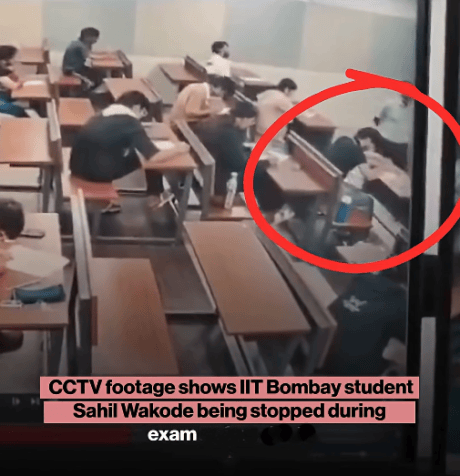
The facts of the case are quite clear, or were, before systematic attempts began to blur them. According to early reports, Sahil Wakode, a second-year B.Tech. student at IIT-Bombay, was found using mobile phone and AI in the examination hall. He reportedly uploaded the question paper on the ChatGPT and sought answers. Prof. Suryanarayan Doolla, the invigilator, saw this, seized the phone and took Sahil to the director of the institution. He was given counselling and told that no disciplinary action will be initiated against him lest his career should be ruined. Next morning, however, Sahil was found dead in his hostel room, having committed suicide.
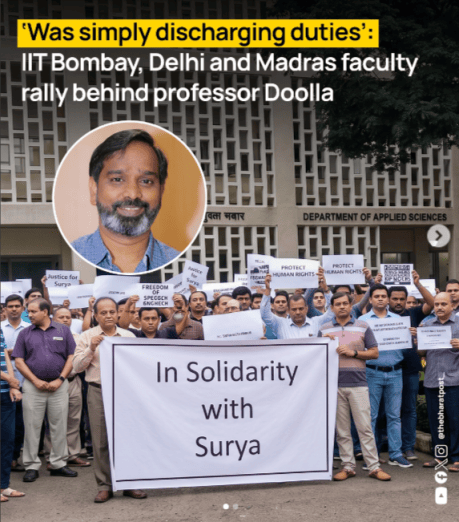
Wakode’s parents alleged that their son was subjected to casteist slurs for the past three months and filed a complaint against the invigilator and the IIT-B director under the SC/ST Act for caste-related harassment and abetment to suicide. The IIT-B retracted its earlier statement about the facts of the case, pending outcome of the proposed enquiry. However, it first relieved Prof. Doolla of his charge as dean of administration and later sent him on leave without waiting for the same outcome. The incident has divided the student community into two sides: some want even stricter actions against Prof. Doolla, but most have expressed high respect and regards for him. The faculty has come out solidly in support of him. Faculty of IIT-Chennai as also IIT-Delhi has expressed solidarity with him. While we must await the inquiry report before drawing any conclusions about the circumstances surrounding to Sahil’s death, this tragic affair has brought into sharp relief certain issues well beyond a cheating incident at a premier educational institution.
First, the caste angle seems to be an afterthought. If Sahil was indeed subjected to caste-related slurs and harassment for the last three months, why did he or his family not complaint about it to anyone or anywhere? The family has spoken up only now, when there is no way to verify the charges.
More importantly, must we bring in caste in everything? A lot of non-sense is going unchallenged under the shelter of political correctness. If a student is found cheating in an exam, should the authorities ascertain his caste before deciding on action to be taken? Is it anybody’s case that students belonging to reserved categories be allowed to cheat in the exams? If yes, why stop at IITs only? Let’s extend this highly affirmative action to civil services exams, JEE and NEET also, to start with.
All right thinking persons must pause to consider the sinister implications of intrusion of caste politics in the institutions of higher learning. First, as to the teachers. IITs are already short of faculty, to the extent of 38 per cent according to some estimates. Prof. Doolla, the invigilator in the case, is a highly accomplished academic with a long, brilliant, distinguished career and lot of creditable work related to student welfare. No wonder, he has received strong support from the students as well as fellow teachers. If such a stalwart is hounded out of IIT just for doing his duty, he would easily be grabbed by other institutions where caste does not matter. But which academic in his right senses would risk joining IITs or, for that matter, any government educational institution? What will happen to the morale of those who remain?
As regards students, it is amazing that some of them are gunning for Prof. Doolla without waiting for any proof. Integrity and impartiality of teaching and evaluation is the cornerstone of any education system. Just recently, the issue of NEET paper leak rightly created consternation across the country. The stakes are much higher in IIT-B case. Those who shouted themselves hoarse about Gen Z and all that are now conspicuously silent, or on the wrong side of the fence. It is for the students, cutting across caste divides, to insist that political considerations must not be allowed to interfere with the running of premier educational institutions.
An Atrocious Act
It is easy to understand the mounting anger against the SC/ST Act. It looks designed for misuse. The act makes it obligatory for the police to register an FIR as soon as a complaint is filed with it and denies anticipatory bail to the accused while mandating cash compensation to the plaintiff ranging from Rs. 1 lakh to Rs. 8.25 lakh depending on the seriousness of the alleged atrocity: 25-50 per cent on registration of FIR, another 25 per cent on filing of the charge sheet and the remainder at stage of conviction. Taken together, these provisions provide a strong instrument and an equally strong incentive for misuse. Over the years, courts have flagged numerous cases which turned out to be fake or driven by the motives such as vengeance against so-called upper caste individuals, monetary compensation, political vengeance, property disputes and revenge against upper caste lovers, college or office colleagues.
Sample these. In 2021, a Brahmin named Vishnu Tiwari was set free by the Allahabad High Court after he spent 20 years in jail on false charges of rape and offences under the SC/ST Act. He was held guilty by a trial court and sentenced him to life imprisonment at the age of 23 in the year 2000. In the 20 years he spent in jail, Tiwari lost all his family members. The Court’s acquittal was based on the medical examination report, which said that no sperm or injuries were found on the woman, who was five months pregnant at the time. Her testimony also indicated that she was an unreliable witness. In March 2021, Narendra Kumar Nirmal, a teacher belonging to the SC community, was accused of threatening a woman with a fake case under SC/ST Act if she resisted molestation. In the same month, a Maratha girl was reportedly molested, brutally beaten up and booked under the SC/ST Act for opposing the vandalising of a Hindu temple by some Dalit locals. In February 2024, the Allahabad High Court quashed a 2016 FIR against a professor for alleged voyeurism, criminal intimidation and offences under SC/ST Act. The court noted that the professor had to pay a heavy price for asking an Assistant Professor to take classes and teach properly. In Swatantra Bharadwaja’s case, the court noted that allegations of caste-based insults which were said to have occurred at the beginning of the incident, were absent from the original complaint and surfaced only 10 weeks later.
As regards compensation, in a classic case of how the state is milked through misuse of SC/ST Act, a woman named Chandravati Devi, resident of Hastpur village, district Aligadh, UP, with her family filed 15 different cases in the ten years from 2014 to 2024, many of which were found to be dubious. Police sources revealed that the family, by repeatedly invoking the SC/ST Act, not only secured financial aid but also managed to pressure local authorities and law enforcement agencies, pocketing approximately ₹46 lakh between 2014 and 2024. In a case before Allahabad High Court one Santosh Kumar Dohrey, an advocate by profession, and his family members received roughly ₹23.36 lakh in financial relief or compensation across various criminal cases under the 1995 Rules.
These are high profile cases which made headlines. There may be hundreds of others of similar nature. Indeed, there are reports of well-oiled broker networks which assist in systematic filing of cases under the SC/ST Act by falsely implicating upper-caste individuals to obtain compensation.
Relief nullified
Remarkably, while courts have flagged the misuse of the act and sought to discourage it, the political establishment has swung into action to nullify any such attempt. In 2018, Modi government amended the act to expressly nullify the Supreme Court order which had said that a preliminary inquiry is necessary before filing a case to ascertain its genuineness and maintainability and that the arrest of a public servant has to be authorised by an appointing authority or a senior police officer. It had also allowed anticipatory bail. No wonder, there has been a dramatic rise in the cases filed under the act since the amendment.
Adding insult to the injury, there are reports that the central government plans to enhance the compensation amount to a minimum of Rs. 1 lakh and maximum of Rs. 12.5 lakh. Last month, Supreme Court declared that hurling alleged casteist slurs in private settings does not constitute an offence under the Act. It has to be a public place where members of public can witness or hear the utterance made by the accused to the victim. We should not be surprised if this relief too is soon negated with an amendment to the act or its rules.
There is no need to repeal the act. Only those provisions found liable to be misused need to be scrapped. Punishments need to be provided for filing false frivolous complaints. Ensuring that no innocent person is harassed by being falsely implicated in a malicious complaint is as important as ensuring justice to the victims of abuse and atrocities.
BJP in a bind
A society as diverse as the Hindus can be welded and held together only by ensuring justice within its fold. The tragic irony is that the BJP, whose politics is centred on overcoming caste divisions and forging the Hindus as a united cultural entity, is stunned into a confused silence. Since this is an intra-Hindu issue, BJP is wary of ruffling feathers, especially among the more numerous and vocal sections of the community. Even the slightest move to restore the balance will be quickly portrayed as a gross betrayal of the downtrodden, an upper caste move to bulldoze the Dalits into submission and so on. BJP remembers only too well the setback it suffered in 2024 especially in UP because of caste-related false propaganda and it cannot forget that it faces a crucial assembly election in the same UP within a few months. But the proximity of the elections is now a double-edged sword.
BJP probably realises that it has nothing to gain by being on the right side of the self-declared champions of social justice, but it is too timid to call their bluff. The feminist lawyer who oversaw drafting of UGC guidelines was never a friend of BJP. The SC/ST sections bent on misusing the Act have no sympathy for the BJP and will never vote for it. Secondly, an increasing number of cases filed under the act are now directed not against upper caste Hindus, but against OBCs which comprise large sections of BJP supporters. By letting the things drift, BJP is risking their alienation. Put together, all the three sections of Hindu society—the upper castes, OBCs and SC/ST have reasons to be cross with BJP. Where will it leave the party?
The issue is too important for the Hindu society to leave it to the BJP leadership for solution. Hindus aggrieved by the misuse of the Act must come out clearly vocally against it on the street. A strong political movement will enable the BJP leadership to take courage in its hands and take the right attitude. As a ruling party, BJP must uphold Rajadharma. It must hold scales even, whatever the temptation to tilt it.
› Virendra Parekh writes on economics and politics, also on issues related to Indian civilization, history and cultural nationalism.
Filed under: india | Tagged: dalits, caste-based discrimination, SC/ST Act 1989, caste hindus, misuse of law |