











 The government suffers from a poverty of ideas which it seeks to hide with a plethora of words. Worse, it seems to have forgotten lessons from our socialist past. The mindset which placed government at the centre of things remains intact. There is a distrust of businessmen, foreign investors, taxpayers and those dealing in cash. Elaborate mechanisms have been set up to keep them on a tight leash. – Punarvasu Parekh
There is a glaring dichotomy in Modi government’s performance. On political front, it knows its objectives, can devise effective strategies to achieve them and implement these strategies in the teeth of severe opposition. The economy, however, stubbornly refuses to do its bidding.
To be sure, the economy has many things going for itself under NDA-II. The government is remarkably free from corruption at the top and looks quite sincere in its ambition of making India great again. A rock solid majority in Lok Sabha affords the country political stability that would be envy of most of the democracies. Prime Minister Narendra Modi enjoys unparalleled popularity and has a knack of marketing politically difficult ideas to the masses. Together, these two circumstances have created a huge political capital that could be leveraged to carry out far-going reforms.
For all that, however, the government suffers from a poverty of ideas which it seeks to hide with a plethora of words. Worse, it seems to have forgotten lessons from our socialist past. The mindset which placed government at the centre of things remains intact. There is a distrust of businessmen, foreign investors, taxpayers and those dealing in cash. Elaborate mechanisms have been set up to keep them on a tight leash.
Quite a few bad old policies are back, sometimes with the same terminology. Often the government gives the impression of being willing to strike but afraid to wound. While it talks of promoting reform, it is not prepared to go far enough. It wants to give relief and withhold or take it back at the same time. The cumulative effect of all this has been compounded by some big ticket mistakes.
In the name of curbing tax evasion and black money, Modi government has consistently prioritized formalization of the economy over growth. This has lured it into committing two big ticket blunders—demonetisation and hurried implementation of an ill-conceived GST. Together, these two measures destroyed demand, disrupted supply chains across industries and bankrupted thousands of farmers and small businesses. We are still living with the consequences. For all its talk of minimum government and ease of doing business, there is more government now in our lives and doing business is more hasslesome now than before.
In fact, the uneasiness set in quite early. Modi’s first finance minister Arun Jaitley (a misfit in the finance ministry by all accounts) had an opportunity to roll back the retrospective amendments to income tax laws which the BJP had rightly condemned while in opposition. He could have begun the promised phased reduction of corporate tax rates while removing exemptions and offered relief to the middle class in income tax. He did nothing of the sort. When oil prices plummeted, the NDA government pocketed much of the gains by hiking duties on fuels instead of passing them on to the people who had been bearing the brunt of expensive fuel when oil prices were high. All this has eroded businessmen’s and investor’s faith in the government.
Coming to the current economic crisis—arguably the most severe slowdown in three decades—it has three aspects.
First, the “twin balance sheet” problem: public sector banks, saddled with huge NPAs and short of capital, have no appetite or resources to lend big. Private sector companies, neck deep in debt and facing underutilization of existing capacity are in no mood to borrow more for creating fresh capacity. This is now compounded by the crisis in NBFCs and real estate. Second, private consumption has taken a hit, partly as a lingering effect of demonetization. Third, exports are lackluster owing to problems with international trading system and India’s protectionist policies. It does not help that sectors that generate employment on large scale—textiles, real estate, gems and jewellery, automobiles and small trade and businesses—are in deep trouble.
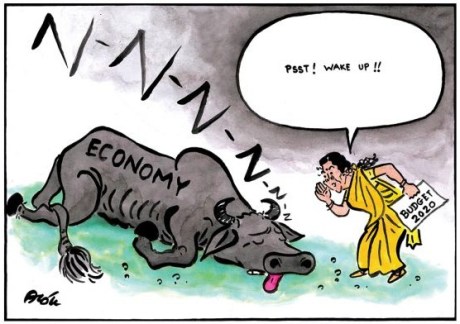
Finance minister Nirmala Sitharaman’s latest budget was expected, above all, to revive the economy. She could (and should) have slashed income tax rates, extended lower corporate threshold of 17 per cent to all companies and abolished surcharge, expanded MNREGA and doubled income support to farmers under PM Kisan Sahay Yojna, so as to increase aggregate demand. She could have listed out steps the government wanted to take to revive job creating sectors, restore the health of financial sector and carry out administrative reforms including judiciary and police.
What we had, alas, was a marathon speech that threw up few winners. After making the right noises on almost everything, it failed to present a credible blueprint to kick start growth by stimulating consumption and promoting investment. There is an air of half-heartedness in the reliefs given and expenditure sanctioned.
The restructuring of income tax slabs will cost the exchequer Rs 40,000 crore, we were told. However, while some tax rates were reduced, quite a few exemptions were eliminated and tax payers were given a choice of either opting for the new regime or staying with the old one. Every taxpayer now has to do his own sums to find out where he stands. Most people are likely to discover that switching to the new system does not make much difference and some may even prefer to stick to the old system.
The dividend distribution tax paid by the companies was abolished which would now have Rs. 25,000 crore more to play with. However, the dividend income will now be taxed in the hands of the recipient shareholders at applicable rates and would probably make up for the revenue forgone.
Come to the expenditure side. The Mahatma Gandhi National Rural Employment Generation Act (MNREGA), for all its flaws, has proved to be an effective means of transferring income to the people at the bottom. The revised expenditure on it for 2019-20 is Rs 71,000 crore, whereas the allocation for 2020-21 is Rs. 61,500 crore—a reduction of 13 per cent. The budget for Pradhan Mantri Awas Yojna has been trimmed by 2 per cent as also the budget for rural development by a similar proportion.
The finance minister is betting on public investment to resuscitate growth—there is a 21 per cent increase in government’s capital expenditure, mostly on infrastructure. This strategy is unexceptionable when all other drivers of growth—private consumption, private investment and exports—are down.
But the problem with infrastructure is not paucity of funds. Even if banks have no funds to lend, even if private sector companies are too debt-ridden to invest and even if government is too constrained financially to fund these projects, the world is awash with money in search of good returns. The real impediments are land acquisition and the myriad approvals needed to put up anything large. If the government were to get its act together and offer shovel-ready projects—complete with approvals and land acquisition, it will be surprised by the number of bids it receives to implement them.
The massive infrastructure investment is proposed to be funded partly from disinvestment proceeds of Rs 2.1 lakh crore. In the current year, as against the target of Rs 105,000 crore, it has managed to garner Rs 65,000 crore. Air India is not going to be an easy sale, and the best offer it fetches may fall short of what is politically acceptable to the government. As with infrastructure, there is no dearth of public sector companies fit for sale, but it requires tremendous inter-ministerial coordination and efficiency to realize the disinvestment target.
Probably the worst part of the budget is the continuation of tinkering with import duties on a large number of miscellaneous items, with a view to protect and promote indigenous industries. This is stupidity. If this was the road to economic greatness, India would have been a super power in the four decades of the licence-permit-quota raj. Instead it was pushed to the precipice of bankruptcy.
The key to economic power lies in productivity reflected in competitiveness of the economy. One way of making India a hub of manufacturing activity is to encourage our industries to join global supply chains. That, however, requires factor market reform, open economy, investor-friendly regime, predictable taxes and rules and high quality transportation and communications. Modi government pays lip service to all of these, but its actions do not inspire confidence.
It is not that the government does not receive right kind of advice. The Economic Survey for 2019-20 emphasized creation of wealth, private enterprise, competitive markets and invisible hand of the price mechanism. It recommended, inter alia, abolition of the Factories Act, Essential Commodities Act, Food Corporation of India Act, Sick Textile Undertakings Act, Land Acquisition Act and Recovery of Debt Tribunal Act. Nirmala Sitharaman’s budget looks like an anti-climax when compared with the survey.
In fairness to the finance minister, budget is too small an instrument to turn around an economy like ours. We need bold actions simultaneously on a large number of fronts with a focus on productivity and competitiveness. If the economy does not revive, do not blame the finance minister.
› Punarvasu Parekh is an independent senior journalist in Mumbai.
Filed under: india | Tagged: BJP government, indian budget 2020, indian economy, nirmala sitharaman |