











 The Rise of the Games
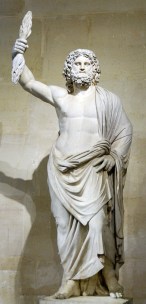
The Olympic Games originated long ago in ancient Greece. Exactly when the Games were first held and what circumstances led to their creation is uncertain. We do know, however, that the Games were a direct outgrowth of the values and beliefs of Greek society. The Greeks idealized physical fitness and mental discipline, and they believed that excellence in those areas honored Zeus, the greatest of all their Gods.
One legend about the origin of the Olympic Games revolves around Zeus. It was said Zeus once fought his father, Kronos, for control of the world. They battled atop a mountain that overlooked a valley in southwestern Greece. After Zeus defeated his father, a temple and immense statue were built in the valley below to honor him. This valley was called Olympia, and soon religious festivals developed there as people came to worship Zeus and to approach as nearly as possible his great strength. It is believed that these religious festivals eventually led to the famed Games of the Olympics.
Although we do not know just when the Games were first played, the earliest recorded Olympic competition occurred in 776 B.C. It had only one event, the one-stade (approximately 630-foot or 192-meter) race, which was won by a cook named Coroebus. This was the start of the first Olympiad, the four-year period by which the Greeks recorded their history.
Athletic competition became so important to the Greeks that the Olympic festivals were a peaceful influence on the warlike city-states. Sparta was famous for the strict military training of its citizens. But it would wait until the Games were over before sending fighters into battle. Other cities followed this example.
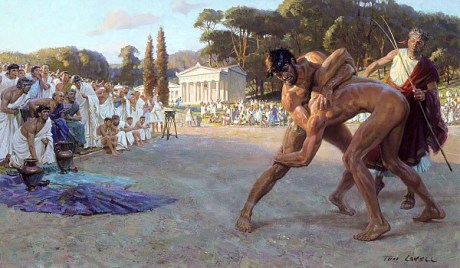
For the first 13 Olympic Games, the only event was the one-stade run. But over the years, new sports were added to the Games. The hoplitodrome, for instance, was a footrace the athletes ran wearing full armor. The pentathlon, in which the athletes competed in five events (jumping, javelin, sprint, discus, and wrestling) was added to the Games in 708 B.C. The pancration was introduced in 648 B.C. This brutal sport had no rules and combined boxing and wrestling. A winner was named only when one man raised his hand in defeat or lay unconscious on the ground.
In addition to the pre-existing religious shrines and altars, a vast complex of buildings and structures was constructed at Olympia to accommodate the growing number of sports and athletes. Chariot races, first run in 680 B.C. , were held in the hippodrome. Boxers and wrestlers trained in the Palaestra, which was adjacent to the gymnasium. The Leonidaion housed the athletes.
 Generally, only freeborn men and boys could take part in the Olympic Games (servants and slaves were allowed to participate only in the horse races). Women were forbidden, on penalty of death, even to see the Games [as all the athletes performed in the nude]. In 396 B.C., however, a woman from Rhodes successfully defied the death penalty. When her husband died, she continued the training of their son, a boxer. She attended the Games disguised as a man and was not recognized until she shouted with joy over her son’s victory. Her life was spared because of the special circumstances and the fact that her father and brothers had been Olympians.
At first, the Games were strictly for Greek citizens. Eventually, however, athletes from all over the Roman Empire (which covered the entire Mediterranean region) were permitted to participate.
All athletes were required to take an oath that they would observe all the rules and standards. In spite of the luxurious facilities offered to athletes, all had to remain amateurs. That is, they had to pay their own expenses, and they could receive no monetary awards.
Winners of the Games were crowned with wreaths of olive leaves and hailed as heroes. They were showered with material gifts, and sometimes a special entrance was cut in the wall surrounding their home city just for them to pass through—a symbol that the people of the city felt well protected with an Olympic champion living among them.
Perhaps the greatest athlete of the ancient Games was Milo of Croton, a wrestler who lived in the 500’s B.C. He won the wrestling crown six times, and he was said to be so powerful that he could carry a full-grown bull on his shoulders.
The ancient Olympic Games also honored, and inspired, artists. The poet Pindar wrote many odes in praise of the Games’ winners. The Olympic buildings were prime examples of the beauty of Greek architecture, and the remains of Zeus’ great statue bear the signature of the famous Athenian sculptor and architect Phidias. Like the athletic champions, artistic champions were awarded olive wreaths and great acclaim.
 The Decline of the Games
After Rome conquered Greece in the 100’s B.C., Olympic standards began to decline. Competition for the common good was ignored by the glory hunters, who were willing to use any trick or deceit to win. For instance, in A.D. 67 the emperor Nero brought his own cheering section and competed in events himself. Even though he fell from his chariot during the race, he was named the champion. In A.D. 394 the Roman emperor Theodosius I, a Christian who considered the Games a pagan festival, ordered them stopped. Olympia then began to crumble. The great statue of Zeus was taken away to Constantinople, where it was destroyed in a fire. In 426, Roman emperor Theodosius II ordered all the temples destroyed. Earthquakes later helped finish what human hands had started, as well as flooding caused by a change in the course of the river that flowed through Olympia. The once-great city was eventually buried.
In 1829, German archaeologists began uncovering Olympia. Today, the site of the ancient Olympic Games is only a shadow of its former glory. Many of the building foundations remain, but few walls and pillars still stand, and the stadium where foot-races were held long ago is now just a broad stretch of barren ground. – Scholastic, 2016
Read more
Filed under: greece, india | Tagged: athletes, greece, india, milo of croton, olympia, olympic games, sports, theodosius i, zeus |









Leave a Reply