














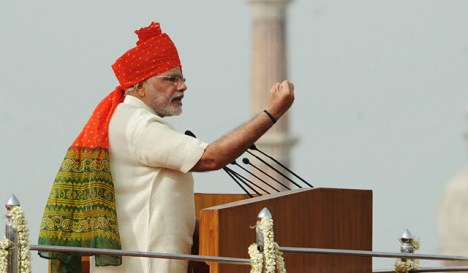
Prime Minister Narendra Modi made his first Independence Day speech on 15 August 2014. Below are the salient points of his address. – Editor
• I come to you not as a Pradhan Mantri, but as a Pradhan Sevak. I pay respects to all previous Governments, Prime Ministers. This country stands on the foundation of unity and cooperation.
• I am from outside Delhi. But I assure you there is ample capacity in the people occupying the Government machinery – from the highest office to the lowest. I want to awaken the power that sleeps within our machinery.
• The nation’s founders dreamed a dream. It is our task to fulfil that dream. All Indians should have that dream. People ask “mera kya” and “mujhe kya”. We must escape this mentality. Not everything is for us. We must awaken the feeling of national good.
• We hear of rapes and we are ashamed. We keep tabs on our daughters. But do we ever keep tabs on our sons? Every rapist is someone’s son. The law will do its job. But as people, we have our own tasks cut out for us too. Parents must ask their sons about the paths they choose. The shoulder that supports the gun can also support the plough.
• In Nepal, there was a time when the youth were walking the path of violence. Today, they stand by their Constitution. If Nepal can do it, can India’s youth not?
• We have suffered communal tensions for centuries. Even after independence, we continue. But for how long? There has been ample violence and ample mistrust. We have only succeeded in hurting our motherland. These things get in the way of progress. Promise yourself ten years of peace and then see what heights we can touch.
• With scientific advancement, we think progress. But today the sex ratio in India is 1000-940 (male-female). Where is this lack of balance coming from? I appeal to doctors, do not kill daughters in hopes of filling your tijori. Do not sacrifice the lives of daughters for sons. I have seen families with as many as five sons where the parents are taken care of by a selfless daughter.
• Commonwealth games saw our players winning medals. Of these winners, 29 are girls.
• If we keep our eyes on our goal, we can get rid of all social ills. Good governance and development is the path ahead.
• Government employees say they are in ‘service’. Private employees say they have ‘jobs’. I ask Government employees: Has the word ‘service’ lost its meaning?
• If 125 crore Indians take one step each, the nation will move ahead 125 crore steps.
• Why do our farmers commit suicide? Fathers leave families behind and kill themselves because they can’t feed them.
• We announce the Pradhan Mantri Jan Dhan Yojana. We will give the poorest person in the country as bank account. He will have his own debit card. He will have 1 lakh rupees insurance.
• Skill development is the need of the hour. We look for skilled drivers and plumbers but they aren’t available. Youths should get skills that can go into the making of a great nation. So that they can go to any corner of the world and have people acknowledge their worth.
• The world has changed. India can’t fulfil its destiny by staying away from the changed world.
• I call upon all Indians everywhere to focus on manufacturing sector and the import-export sector. India must put all its efforts into becoming better, but I invite the world to us as well: “Come! Make in India!”
• “Come! Make in India!” Sell anywhere in the world, but make in India. Chemical, automobile, paper & plastic, satellites, cell phones – make it all in India!
• To Indian youth, I say our dream should be “Made in India!”
• Serving the nation has to be more than just sacrificing your life like freedom fighter Bhagat Singh. The farmer does equally great service as the soldier.
• India’s youth, to them I say. Do not compromise. When manufacturing, your goal should be: Zero defect; zero effect (on environment).
• People used to think of us as a nation of snake charmers. Now we are seen as a nation of IT wizards. So we dream of a Digital India. If our villages are connected with broadband connectivity. Imagine what it can do for education and for healthcare. Can we move towards mobile governance? This is what I mean by Digital India.
• We import foreign electronics in large amounts. It is our second greatest import after oil and natural gases.
• E-governance to me means Effective Governance. If we focus on it, Digital India can stand on equal footing with the world.
• Cleanliness is of great importance. For how long will we continue to live in dirt. The first task we focused on was cleanliness. If 125 crore Indians decide they will spread cleanliness, India will be clean.
• Mahatma Gandhi’s anniversary is coming. What will be our gift to him? Can we promise that we will clean India by 2019? This task can only be fulfilled with the people’s participation.
• It is a shame that our women do not have access to toilets. This leads to illness and disease. August 15 is the time for big announcements. I do not know what I will be called for making these announcements. But I come from a poor family. I know what it feels like to be poor.
• Starting today, we wish to start the mission to have toilets in every school. With MPLAD funds, I appeal that in the next one year, toilets be built in every school in India.
• I announce a scheme in the name of the Parliament. Sansad Gram Yojana. Choose any village, set parameters. Then make one village the ideal village – the adarsh gram. Members of Parliament should aim to have three villages built to Adarsh standards by 2019. After that, five ideal villages every five years should be created.
• When the Planning Commission was created, it was created with the needs of the time in mind. The body has contributed to this in its best capacity as well. State Governments are coming into more strong roles and I think this is a good thing. Strengthening the federal structure is what will take India forward. States and the Centre in teams will create the new shape of the Planning Commission. With this in mind, the Planning Commission will have a new incarnation. It will have a new shape.
• Today is Sri Aurobindo’s birth anniversary as well. He had said that India will play the role of the world’s teacher. He and Swami Vivekananda had a vision of India becoming a teacher for the world. I want that vision to come true.
• We fought the war for freedom. We were together and unarmed. Did we not win? Can we not defeat poverty the same way? Our neighbouring countries also have the same problems. Fighting and killing each other does not take us anywhere. The one who saves is greater than the one who kills. In Bhutan and Nepal, I saw this feeling reflected.
• I am not the Pradhan Mantri. I am the Pradhan Sevak. I promise my colleagues in the Government. If you work 12 hours, I will work 13 hours. If you work 13 hours, I will work 15 hours. – Niti Central, 15 August 2014

Rape, toilet speech for the greater national change – S. Bhatt
 “While touching the issue of rape-related crimes, Modi said: ‘I want to ask parents, when daughters turn 11 or 14, they keep a tab on their movements. Have these parents ever asked their sons where they have been going, who they have been meeting? Rapists are somebody’s sons as well! Parents must take the responsibility to ensure that their sons don’t go the wrong direction.'” – Sheela Bhatt
Quintessentially Modi, said Bharatiya Janata Party’s spokesperson and writer M J Akbar after Prime Minister Narendra Modi concluded his speech from the ramparts of the Red Fort on India’s 68 Independence Day.
Prime Minister Modi wore the hat of a social reformer on Friday.
His speech had the soul of a Rashtriya Swayamsevak Sangh pracharak. For them, the power of New Delhi is all about shaping Indian families and building national character.
Sporting a bright red bandhni-designed safa along with simple kurta-chudidar helped him play out his “Hindu-nationalist” identity. His social ideas too had a thread of “cultural nationalism” of the RSS style running through it.
Standing firm on the dais without a bullet-proof glass barrier, alongside the national flag, Modi displayed with full vigour his typical macho body language, his government’s priorities in the social sector and his own resolve to govern the country.
He talked less about politics and more about basics.
His language was assertive but not aggressive.
Even if it was a bit ceremonial, he graciously acknowledged his predecessors.
The prime minister reminded people that he is an outsider. And, true to his outsider spirit, he talked about toilets.
Modi’s speech has to be applauded for bringing toilets, gender imbalance and cleanliness into the national discourse.
He gave himself a things-to-do deadline for building toilets in all schools across India within a year.
One wished he added the adjective, ‘functioning’ before toilets. Thousands of schools in India does have toilets but they either do not have running water or are not being maintained.
This is almost an impossible task. So let us see with immense interest how Modi follows his promised dream.
Also, his announcement of creating bank accounts for the poor and giving them Rs 1 lakh insurance is loaded with many possibilities and impossibilities.
From a sheer business point of view, Modi is talking about some potential insurance business of Rs 23,000 crore!
Officially, there are around 23 crore poor in India. Minimum, one would say.
Giving each of them Rs 1 lakh worth insurance, along with opening their bank accounts, is awesome but seemingly impossible idea to fulfil within the time limit Modi has set.
Precisely for that reason, Modi has created a flutter.
Let the administrative details of his Independence Day ideas come out. Will he give business to the private insurance companies or the government-controlled Life Insurance Corporation?
Knowing fully well that he was not playing elite, restricted and fitting-to-the-solemn-occasion speech, Modi said he does not know whether people will appreciate him talking about dirt and toilets from the ramparts of the Red Fort. But since he came from a poor family, he expressed his concerns for such issues.
The most redeeming feature of his speech was his penchant for cleanliness.
He said that by 2019, ensuring cleanliness will be the most fitting tribute to Mahatma Gandhi on his 150th birth anniversary.
The prime minister’s speech constantly gave the feel that change is in air.
It was high time an Indian Prime Minister went back to basics and talked about how shameful it is that the country’s womenfolk have to wait for darkness to go out in the open to defecate.
Modi asked, “Can’t we build toilets for the security of our women?”
While touching the issue of rape-related crimes, Modi said: “I want to ask parents, when daughters turn 11 or 14, they keep a tab on their movements. Have these parents ever asked their sons where they have been going, who they have been meeting? Rapists are somebody’s sons as well! Parents must take the responsibility to ensure that their sons don’t go the wrong direction.”
His idea of announcing a scheme named after Parliament called Sansad Adarsh Gram Yojana is a challenging one too.
Modi said that by 2016, MPs should have at least turned one village into a model village. By the end of five years, Modi wants each MP should have converted at least five villages into model villages.
Through the scheme, which will be kicked off from October 11 — the auspicious day of Karva Chauth, Modi is talking about creating some 3500-plus ideal villages by 2019.
During the course of his speech, Modi, in a cold-blooded manner, dismantled the Planning Commission, ending the Nehruvian style instrument of national deliberations on planned growth.
Asserting that the country has changed, the prime minister said that since the needs had changed, it was time to build a new institution instead of renovating the old relic.
Modi also talked about skill development and tried to inspire a “Make in India” mission.
He, however, smartly avoided political traps.
His government was elected by people who were angry on issue of corruption, price rise and insecurity due to internal and external vulnerabilities.
Modi didn’t touch issue of corruption, high cost of living and Pakistan-backed terrorism or even the issue of black money stashed abroad.
He diverted the national attention to social issues rather than hardcore economic or security-related issues.
Modi’s speech, as expected, was perfectly-delivered. But it was short of hard issues that could give the nation new direction or clear hint of fundamental changes that are likely to come though governance particularly.
Modi, though, has time on his side.
If his government machinery starts building toilets on a war-footing and if some 780-plus MPs start building the ideal model villages in nooks and corners of India, Modi will deserve applause on August 15, 2015. – Rediff, 15 August 2014
Filed under: india | Tagged: BJP, india government policies, india independence day, indian economy, indian government, indian politics, narendra modi, politics, poverty eradication, public service |










 BHARATA BHARATI
Good Emotional Speech from the Pradhan Sevak. In many ways Namo is similar to Nehru; the Administrative Machinery of the GOI and the people of India. particularly, the Hindus are sluggish; the politicians, the self proclaimed social reformers, the Traders, the greedy Officials and the external agencies exploit! On my part I have made several suggestions; but who am I? I had not been a big official of the GOI or in the Business circles! ஏழை சொல் அம்பலம் ஏறாது; எனக்கு பணக்காரனாகவும் தெரியாது!!
LikeLike