













 “From the national perspective, UPA II is a saga of mindless squandering of precious opportunities by a set of people with their own agendas. It is not that nothing has been achieved. But, what has been achieved is small in comparison with what could have been achieved. Five years ago, the government went into the elections with growth rates flirting with all-time highs. This time around, in sharp contrast, comparisons for many sectors – particularly manufacturing – are being made with all-time lows. That says it all.” – Virendra Parekh
 The bugle has been blown. Lok Sabha elections will be held in nine phases between April 7 and May 12. So, in the coming weeks,
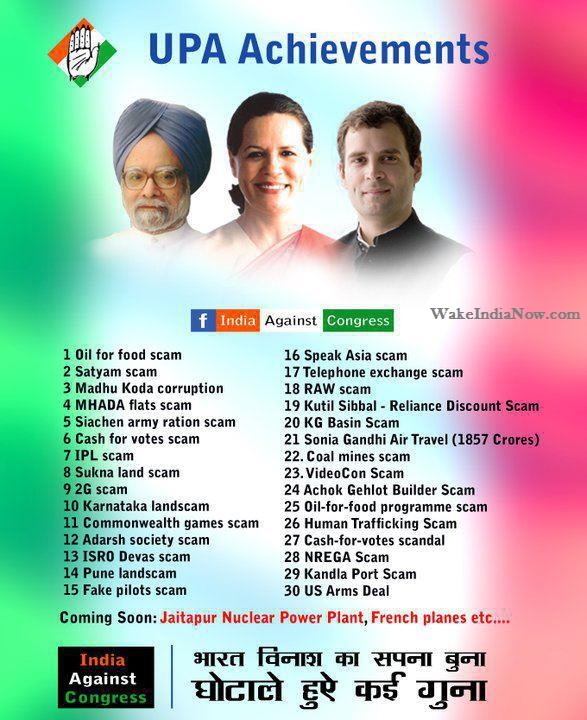
… a government which has presided over the most venal, corrupt and incompetent administration since independence,
… a government which has intentionally pushed up prices of cereals, pulses, milk, vegetables and other essential commodities making life hell for ordinary people,
… a government which has gravely compromised the defence preparedness of all the three wings of armed forces,
… a government to whom meekly submitting to Pakistan’s barbarism and China’s predatory adventurism represents statesmanship of the highest order,
… a government which is a living and present danger to the security of the country with its anti-national divisive policies,
… that government, that party and that leadership will be seeking from you a fresh mandate to rule this country.
This government has deliberately and intentionally gone soft on terror and terrorists at home pre-occupied as it is with ‘Hindu terrorism’; let Pakistan off the hook on cross-border terrorism; given a free hand to the generic church to pursue its nefarious agenda; sought no appease China instead of countering its incursions – diplomatic and physical – into Indian territory and sacrificed national interests in Sri Lanka to please a regional ally. In short, it has made India a fair game for enemies on the both sides of the border.
Since economy and growth are the main issues in this election, it is pertinent to ask: What is economic legacy of the UPA II government which is, by all accounts, most unlikely to be reelected? Terrible, to put it shortly. Economic management under UPA is marked by politicking, plunder, incompetence and plain malevolence.
 First, communalization of economic policies. Congress has been communalizing polity and society since independence, while calling it secularism and getting away with the bluff. UPA went a step further. Under the pretext of ‘inclusive growth’ it has introduced divisive vote bank politics even in economic policies. On December 9, 2006, addressing the National Development Council meeting in New Delhi the prime minister asserted that “Plans for minorities, particularly Muslims, must have the first claim on resources.”
This was not mere rhetoric. Soon enough, his government began schemes of discriminatory scholarships, grants and even bank loans exclusively targeted at Muslims. A truly secular government would apply religion-neutral criteria like income, geographical location, parental literacy etc. to identify beneficiaries of affirmative action. But UPA government, true to form, has divided poverty, illiteracy and backwardness on the basis of religion. The recent spate of opening ‘minority’ institutions and their branches (the extension campus of the Aligarh Muslim University, for example) should not surprise us.
Secondly, the end of India’s growth story by recklessly squandering precious growth opportunities and focusing instead on plunder, pilferage and patronage.
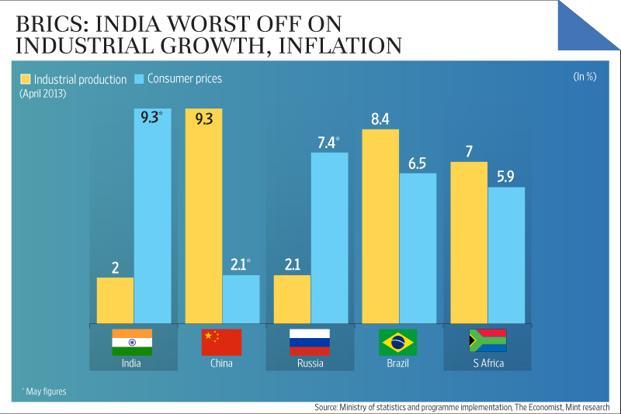
Economic growth has collapsed even as consumer inflation remains high. Jobs are growing even more slowly than the GDP. Agriculture is losing viability as a commercial enterprise. Investment cycle remains in a downturn.
The latest quarterly estimates for the December 2013 quarter put the GDP growth at 4.7 per cent, taking the tally for the first three-quarters of the year to 4.6 per cent. The general opinion among economist is that growth for the whole year will hardly be around 4.7 per cent, not much above the 4.5 per cent seen last year. For the first time in 25 years, we are heading towards two consecutive years of sub-5 per cent growth.
 The UPA defends its record by averaging out some major economic indicators during the ten years of its rule and invoking adverse international developments for the current slowdown. During the decade of the UPA rule as a whole, overall economic growth has averaged 7.5 per cent per year, the fastest in any decade in India’s history. As regards poverty removal, the percentage of the population below the poverty line (Tendulkar definition) has dropped sharply from 37 per cent in 2004-05 to 22 per cent in 2011-12. It is the steepest decline in the poverty ratio ever seen in India in a decade.
This does not impress anyone because the golden years of high growth with financial stability are long past. Most of the high growth occurred in the first seven years up to 2010-11 (averaging 8.5 per cent a year), after which it crashed, mainly as a culmination of bad economic policies assiduously pursued by the government.
The high growth and low inflation of the first five years were due mainly to the global economic boom of 2002-07 and the wide-ranging, productivity-enhancing economic reforms carried out prior to 2004. When UPA was reelected to power in 2009, it was expected to follow the reform agenda with vigour and push economic growth into double digits, especially because it was no longer beholden to the Left parties for survival in power. At the minimum it was expected to give a thrust to build up infrastructure – roads, railways, ports and power plants. This would have put money in people’s hands by giving them real jobs and also created the basis for further economic growth.
Instead, we saw a massive plunder of natural resources to fatten politicians and their cronies and complete politicization of economic management. Key sectors such as telecom, mining and land allocation fell prey to crony capitalist policies leading to gigantic scandals (2G spectrum allocation scam, coal and iron ore), whose debilitating aftermaths continue to impact these and related sectors. Transferring cash to perceived vote banks became a policy objective. Minimum support prices were raised recklessly, major subsidies (oil, food and fertiliser) were allowed to grow unchecked, entitlement programmes (such as the rural job scheme and now the food security) were pushed vigorously, government servants’ pay and other sops were hiked. Instead of fostering a culture of hard work, honesty, accountability and productivity, the government promoted a culture of entitlements.
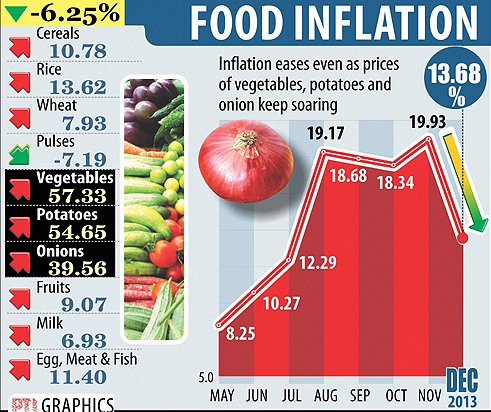 Since the additional cash was not matched by additional production or productivity, the result was steep rise in prices of essential commodities. The stench of corruption and unbearable burden of inflation has created deep resentment against the government cutting across all sections.
Whatever was left of growth momentum was destroyed by policy paralysis, slow clearances and approvals, huge time overruns on important infrastructure projects, falling output of gas and the resultant imbalance in capacities across sectors. Thousands of megawatts of power capacity is lying idle or underutilised for want of fuel –gas or coal – even in the face of severe power cuts. India has one of the largest reserves of coal, but it is importing coal worth billions of dollars year after. Millions of tonnes of food grains are rotting in government godowns even as millions go half hungry.
Bad policy calls such as letting the rupee appreciate in 2000-10, series of hikes in key policy interest rates to curb inflation in the teeth of wiser counsel, the sudden tightening of environmental standards (2010) and the inexplicable recourse to capricious and retrospective tax policies (2012), together with sectoral scams noted above, played havoc with the general investment and business climate and contributed to the sharp economic slowdown.
From the national perspective, UPA II is a saga of mindless squandering of precious opportunities by a set of people with their own agendas. It is not that nothing has been achieved. But, what has been achieved is small in comparison with what could have been achieved.
Five years ago, the government went into the elections with growth rates flirting with all-time highs. This time around, in sharp contrast, comparisons for many sectors – particularly manufacturing – are being made with all-time lows. That says it all.
It is still not done. Following a scorched earth policy, the government is busy planting mines in the economy and moles in key positions to make life hell for its successor and create hurdles so that, hopefully, it could shine in comparison.
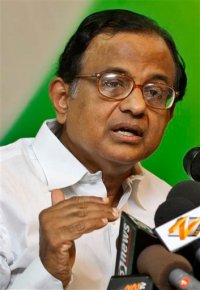 The finance minister has presented a deceptive budget. By deferring large items of expenditures, overestimating revenues and understating expenditures he has created the illusion of having controlled the deficit. If these estimates go wrong (as expected) and the deficit shoots past the target, someone else will take the blame.
This government has passed a law that will make land acquisition for industry and infrastructure projects an extremely expensive and time consuming process with high degree of uncertainty. That will greatly hamper the pace of economic recovery. It has passed a food security law which will impose an unbearable burden on the government’s treasury, while pushing grain prices in the open market even higher. The appointment of the Seventh Pay Commission, DA-pay merger for government staff and the hike in subsidized gas cylinder from 9 to 12 are part of the same strategy, as is the increase in MNREGA wage to Rs. 175 per day on average. The gas price is sought to be doubled from April and, in a far-reaching mala fide move, the field trials have been permitted for 120 food crops that will destroy India genetically.
The BJP, always too clever by half in such matters, unwittingly and shortsightedly chose to vote for nearly every populist bill UPA brought to the floor of Parliament, without stopping to think that while the credit will be pocketed by the UPA, the consequences will be faced by the its own i.e. BJP-led government.
The follies and perfidies of this government will continue to haunt us long after it is gone. Inflicting a stinging defeat on it at the hustings is the least we can do.
» Virendra Parekh is the executive editor of Corporate India magazine and lives in Mumbai.
Filed under: india | Tagged: corruption, economic development, economy, finance, india, india elections 2014, indian economy, indian national congress, industry, inflation, lok sabha election 2014, minority appeasement, poverty, UPA government, UPA-2 |








The type/content of education that is offered now is just a money spinner for the student, the teachers and those who have founded the institutions; the communists ant the DK/DMK movements have done immense and irrepairable harm to ALL the people; both the leading ‘NATIONAL’ parties have been having alliance with the DMK -may be because they are a group to reckon with; may be they judged that was the only way to tame them! In this light, look at the plight of the Hindus: although they are the majority they can not have any thing of theirs; they are at the mercy of the Arms / crude oil / nuclear fuel / JOB / edible oil / machinery / etc.suppliers! this makes them weak while bargaining; traditionally the Indians have not been patronising local talents; most of our stories are woven around jealousies; the Sanatana dharma stresses unquestioned surrender to GOD and doing the Homas, Pujas etc. for the well being of all in the Society as the Dharma for the Brahmins and for the ‘few divinely selected’ others too and stresses fighting / creating goods and services / expanding the empire etc. for the others; but this has been misinterpreted purposely to convey that Hinduism was for a lazy and comfortable living to the Brahmins; and for that sake only, others had to slog; this might have given a message that why not every body surrender to GOD, derelicting ‘THEIR’ duties, and go to the Heaven! This attitude might have, weakened the Hindus and forced them to shrink their occupancy, may be right from the present Turkey to India, with pockets of others every where even after partitioning! Unable to make any dent in correcting the corruppted Hindu practices, Nehru, Shastri and Indhra wanted the Indians, ie. the Hindus and sober nonHindus to become Economically and technically Strong-towards this, they started the giant PSUs, the IITs, the RECs, the IIMs, the Research Establishments, the Defence Establishments, even the FCI and so forth- they had to face innumerable obstacles from Industrially Developed Nations, the commonality between most nonHindus, the thrust of ‘Democracy’ and ‘Secularism’ on India, our own Internal squabbles, the inadequacies of our Government and Judiciary and as said in the beginning the DK/DMK, the labour Unions and the Communists, who could notice the prosperity of only the elites in all these establishments- they could not make out that these were top priorities for India; they developed hatred to the elites and forced reservation, equality …The traders were waiting for an oppurtunity to import in the name of latest and world class, ‘when some body has already researched why we should repeat’! Added to this, because of the perceived threat of growth of one of the nonHindus’ population in the name of ‘RELIGION’, there has been a race for increasing the Hindu Population too! the outcome is we in India are presently 126 crores while the preIndependent India, comprising of Pakistan, Present India and BanglaDesh was about 30 crores only!
This is the cause for the slowing down of the economy-neither of the National Parties could help this; so it is better not to relegate our past National Leaders!!
LikeLike
True. But that is only what ought to have been expected! The imperial rule was never thrown out. India is the only country in the world that did not fight for its freedom, but beg for it. The feudalism of the middle ages remained where it was, only in a worse dynastic form! Instead of a representative democracy we were remunerated with a transfer of power that suit the British Crown the best (for its exit after the World War II) not to the people of India but to a subservient dynasty that ruled a divided nation for 67 years. All roads to build a self respecting nation was blocked. History was only a subject for distortion. The people were merely meant for exploitation. Thus poorest people was gifted with a most expensive system of democracy. It is said that a democracy without education is hypocrisy unlimited.
LikeLike