















 A wave of violent attacks against Bangladesh’s minority Hindu community shows the urgent need for authorities to provide them with better protection, Amnesty International said.
Over the past week, individuals taking part in strikes called for by Islamic parties have vandalised more than 40 Hindu temples across Bangladesh.
Scores of shops and houses belonging to the Hindu community have also been burned down, leaving hundreds of people homeless.
The attacks come in the context of large-scale violent protests that have been raging across Bangladesh for weeks over the country’s ongoing war crimes tribunal, the International Crimes Tribunal (ICT).
“The Hindu community in Bangladesh is at extreme risk, in particular at such a tense time in the country. It is shocking that they appear to be targeted simply for their religion. The authorities must ensure that they receive the protection they need,” said Abbas Faiz, Amnesty International’s Bangladesh Researcher.
“All political parties in Bangladesh should condemn strongly any violence against the Hindu community, and to instruct all their members and supporters not to take part in such attacks.”
Survivors told Amnesty International that the attackers were taking part in rallies organised by the opposition Islamist party Jamaat-e-Islami (JI) and its student group Chhatra Shibir.
JI has publicly denied any involvement in violence against the Hindu community.
Attacks have happened across Bangladesh, but mostly in remote areas in the country. The latest attack took place today in Daudkandi village, south-eastern Comilla district, where a Hindu temple was vandalised and burned down.
One survivor told Amnesty International that on 28 February, his family’s village of Rajganj Bazar in the south-eastern Noakhali district was set on fire by people taking part in a JI-organised strike.
“They moved into our properties and set fire to 30 of our houses. Seventy-six families were living in these houses. They also set fire to our temples – all are now vanished,” the survivor said, who asked to remain anonymous out of concerns for his safety.
He said the authorities have provided temporary accommodation to the affected families, who had lost almost all their belongings to theft or destruction in the violence.
Another survivor said that on 2 March, a group of about 100 young men holding banners in support of JI looted and damaged four shops in Satkania near Chittagong and vandalised a Hindu temple in the village.
Bangladesh’s Hindu minority makes up only eight per cent of the population, and has historically been at risk of violence from the Muslim population – including during the independence war in 1971, and after elections in 2001.
“Given the obvious risks the Hindu minority faces in Bangladesh, these attacks were sadly predictable. We urge the authorities to take note of the violence and act to prevent further attacks,” said Faiz.
Tensions have been running high in Bangladesh in recent weeks as JI and its student wing have called strikes and mass protests against the ICT, which has found some of its senior members guilty for crimes committed during the 1971 war.
Protesters have also been involved in violent clashes with police, who have used tear gas, rubber bullets or live ammunition against them. At least 60 people have been killed, mostly by police fire, but among the dead are also several policemen.
“While there are credible reports that police firing may have followed violent attacks against them by protesters, police use of excessive force cannot be discounted”, Faiz said. – Amnesty International, 6 March 2013

See also
Filed under: india | Tagged: bangladesh, communalism, ethnic cleansing, hindu, hindu refugees, hinduism, human rights, islam, islamic iconoclasm, jihad, koran, muslim terrorism, politics, politics of communalism, psychological warfare, rape, religion, religious bigotry, riots, terrorism, violence against hindus, west bengal |










 BHARATA BHARATI
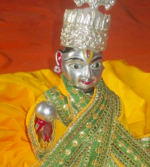
Hindu goddess idol vandalised in Madhapur, Bangladesh – bdnews24.com – 16 March 2013
‘Miscreants’ vandalised a Saraswati idol at a temple beside the residence of ruling-party Member of Parliament (MP) Mohammad Atiur Rahman Atique in Sherpur city’s Madhabpur.
The Madhabpur Puja Temple committee informed the police about the incident that took place on Friday night.
Hindus have been offering prayers at this temple for the past 77 years, said the temple committee Chief Dilip Kumar Paul. “Vandalism was conducted to dent the communal harmony.”
Paul demanded punishment for the perpetrators.
He, however, did not blame anyone specifically for the sabotage.
“Whoever is responsible … they will be identified and arrested,” said Sherpur Sadar Police Station Officer in-Charge Mazharul Karim.
He visited the temple on Saturday morning.
Suspected Jamaat-e-Islami activists had been carrying out vandalism and attacks on the Hindus in several areas of Bangladesh over the issue of trial of war criminals.
One Hindu was reportedly hacked to death during the attacks.
LikeLike
Reblogged this on Hindu Internet Defence Force.
LikeLike
Hindu temples, homes attacked across Bangladesh – TOI – AFP – Mar 13, 2013
DHAKA: Islamic activists have attacked dozens of Hindu temples and hundreds of homes across Bangladesh since an Islamist leader was sentenced to death for war crimes last month, a Hindu group said Wednesday.
Bangladesh Puja Udjapon Parishad, a group which looks after Hindu temples, said 47 temples and at least 700 Hindu houses had either been torched or vandalised since the verdict against Delwar Hossain Sayedee.
Verna Sayedee, vice-president of the country’s largest Islamic party Jamaat-e-Islami, was sentenced to hang on February 28 for crimes including rape and murder committed during the 1971 independence conflict.
The sentencing of Sayedee and other Jamaat-e-Islami leaders has triggered the worst violence in impoverished Muslim-majority Bangladesh since independence, with 85 people so far killed in the unrest.
Kazal Debnath, a vice-president of Bangladesh Puja Udjapon Parishad, blamed the attacks on Hindu temples and homes on Jamaat-e-Islami and its student wing Islami Chhatra Shibir.
“It was the work of the Jamaat and Shibir, but we also accuse the government, the police and the local government representatives including (our) MPs for failing to protect the temples and our community,” he told AFP.
He said the attackers were given free rein to “torch our temples, houses and properties”.
Jamaat has denied any role in the attacks, blaming supporters of the ruling Awami League party for the violence.
But Foreign Minister Dipu Moni told diplomats last week that Jamaat and Shibir attacked Hindu temples and houses in a “pre-planned manner”.
Hindus, who make up nearly 10 percent of Bangladesh’s 153 million-strong population, are traditionally seen as supporters of the Awami League, which brands itself as a secular party.
They were the main targets during Bangladesh’s 1971 independence war against Pakistan and during post-poll violence in 2001 when a centre-right party allied with Jamaat won a two-thirds majority.
Jamaat-e-Islami leaders have been on trial at the domestic International Crimes Tribunal, accused of colluding with Pakistan and pro-Pakistan militias during the war for independence.
But the party says the process is an attempt by the ruling party to settle scores and not about delivering justice.
LikeLike