










 “First an imaginary invasion by an imaginary people called Aryans who become Nazis, and then denying and decrying the evidence of horse to keep alive the superstition of ‘No Harappan horse’. In the view of this writer, a basic problem is that humanities have not kept pace with advances in science. This is particularly the case with Indology and Indo-European Studies still stuck in the nineteenth century. It has never managed to shed its amateur roots—founded by civil servants, colonial bureaucrats and missionaries—and emerge as a rigorous academic discipline.” – Dr. N.S. Rajaram
 Science, natural history and genetics in particular, has given us a framework for tracing the spread of humans and their languages from our African homeland to rest of the world. It has answered in particular the question of why people from India and Sri Lanka to Ireland and Iceland speak languages clearly related to one another. On the basis of natural history, genetic analysis and archaeology, we know that the spread from the Indian subcontinent to Eurasia and Europe took place in two major waves—the first c. 45,000 years ago and the latter some 10,000 years ago. To the second wave may be attributed the Sanskritic influence found in European languages. These facts may be encapsulated as:
♦ African ancestors → Afro-Indians → South Asians → Indo-Europeans
followed by
♦ South Asians (Gauda-Dravida) → Indo-Europeans (with Sanskrit)
Thus the picture given by science for the spread of Indo-European peoples and languages is qualitatively and chronologically different from the one given by historians, anthropologists and linguists. The origin of Indo-Europeans was not the Eurasian steppe or Europe but Africa; the region where they evolved to become Indo-Europeans was the Indian subcontinent. And the whole process took not four or five thousand years but over sixty thousand years. These findings are now supplemented by growing knowledge about the domestication of animals and the spread of agriculture. These too made their way into Eurasia and Europe during the second wave and left their imprint along with Sanskritic words and ideas.
 Monsoon Asia: Hothouse effect
To deal with the phenomena of the origin and spread of peoples and languages, we needed to define Indo-Europeans as individuals whose ancestors at one time lived in the Indian subcontinent—the present states of India, Pakistan, Nepal, Bhutan, Bangladesh, Sri Lanka and the eastern part of Afghanistan—and later moved out to settle in Eurasia and Europe. (Afghanistan straddles the Indian subcontinent, Eurasia and Central Asia.) In the language of population genetics, they are descended from founder groups of Indian origin who settled in Europe, just as the Zoroastrian Parsis of India are descended from founder groups of Persian origin who settled in India some 1200 years ago.
What applies to people applies also to flora and fauna, especially the domesticated animals in the late Pleistocene through the Holocene. These too moved with the second wave of Indo-Europeans into Eurasia and Europe. We have already seen how it led to the overlaying of Sanskrit words and other influences on existing languages. This was accompanied by the introduction of domesticated animals including pigs, sheep/goat, cattle and the horse: yes the horse. As we shall see later the claim that India had no horse until the invading Aryans (non-existent) introduced them is a total fabrication of AIT advocates.
But first we need to take a brief look at the climate and ecology of South Asia and the adjacent areas to the east and southeast. (See map.) What distinguishes them is their climate, influenced by the southwest monsoon and the Himalayan Mountains. This makes them a single ecological zone. During the late Pleistocene (last Ice Age), this region of tropical Asia, stretching roughly from the Indus in the west to the Mekong River in the east was more favorably placed for the development of agriculture and animal husbandry by the domestication of wild species of plants and animals than regions of the northern latitudes.
 This is reflected in the DNA composition of wild and domestic species from the region. Genetic analysis of cattle, sheep/goat, and pigs all point to one conclusion—this region of South, East and Southeast Asia stretching from the Indus to the Mekong was a hothouse for the development of agriculture and animal husbandry during the late Pleistocene and the early Holocene, or 12,000 to 10,000 years ago and later. (Forget the story of agriculture coming out of the so-called ‘Fertile Crescent’; it is a myth like the Aryans bringing civilization to India.)
The reason for this hothouse effect is no mystery: the climate in tropical Asia, protected from the brutal northern winters by the Himalayas could support larger populations of plants, animals and humans. This region, tropical Asia or more properly monsoon Asia recovered more rapidly from the grip of the Ice Age than the northern latitudes.
As the Ice Age ended and temperatures rose, the region benefited from more rainfall (due to greater evaporation) and also the discharge of fresh water from melting glaciers into the Himalayan rivers. It gave these rivers two sources—the summer monsoon and the melting ice caps, making their flow perennial. Some like the Brahmaputra and the Mekong became mighty. This meant ample sources of water for the expansion of agriculture and increased domestication of animals needed for farming, food and transportation. Agriculture spread and soon replaced hunting-gathering as the main source of subsistence. (Some scholars claim that arya from ar for the plough referred to agriculturists, but this is generally not accepted though no one seems to have a better explanation.)
Both agriculture and expanding populations made their way north, west and northwest carrying their skills and language with them. Archaeology, genetics (of humans and animals) and linguistics all tell the same story—this outward expansion from the Indian subcontinent in the early Holocene. It has left its imprint on the languages of the region in the form of Sanskritic words and cultural practices. The same is true of domestic animals like pigs, cattle and sheep/goat. Curiously, one of the animals they took with them, albeit inadvertently was the domestic mouse: the European mouse is genetically of Indian origin. The Indo-European mouse may be a humble creature, but to the scientist it is just as important as the Indo-European man.
Archaeo-geneticist Melinda Zeder observes: “In all livestock species, including goats, cattle, buffalo, pigs and sheep, a divergent DNA lineage occurs only in Southern and Eastern Asia. This suggests a possible center of animal domestication in Southern or Eastern Asia.” Actually since the DNA lineages ‘diverge’ from (meaning branches originate from) South and East Asia, we can say that these domestications took place in India, China and South-east Asia. These domesticated animals were taken into Eurasia and Europe by the second wave of Indo-Europeans. As just noted, the Indian mouse also accompanied them. This is a simplified summary of highly detailed scientific findings over several years.
What is true of animals from pigs to mice is true also of the horse though it is somewhat more complex. This is partly because horses were domesticated locally over a wide area from South Asia to Spain. ‘Scholars’ with a stake in the Aryan invasion myth have muddied the waters with denial and conjecture in their efforts to save their theories. They have confounded scientific data about horses with artifacts, icons and other depictions. This suggests that there is much room for improvement on the part of scholars like linguists who presume to interpret data without bothering to understand the science behind it.
 The horse story: Science over the nonsense
Upholders of the Aryan invasion in its many forms have made the supposed absence of the representation of the horse (Equus Caballus) in Harappan iconography a key factor supporting their pet theory. This is because there were no horses in India before the invading (or migrating) Aryans brought them in the second millennium—or so they claim. Even this is based not on science but the supposed absence of depiction of the horse in Harappan remains. This is a dubious argument at best for Harappan remains have yielded no depictions of the cow either while image of the bull is abundant. Does this mean they raised bulls without cows?
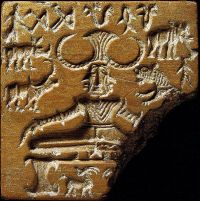
It is a palpably absurd argument: animal depictions (see pictures) are a matter of opinion; they cannot be tested scientifically as we can and do test animal remains. Yet some linguists like Michael Witzel and his followers (Steve Farmer, Romila Thapar, etc) have made the absence of horse images (in their opinion) the centrepiece of the argument to deny altogether the existence of the horse in India, including at Harappan sites. This according to them proves not only the Aryan invasion but also that any horse depictions found must be fraudulent. Why? Because it violates their theory!
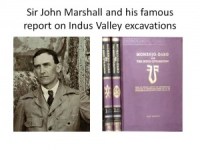 This comes closer to religious dogma than science. Further, clay and terracotta figurines and depictions of the horse, while relatively rare, are by no means unknown. (They are relatively rare in all Indian art.) All major archaeologists beginning with Sir John Marshall who as Director General of the Archaeological Survey of India supervised excavations at Harappa and Mohenjo-Daro have recorded finding horse images and figurines (see images.) In addition to Marshall, these include E.J.H. Mackay, R.S. Bisht, B.B. Lal and S.R. Rao—all archaeologists of world repute. They were all experts with decades of field work and not ivory tower academics like Witzel or dilettante self-proclaimed experts like Farmer.
The amusing thing is that Marshall himself in his authoritative three-volume magnum opus Mohenjo-Daro and the Indus Civilization reported finding horse remains and gave even a comparative table of different kinds of horses including the one he had found at Mohenj-Daro! (Volume 2, page 654.) When this was brought to Witzel’s attention, that these belonged to a real horse that he could not attribute to fraud, Witzel’s reaction was that these horse remains must have been introduced much later! In effect this implies a 4000 year-old conspiracy to fool Marshall.
Setting aside such conspiracy theories, it is not a good idea in the first place to study the existence of plants and animals based on artistic depictions. These are subject to opinion except in the case of unmistakable creatures like the elephant or plants like the ashvattha which cannot be mistaken for anything else. The only sure way is to locate and identify animal remains and fossils by scientific testing. Here there is no doubt about horses in India: both wild domesticated horse remains have been found that go back thousands of years at places like Koldihwa (7500 BCE), Mahagara (6500 BCE) and many more.
The subject is highly technical but many experts now believe that a prehistoric Indian species known as Equus Sivalensis (Shivalik Horse) may be an ancestor of nearly all the domesticated species in the world today. In fact, it has recently been reported that “Horse (South Asian breed, possibly Equus Sivalensis or the Shivalik Horse) fossils were found at Hathnora on the Narmada dating back to 75,000 years.” This is fully 70,000 years before Harappa and Mohenjo-Daro.
“Cows, sheep, and goats had simple beginnings as livestock, with evidence suggesting that a small number of animals of each species were domesticated in just a few places between about 8,000 and 10,000 years ago. Today, genetic diversity among these creatures remains low…” Horse DNA tells a different story, according to a paper published in the authoritative Proceedings of the National Academy of Sciences. “After analyzing mitochondrial DNA from a wide range of horse breeds across Asia, Europe, the Middle East and the Americas, scientists were able to connect all modern horses to a common ancestor that lived between 130,000 and 160,000 years ago.”
This is likely to have been the Equus Sivalensis known in South Asia and possibly East- and Southeast Asia. The point of all this is that all this is serious science, not simple minded speculation of invading Aryans bringing horses as late as 1500 BCE and some ‘scholars’ claiming there were no horses in India before then, and then going on to charge any evidence to the contrary to be the result of fraud and conspiracy.
 Need for better standards
This is a sorry record—first an imaginary invasion by an imaginary people called Aryans who become Nazis, and then denying and decrying the evidence of horse to keep alive the superstition of ‘No Harappan horse’. In the view of this writer, a basic problem is that humanities have not kept pace with advances in science. This is particularly the case with Indology and Indo-European Studies still stuck in the nineteenth century. It has never managed to shed its amateur roots—founded by civil servants, colonial bureaucrats and missionaries—and emerge as a rigorous academic discipline.
Even today, almost anyone, knowing neither Sanskrit nor archaeology can pose as an expert on Vedic India by latching on to a person or a group. The emergence of natural history and genetics as a major player, even a game changer in the field is making life increasingly harder for such dilettantes. This has led to consternation among its workers faced with the threat of sudden obsolescence and turmoil in the field. While one can sympathize with their predicament, science must replace prejudice and dogma or else there can be no progress. We can no longer allow assertions like the following made by the late Murray Emeneau, a leading figure in Indo-European linguistics to dictate agenda in the name of history:
 “At some time in the second millennium B.C., probably comparatively early in the millennium, a band or bands of speakers of an Indo-European language, later to be called Sanskrit, entered India over the northwest passes. This is our linguistic doctrine which has been held now for more than a century and a half. There seems to be no reason to distrust the arguments for it, in spite of the traditional Hindu ignorance of any such invasion.”
This linguistic doctrine (rather dogma) that in effect says “Evidence be damned,” is what a large section of scholars in Indo-European Studies is trying to preserve in various guises. They succeeded for nearly half a century after the end of Nazi Germany and European colonialism, but science has finally driven the last nail in their coffin. It is time to bury its sordid past and begin a rewriting of the human past based on science and the primary sources. We change when science changes the picture, not because new political masters in and out of academia assume control. – Folks, 1 January 2013
» Acknowledgement: The author is most grateful to Dr. Premendra Priyadarshi for providing him with the details and references relating to the domestication and spread of animals. The picture is quite complex but what is given here is a simplified summary of recent findings.
» Navaratna Srinivasa Rajaram (born 1943 in Mysore, India) is an Indian mathematician, who is however notable for his publications with the Voice of India publishing house focusing on the “Indigenous Aryans” controversy in Indian politics, in some instances in co-authorship with David Frawley. He’s also a member of Folks Magazine’s Editorial Board since 2009. Rajaram holds a Ph.D. degree in mathematics from Indiana University, and has published papers on statistics in the 1970s and on artificial intelligence and robotics in the 1980s.
See also
Filed under: india | Tagged: africa, african ancestors, animal domestication, anthropology, archaeology, aryan, aryan invasion theory, climate, cosmology, creation, creation myths, dating system, demography, harappan horse, history, horse, human history, human migration theory, indo-european, indo-european languages, indo-europeans, indology, indus valley civilisation, out of africa theory, out of india theory, racism, sanskrit grammar, science, secularism |





 BHARATA BHARATI
I have found Dr. Rajaram’s writings exemplary in their method. There is a combination of authentic scholarship and an attempt to write a popular style so that the general reader can relate to the material. The first article of his that I read was the one on the Boson particle. I had read many on the topic and found his the most lucid.
The present article and its earlier parts 1& 2 on the Indo Europeans continue his unique style.
I hope Sanskritists and Vedic scholars will team up with his scientific knowledge and make the project a truly formidable one.
LikeLike
The divinity schools in US and west , write a lot about Hinduism . Do they really go through the basics of Sanskrit or they rely on Englsih translations. I had an interesting talk with a Hare Krishna Indian to be sure, pundit. His view was that the westerners knew very little Sanskrit and the pundits hired then knew very little English. This is all in the 19th-20th century. His rationale was that the whole meaning was lost in translation. Even though I did not agree with the preachings of ISKCON, I found his discourse very honest.
There is a book by John Dobson “Advaita Vedanta and modern science”. JD was a monk for some 45 yrs in RK mission. He is still alive. Due to his invention of amateur telescope, he left RK mission. He has to say this about Sanskrit.
“There is no language on the face of the earth even comparable to Sanskrit in its competence to handle philosophical concepts. Swamiji found himself translating and re-translating from Sanskrit to English. In English there is no word for Vivartavada (the doctrine that the first cause is apparitional). Parinama (transformation) is understood but not Vivarta. There is no word for Brahman, for Atman, for Maya or for the Gunas. It is not just that the words are absent; the ideas are also absent”
Swamiji here is Swami Vivekananda. Dobson is emphatic that “It is not just that the words are absent; the ideas are also absent”.
So the divinity schools in USA and the west are having a nice time without proper knowledge and meaning of Sanskrit esp when there are no equivalent words in English for the Sanskrit language. .
Recently Infosys Narayanamurthy gave a huge amount to Harvard for Sanskrit and Indic studies. He should have given an equal amount to this great Sanskrit scholar in his native state, Karnataka.
http://www.taralabalu.org/panini/
With very little funds the above web site is doing a great job. We Indians do not appreciate our indigenous talent.
LikeLike
Dear Mr Rajaram,
As to your question “For example, why do accents for the same passage differ when they occur in both the Rig and the Yajur?”
Answer
One obvious answer is that rules of Swaras can vary between different Vedas and even within the same veda between different shakas of the same veda. This can be found from the Praatishakya texts associated with each veda. Also the meaning would differ based on the purpose. For example in Soma Yajnas the Riks are chanted without swaras in Eka shruti. An example is the purusha sukta. which exists in all vedas. There are bound to be differences in swaras. But the subtle meanings of the texts change. As far as i know, traditional scholarship does not give any special place to the rig Veda based on chronology alone. Also at the end of Dwapara yuga, Vyasa is supposed to have classified the previously monolithic,Veda, into as they exist now. What do you think about this?. Would be very interested to know. your views on this.
LikeLike
I too used to subscribe to such views but my recent study of the evoloution of language and thought leading to the Vedas especially the Rigveda tells me that we need to re-examine all such beliefs. Western scholarship has been overthrown–wrong in assumptions and in detail, and native Indian scholarship not much better. Traditional Vedic scholars have preserved and can chant but cannot give a coherent account why they do what. For example, why do accents for the same passage differ when they occur in both the Rig and the Yajur?
My starting point now is: human civilization is only about 65,000 years old–or post-Toba explosion. Of that 65,000 the human family has spent nearly 60,000 years in the Indian subcontinent–in the milieu which gave rise to the Vedas. And these are the ancestors of all the people in the world today, and their language gave rise to all non-semetic languages spoken today.
This is truly mind-boggling: it has no counterpart in any other field of knowledge or human endeavor. The Vedas are the outcome and record of that mind-boggling experience.
What we call modern Vedic scholarship (mainly Indian Vedic scholarship) has been around for 5000 years or less. Western scholarship has existed for less than 200 years, all in a milieu far removed from what the creators of the Vedas lived through. Does this qualify us to sit in comfort and decide who said what and what they meant?
Commentaries like the Brahmanas were the first attempts to comprehend the meaning and intent of the Vedas. Shatapatha Brahmana is about 5000 years old. I wouldn’t be surprised if parts of the Rigveda are 5000 years older than that. In any event commentaries and revisions were created becasue people didn’t know what the Vedas, the Rigveda especially was saying. I feel that the Rigveda must almost be treated as a special case different from the others.
What research in the past year has taught me is that all our theories and explanations are unfounded. We must begin anew. And trying to decide time and space based on language structure is absurd. Let us start with the realization we know very little.
I don’t know if this makes much sense but it is the best I can do at this stage.
LikeLike
Mr Ramanathan
Rig Veda is very philosophical . You have rightly pointed out that there is commonality in both Rig and Yajur. Yajur Veda is rigorously ritualistic . This you can infer to Ramayana in which Lord Rama belongs to Yajur Veda. The amount of rituals in Ramayana is huge. When you come to Mahabharat, it is Sam Ved . which has seven alphabets. Lord Krishna declares Himself as Sam Ved. Rig and Yajur has three major alphabets ( I may not be using the right word alphabet). Just look at the amount of music in Lord Krishnas life. The flute symbolises this, One yug difference and the variation in the avatars disposition towards Vedas is different. .
LikeLike
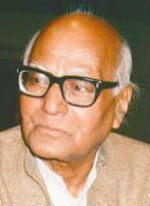
Truly a great man Dr SR Rao.
Tribute to S.R.Rao:The story of discovery of Lothal
One of India’s greatest archaeologists, Dr. S.R.Rao who though from Bangalore, Karnataka, had made Gujarat his karmabhoomi, passed away last week. A team led by him had excavated India’s top Harappan site Lothal, Lord Krishna’s submerged capital town Dwarka, and Hindu mandirs covered by a converted mosque structure at Siddhpur. I’m starting my life-long series ‘discovery of Gujarat’ with this article paying tribute to him.
http://deshgujarat.com/2013/01/07/tribute-to-dr-s-r-raothe-story-of-discovery-of-lothal/
LikeLike
Dear Mr Rajaram,
Excellent article sir. I am studying the taittriya yajurveda in the traditional way along with some of the Angas. I am stunned at the amount of hard science that goes into these subjects. The AIT has had the effect of people teasing me and debasing me for my vedic study saying that i am not in tune with the times, though by profession i am a computer engineer working in a semi conductor firm.
A question to you sir. Western vedic scholarship classifies the Vedas as belonging to different periods. For example even within the taittriya shaka the samhita has been said to be compose before the brahmana and so on. Traditional scholars on the other hand do not accept such chronology. The rig veda has references to the yajur veda and sama veda and so on. Also as per traditional scholarship, the difference in language among the vedas is due to the differences in the purpose for which they are employed. For example the rig is used to call the gods to the sacrifice and praise them. So language tends to be archaic. Like for example when we praise somebody on stage, we tend to use archaic tamil or kannada(i am a tamilian thus taking these 2 languages ). But when doing performing some act, language tends to be direct and short. That is why the language of the yajus is less archaic and poetical than the Rig.
What do you think of this explanation?
LikeLike
Happy Makara Sankranti to everyone!
I am grateful to Sri Ishwar Sharan for taking the trouble to present my articles in more attractive format than what I had done.
I appeal to scholars, especially those with a solid grounding in Vedic scholarship to help us understand some of the implications of these findings–namely the Vedic origins go much deeper than any of us had imagined. When Sanskrit was already making its impact on European and Eurasia languages in the early Holocene (10,000 years ago) how far back do Vedic origins go?
More than chronology, what was the knowledge the Vedic rishis trying to preserve going to such great lengths as creating a language of extraordinary sophistication combining words and sounds with the rules of chanting?
There experience was unique. They had lived through the most extraordinary period of human history. Where our history goes back only about 5000 years, they had a history 10 times as long and in the same place. What were they trying to tell us in their Vedas, especially the Rig Veda?
The proves one thing, Sri Aurobindo was right: the Rig Veda was not the beginning, it was the culmination of a long process. Does this mean that commentators who came later–from Yaska to sages of the Brahmans were as much at a loss understanding the Vedas as we are? How valid are their explanations?
LikeLiked by 1 person