












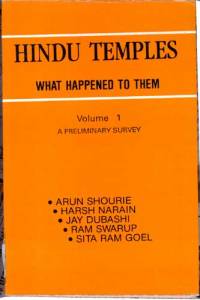
 You might have heard about a book published 21 years back, Hindu Temples, What Happened To Them, available from Voice of India, New Delhi.
Volume 1 was by Arun Shourie, Harsh Narain, Jay Dubhashi, Ram Swarup and Sita Ram Goel.
Volume 2, containing the Islamic evidence, was by Sita Ram Goel.
There was a systematic study of what happened to thousands of Hindu temples across India which don’t exist as they did centuries back. Elaborate evidence was accumulated, studied and presented in these two volumes. Except for Ayodhya, almost all of these cases of temples are not in public memory or media debate today. People have just ‘moved on’ as you hear in intellectual circles.
 But how does the matter come up in political and media circles, even if a tiny — just a few square feet —temple is attached to a structure that is remotely Islamic? Yes, we are talking about the Bhagyalakshmi Temple in Hyderabad, attached to the famous heritage icon, Charminar. The temple is a tiny structure, held very high on the devotion scale by lakhs of local Hindus and happens to be adjacent to Charminar, but not inside its premises.
Encroachment!
Temple did not exist before!
These are the screams you will hear periodically, whenever political heat is turned up in old city Hyderabad. Let’s examine the issue using the details from credible authors and important local politicians about the current episode of Bhagyalakshmi Temple.
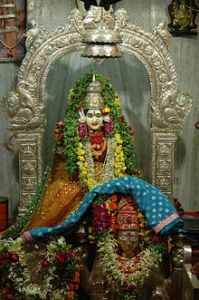 Two key basics of Hindu worship
Firstly, we must understand one basic heritage of Hindu dharma. Hindus regard almost all things as sacred in this world. Bhagawan or Bhagawati exists everywhere. Go to any village in India and you can find numerous statues or images of Devas and Devis under trees, at the village centre, next to houses, inside houses, next to schools, in front of hospitals and clinics, in shops, in vehicles, in parks and pretty much everywhere. All it takes is a stone to form a temple once people develop enough devotion to that structure. Formal temples built using Agama Shastras and Prana Pratishatapana surely help, but you don’t need a formal building for worshiping. In many cases, temples evolve once devotees increase, from the smaller structure before.
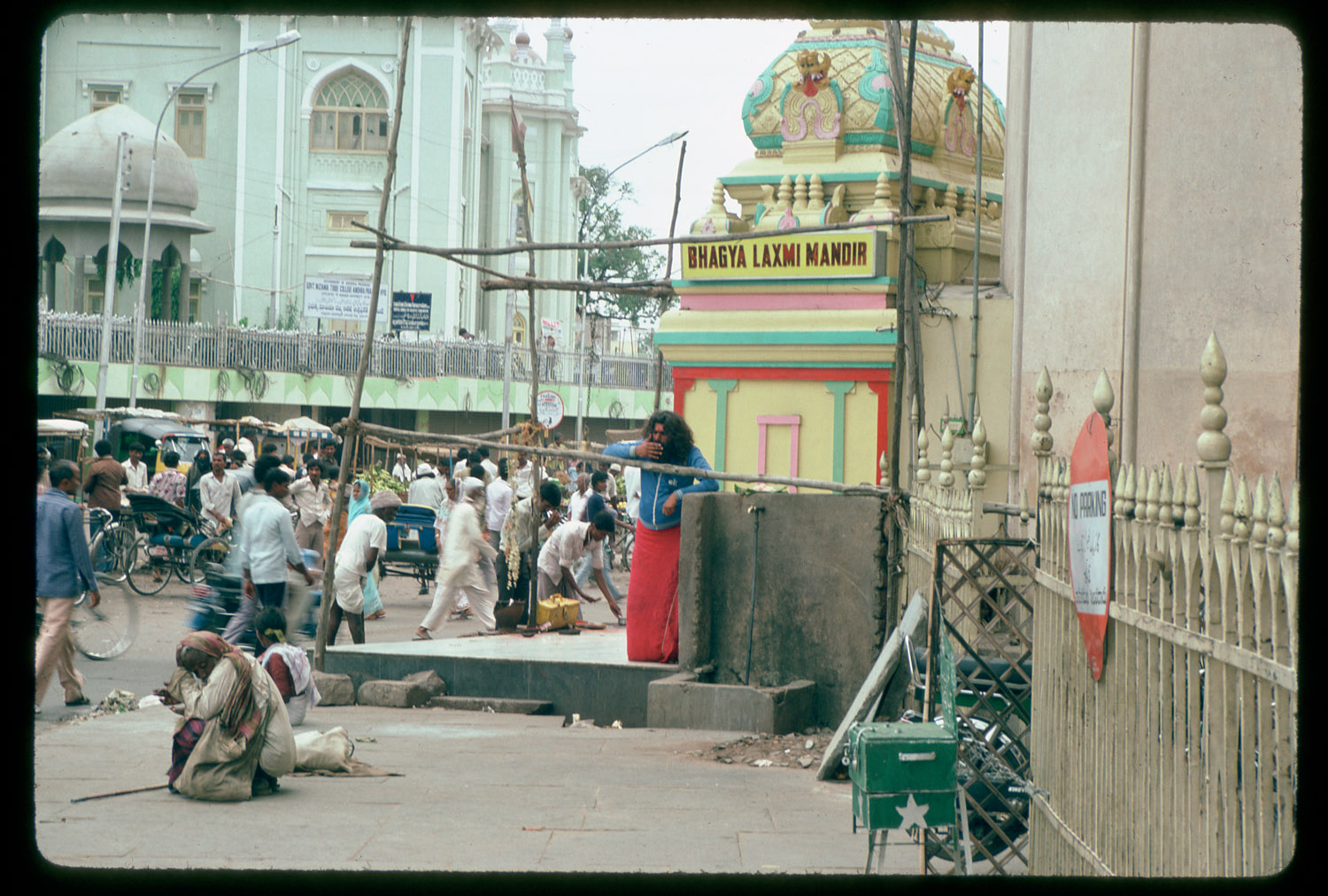 So if anyone says the temple did not exist, they must understand that a temple or structure in the current form might not have existed. But that does not mean people did not regard that spot as sacred.
Secondly, one also needs to understand that Hindu dharma is an ever evolving dharma (loosely translated as religion, but not exactly a religion). You might have worshiped a Devi (goddess) in one name today, but a few generations later she might be worshiped with a more contemporary name. My great-grandfather worshiped ‘Vinayak’ but I worship ‘Ganapati’, for example. So today’s Bhagyalakshmi might have been worshiped with another name before, as Devis have thousands of names literally (refer to Lalita Sahasranama for instance). Bhagyalakshmi may have been worshiped as Maisamma or another name. It is very common in the Telangana area which has Hyderabad in it to have Yellamma, Mahankali and Durgamma as names for Devis. But at the core, Hindu dharma scholars will clearly show you the link of all Devi worship to the one female power of the Almighty.
 Why Now?

So, why this hullabaloo about the Bhagyalakshmi Temple now? Politics! Nothing more, nothing less. One section of Hyderabad politics is against this temple (not just today, but before also), while the other section is fighting for Hindu rights aggressively. Supporting the former section of politicians, some papers produce ‘evidences’. It’s usually the same people who doubt even the narration of the Telangana native Hindu girl Bhagmati [who married Muhammad Quli Qutb Shah in 1589 CE and] became Hyder Mahal Begum after conversion [to Islam in 1605 AD], on whose name Hyder-a-bad city has been setup.
Let’s examine the issue from various angles.
 From Books

Read the current Government of India minister, and former Under-Secretary-General of the United Nations, Shashi Tharoor’s book The Elephant, the Tiger, and the Cell Phone: Reflections on India in the Twenty-first century. On page 42 he describes Bhagyalakshmi Temple at Charminar clearly. The key takeaway from this very learned man’s book is this: “But at the foot of the city’s most famous monument, the four-turreted Charminar, sits a Hindu temple to the goddess Mahalakshmi, the priests chanting their mantras for centuries under the celebrated Islamic minarets.”
The book’s online link is here: http://books.google.co.in/books?id=uqvpZutXN7cC&lpg=PA42&pg=PA42#v=onepage&q&f=false
Read Srikanta Ghosh’s Indian Democracy Derailed: Politics and Politicians, published in 1997. On pages 73-74 he gives some key information. Srikanta Ghosh was with the Law Research Institute of Calcutta.

The book’s online link is here: http://books.google.co.in/books?id=RGyO0E86X1oC&lpg=PA74&pg=PA74#v=onepage&q&f=false
- The Charminar temple was in her — Bhagyavati’s — memory.
- Even now (in 1997 when the book was written), a Harijan woman is the trustee of the temple.
- Bhagyalakshmi temple’s desecration on November 23, 1979, has no parallel. See this clipping from the book, for more details of why the temple was attacked in 1979.

Read Roshen Dalal’s book (page 220) where it is described as to why Goddess Lakshmi is linked to Charminar’s guard. This is more from the local stories: http://books.google.co.in/books?id=DH0vmD8ghdMC&lpg=PA220&pg=PA220#v=onepage&q&f=false
From the local politicians’ claims
Let us present three local politicians, who are supporting the temple.
First, Andhra Pradesh Congress Committee’s General Secretary, G Niranjan, claims the following, as reported by Siasat: http://www.siasat.com/english/news/pcc-leader-disputes-old-pictures-charminar
- Till 1979, it was just a two-three feet idol and after it got damaged after being hit by a RTC bus, the then Chief Minister Marri Chenna Reddy ordered the construction of a temple through the Endowments Department.
- Mir Mahboob Ali Pasha, the 6th Nizam, had sent puja articles to Bhagyalakshmi temple during the Musi floods of 1908. Yes, the Congress leader is mentioning a 104-year-old event involving this small temple.
- Senior citizens with G Niranjan, Dharamchand Tayal (76), Naga Hanumantha Rao (76), Mallesh Goud (69) and Raj Ratnam (63) claimed that they have been performing puja at the temple since their childhood.
- Niranjan said he was now 61-year-old and he has been visiting the temple and also the Chilla abutting the Charminar since he was five. That means puja is being performed by the Congress’s general secretary, who is a local in the area, for 56 years!
Second, Andhra Pradesh’s BJP MLA and party chief, G Kishan Reddy, has confidently tweeted that the State Government endowment records clearly prove the existence of Bhagyalakshmi temple statue for last 200 years. Can anyone deny? http://twitter.com/kishanreddybjp/status/272010439209132033

Third, Raja Singh of Telugu Desam Party. He is associated with the Facebook page Sri Ram Channel which is in the forefront of support for Bhagyalakshmi temple. His Facebook page also has support to the temple: https://www.facebook.com/T.RajaSingh
From the Government Record
The Andhra Pradesh Government’s Endowments Department clearly lists Charminar’s Bhagyalakshmi Temple under the Serial Number 4839 as a legitimate temple bringing revenue to the Government, under the classification 6C. If the temple was ‘illegal’, why would a secular Government extract its income for Government use?
From the culture and heritage of Hyderabad
Beyond the politics, books and Government records, it is very clear that local Hyderabad people have always regarded this small temple as a core part of their cultural and religious heritage. Of course, they want to keep it that way for the future too. We have talked to many local people who recall generations of devotees for this famous temple. If any journalist wants to go further and talk to the local people, leave a comment and we will assist you in interviewing local Hindus who have patronised the Bhagyalakshmi Temple for long time.
 For decades, Sri Bhagyalakshmi Temple at Charminar has been a well sought out place for Hindu men, women and children.
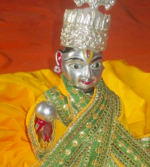
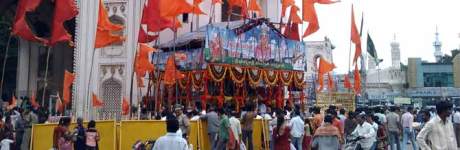
The small temple is decorated using temporary extension during Dussehra and Deepawali festivals for a few days each year (see photo above). After the festivals, the extended decorations are removed. Note that all decorations are temporary, and is on the street side, with absolutely nothing going inside the historic Charminar. There are thousands of such temporary decorations across India, during various religious festivals and this one is not anything out of the ordinary.
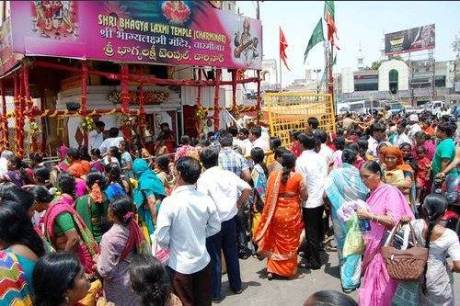
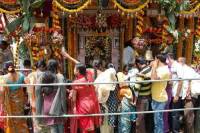
During other festivals too this temple is crowded. Men, women and children assemble in the narrow space to ring the temple bells, offer flowers, coconuts and offer puja to Goddess Lakshmi, and move on quickly. This picture is from Ugadi festival, which is new year’s day for Andhra Pradesh Hindus.
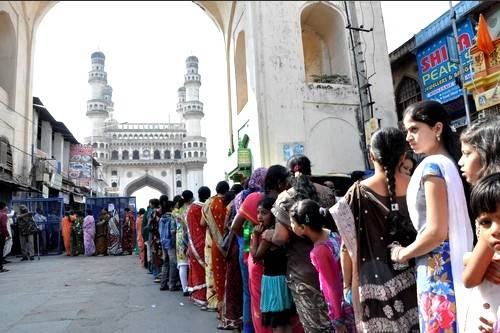
During major festivals like Deepawali, the queues of devotees are very long, with thousands of men and women waiting in separate lines around Charminar. This queue is from the 2012 Deepawali.
 The latest dispute
For decades, every Dussera and Deepawali sees the extra decoration of the temple and murti. Celebrations are going on mostly without any objection from any political party, police or the courts. The Police Commissioner’s office should have the details of decades of celebrations submitted by the temple’s patrons. The latest temple structure was constructed by the Government of Andhra Pradesh in the 1970s, most likely a reconstruction as the original statue was damaged by a Government bus ramming into it. With the temple clearly listed in the Endowments Department records available online, with its donations from devotees used by the Government for decades, there is no question of any legal issue with this temple.
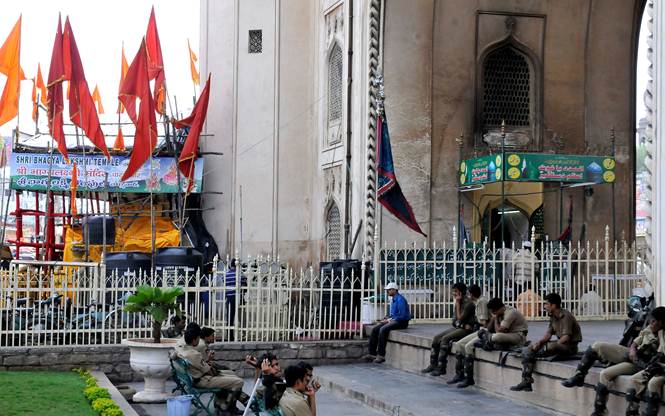
 The main objection of the temple’s opponents is that it may be damaging the heritage site Charminar. This ‘protect Charminar monument’ argument seems lame, political and most likely communal. Because, even though the temple is clearly outside the Charminar, with all decorations and gatherings happening on the street side, there is a ‘chilla’, or Muslim religious site, inside the Charminar complex. You can see in the picture below the details. The temple’s flags are on the left, while the chilla is on the right with a green banner, inside the Charminar complex. If you watch carefully, you can see that the Chilla is damaging the Charminar with black marks due to incense smoke. If someone truly wanted to ‘protect’ the heritage monument, they would have also spoken strongly against a Muslim religious site inside the more-than-400-year-old Charminar with black stains right over that site.
The irony is that, the same people who went to court against the temple’s temporary decoration in 2012 wanted to march in thousands to the chilla inside the Charminar to offer ‘salaam’. The police prevented such massive crowds from gathering and arson and violence broke out, resulting in the arrest of many local politicians.
 What should be done?
The important thing to note is that peace is essential. Bhagyalakshmi Temple should be left as is. It has existed for a long time, it has been a sacred Hindu site in independent India, it is a legal temple registered by the State Government’s Endowments Department, generating revenue for the Government, and it is a sign of the cultural/religious diversity of Hyderabad.
The other key thing is that the temporary temple decorations happen for a few days, during major festivals, and are completely on the street side. They would in no way affect the heritage site of Charminar physically. – Niti Central, 26 November 2012
» Kiran Kumar S. can be contacted at kiran.kumar.s@niticentral.com
» Picture credits: Sri Ram Facebook Channel, Newswala, Umasudhir at WordPress.
Reference
- Extract from Hindu Temples: What Happened To Them, Vol. 1, Chapter 10 concerning Hyderabad and Hyderabad District:
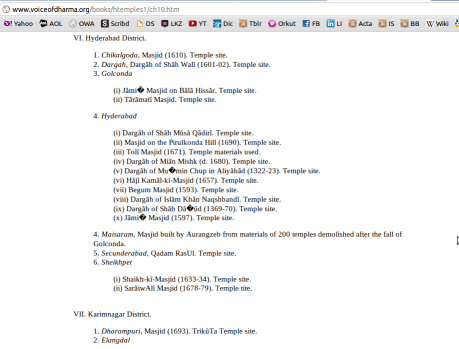
Related Links
Filed under: india | Tagged: agama, archaeological survey of india, ASI, beliefs of hinduism, bhagyalakshi temple, charminar, communalism, devatas, devi, festivals, goddess, harsh narain, hindu, hindu temples, hindu worship, hinduism, hindus, history, human rights, hyderabad, iconography, india, indian history, indian politics, islam, islam in india, muslims in india, mythology, politics, psychological warfare, religion, rituals, sita ram goel, temple demolition |







 BHARATA BHARATI
I just fail to understand what Kanchan is trying to prove by raising this nonsense of copyright. I do not think after giving due credit to the author and the website there remains anything as to copyright or other matters. The point is dissemination of messages that will awake Hindus vis-a-vis the character of Islam and Christianity. Kanchan’s attitude reminds me that of SRG whose writings have no copyright.
LikeLike
Namaskaram Kanchan, not sure what the problem is. The editor has given credit. I found the article extremely moving and interesting and would not ordinarily have read it, if Bharata Bharati had not published it. The defence of Hinduism and Hindus is complicated enough without this sort of stuff about copyright, especially when it seems as if there has been no violation.
Bharata Bharati is daily reading for many of us Hindus because of the variety of articles it has provided. Do have a look at the list right here on the page.
LikeLike
Yes, the temple is older than Charminar.
I remember Sita Ramji telling me that the site originally had a Vishnu temple on it which Sultan Muhammad Quli Qutb Shah, the builder of Charminar, used to visit and pray in.
At the end of a plague epidemic in the area, the Sultan had the Vishnu temple removed and Charminar built in its place — as a thanksgiving for Lord Vishnu answering his prayers!
Sita Ramji told me this story to illustrate the perverted mind-set of a Muslim ruler towards Hindus and a Hindu deity even after he had been blessed by both.
However Hindus do not forget their holy places so easily and as there remained some of the old temple’s foundation protruding at the corner of the Charminar building, Hindus continued to worship by anointing the stone with kumkum and tumeric.
When Christians destroy temples, they were usually careful to clean up after themselves and not leave any tell-tale evidence behind. But Muslims are quite proud of their temple-breaking activities and there is always hard evidence of the original Hindu temple some place in the new Muslim building (as in the mosques at Ayodhya and Varanasi).
Charminar is a protected monument under the authority of the ASI. They can easily ascertain whether there is an old Hindu temple under the mosque or not.
But they will not do it of course. The ASI is as corrupt and politicised a department as every other “independent” department of the Indian Government.
LikeLike
Temple older than Charminar – TOI – 23 November 2012
HYDERABAD: Trouble in the Old City of Hyderabad is all set to intensify with Hindu groups insisting – in what is a new assertion – that a temple existed at the site of the Charminar years before the monument came up. A modern day temple dedicated to Goddess Bhagyalakshmi may have come up in the 1980s but a stone idol was worshipped at the spot where the temple now abuts the Charminar for centuries , they claimed. “A temple existed even before Charminar was built and although the present structure came up later, we are committed to the protection of the temple at any cost,” Bhagwant Rao, head of the Bhagyalakshmi Temple Protection Samithi told TOI on Thursday. Hindu leaders say they have merely erected a bamboo structure and a tarpaulin canopy to give shelter to devotees from heat and cold, and it will stay that way.
The local Muslims, mainly led by the Majlis-e-Ittehadul Muslimeen (MIM) Party have vehemently protested near the Charminar against this expansion of the Bhagyalakshmi temple, saying it was illegal and could damage the historic monument and needs to be pulled down.
“If the authorities do not step in and stop mischief mongers, we will simply have to use self-defence,” Rao said.
Political analysts and security experts apprehend that the area could see communal flare-ups increasing and possible clashes, if authorities do not step in and force the religious leaders to tone down. The police however perceive that the tension will only continue till December 6, anniversary of Babri Masjid demolition .
In anticipation of trouble, the police are forcibly shutting down shops early in the evening and have intensified patrolling in the area. Raja Singh, TDP corporator often at the forefront of communal trouble has now initiated a Facebook campaign in favour of Bhagyalakshmi temple, describing it as an “international issue” . “The Hindus of today are much more prepared and in spite of being outnumbered by Muslims in the area, they will fight to the end to save the temple,” Singh said.
Analysts say religious flare-ups over the Bhagyalakshmi temple at Charminar might play a major role leading up to the next assembly elections in 2014 as both Hindutva inclined formations and MIM could try to fan religious sentiments to woo voters. “The temple has been there, whether for three decades or four centuries , but there was no confilict over it. Why has the matter been raked up now? The answer is obvious, ” said Ashok Kumar (name changed), a resident of the locality.
LikeLike
The article has been credited to the author Kirin Kumar S. in the title itself and to Niti Central at the end of the article with a link to the Niti Central website. The article is also linked to the Niti Central website in at least two other places through the images.
As this is a repost with due credit given to both author and publisher, Niti Central, there is no violation of copyright. Copies of the reposted article were sent to the author and Niti Central by email this morning — which is how you came to know of it.
An Internet search will reveal that the article has been posted on other blog sites before it was reposted here.
Your own articles have been reposted on this website for the past three years without protest from you.
Niti Cental is linked to this website by RSS in the left sidebar. Does that constitute an infringement of copyright too?
It is simply not possible to get permission to repost articles due to the time factor and the fact that most editors and publishers do not respond to requests.
Your demand, the first this editor has ever received, is surprising and not in keeping with the accepted ethos of the Internet today especially as due credit has been given to both author and publisher. Most Internet publications are happy to have their articles reposted on this website as it brings them more traffic.
LikeLike
Reproducing this article which originally appeared on niticentral.com without permission or credit is a gross violation of copyright. Please have it removed from your blog/site immediately and confirm compliance via e-mail. Kanchan Gupta. Editorial Director, NiTi Digital.
LikeLike
The continued existence of the Bhagyalakshmi Temple is the clearest evidence of the devotion of the aam admi Hindu to their Dharmic tradition. The ongoing willingness of the Hindus to fight for their temples is inspiring.
LikeLike