








Tamil Nadu’s Dravidian political movement has, since its inception, treated Sanskrit not as an ancient linguistic treasure but as a political adversary. The resistance against it is not rooted in linguistic logic but in a broader ideological opposition to anything perceived as connected to Hindu traditions, North India, or a Brahminical connection. – Mrityunjay Sharma
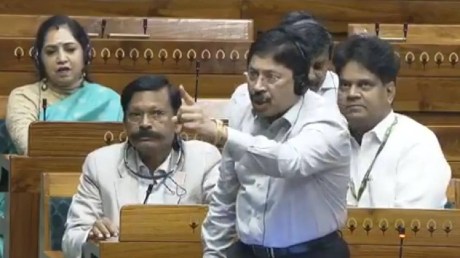
It was yet another predictable day in Indian politics last week when DMK MP Dayanidhi Maran raised an objection in the Lok Sabha over the inclusion of Sanskrit in simultaneous interpretation services. The move, in line with the Dravidian party’s long-standing ideological opposition, sparked an exchange that ultimately prompted Speaker Om Birla to ask the most fundamental question: What’s your problem with Sanskrit? It wasn’t just a retort. It was a moment of clarity that underscored the absurdity of a debate that has festered for decades.
Tamil Nadu’s Dravidian political movement has, since its inception, treated Sanskrit not as an ancient linguistic treasure but as a political adversary. The resistance against it is not rooted in linguistic logic but in a broader ideological opposition to anything perceived as connected to Hindu traditions, North India, or a Brahminical connection.
The DMK’s opposition to Sanskrit is neither new nor unexpected. It is a legacy of the Dravidian movement led by Periyar E.V. Ramasamy, which framed its struggle as one against Brahmin dominance, Hindu traditions, and what it called North Indian cultural hegemony. Over time, however, what started as a movement for social justice morphed into an active project of cultural erasure, where rejecting Sanskrit became a necessary ritual. The anti-Hindi agitations of the 1960s were a defining moment in this ideological battle.
When the Congress government attempted to introduce Hindi as the sole official language, Tamil Nadu erupted in protests. The DMK led the charge, framing Hindi as a symbol of North Indian political dominance. But the fight didn’t stop at Hindi; Sanskrit, a classical language with deep historical and spiritual significance, became another target. The argument was simple: Sanskrit, being the language of Hindu scriptures and used historically in religious and academic discourse, had to be opposed. In the process, a rich linguistic and intellectual tradition was vilified.
Maran’s argument that Sanskrit is spoken by only 73,000 people, as per the 2011 Census, is a classic case of selective data usage. If the number of speakers is the sole criterion for a language’s importance, DMK should have opposed the inclusion of other languages with limited speakers like Manipuri or Dogri as well. But it won’t: the problem is not with a language being underused; the problem is with Sanskrit itself.
Sanskrit is not just a spoken language; it is the bedrock of India’s literary, philosophical, and scientific traditions. Its influence is embedded in modern Indian languages, including Tamil, which, despite Dravidian claims of linguistic purity, has a significant number of Sanskrit-derived words. More importantly, Sanskrit is not a relic; it is actively taught and studied across the country, and its role in India’s intellectual history is undeniable.
The hostility towards Sanskrit is part of a broader anti-Hindu sentiment that has become a defining feature of Dravidian politics. DMK leaders have not hesitated to extend their rhetoric beyond language. Udhayanidhi Stalin recently equated Sanatan Dharma with diseases like dengue and malaria, calling for its eradication. Karnataka minister Priyank Kharge referred to Sanatan Dharma as inhuman and regressive. These are not isolated statements but a reflection of an entrenched ideology that views Hindu traditions as something to be dismantled rather than celebrated.
The opposition to Sanskrit, therefore, is not a linguistic issue but a cultural one. It is part of a sustained attempt to redefine India’s civilisational heritage by excluding elements that do not fit a narrow regionalist narrative. By attacking Sanskrit, Dravidian parties are not just rejecting a language but dismissing centuries of shared intellectual and cultural history.
If India is to truly embrace its pluralism, it must reject such divisive politics. The inclusion of Sanskrit in parliamentary interpretation is not an imposition but a recognition of its historical and constitutional place in India’s linguistic landscape. There is room for Tamil, Hindi, Sanskrit, and every other Indian language. True cultural diversity is about inclusion, not selective exclusion.
So, what’s the problem with Sanskrit? The answer is simple: there isn’t one. Unless, of course, the real agenda is not about language, but about erasing anything that challenges a carefully constructed political narrative. And that is a far greater threat to India’s diversity than any language could ever be. – News18, 17 February 2025
› Mrityunjay Sharma is a BJP leader and author of ‘Broken Promises: Caste, Crime and Politics in Bihar’.

Filed under: india, tamil nadu | Tagged: dravidian parties, dravidian race theory, sanskrit language, Sanskrit-derived words, tamil language | Comments Off on The DMK’s problem with Sanskrit – Mrityunjay Sharma



 BHARATA BHARATI