











 “Millennia before European thinkers translated their facts on the ground into a theory of balance of power, the Arthashastra set out an analogous, if more elaborate, system termed the ‘circle of states.’ Whatever professions of amity he might make, any ruler whose power grew significantly would eventually find that it was in his interest to subvert his neighbor’s realm. This was an inherent dynamic of self-preservation to which morality was irrelevant.” – Dr Henry Kissinger
 World order in Hindu cosmology was governed by immutable cycles of an almost inconceivably vast scale — millions of years long. Kingdoms would fall, and the universe would be destroyed, but it would be re-created, and new kingdoms would rise again. The true nature of human experience was known only to those who endured and transcended these temporal upheavals.
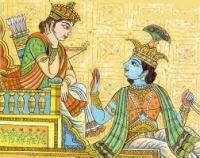
The Hindu classic the Bhagavad Gita framed these spirited tests in terms of the relationship between morality and power. Arjuna, “overwhelmed by sorrow” on the eve of battle at the horrors he is about to unleash, wonders what can justify the terrible consequences of war. This is the wrong question, Krishna rejoins. Because life is eternal and cyclical and the essence of the universe is indestructible. Redemption will come through the fulfillment of a preassigned duty, paired with a recognition that its outward manifestations are illusory because “the impermanent has no reality; reality lies in the eternal.” Arjuna, a warrior, has been presented with a war he did not seek. He should accept the circumstances with equanimity and fulfill his role with honor, and must strive to kill and prevail and “should not grieve.”
While Lord Krishna’s appeal to duty prevails and Arjuna professes himself freed from doubt, the cataclysms of the war — described in detail in the rest of the epic — add resonance to his earlier qualms. This central work of Hindu thought embodied both an exhortation to war and the importance not so much of avoiding but of transcending it. Morality was not rejected, but in any given situation the immediate considerations were dominant, while eternity provided a curative perspective. What some readers lauded as a call to fearlessness in battle, Gandhi would praise as his “spiritual dictionary.”
Against the background of the eternal verities of a religion preaching the elusiveness of any single earthly endeavor, the temporal ruler was in fact afforded a wide berth for practical necessities. The pioneering exemplar of this school was the 4th century BC minister Kautilya, credited with engineering the rise of India’s Maurya Dynasty, which expelled Alexander the Great’s successors from northern India and unified the subcontinent for the first time under a single rule.
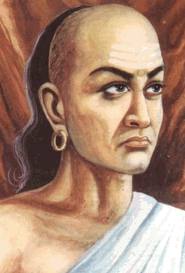 Kautilya wrote about an India comparable in structure to Europe before the Peace of Westphalia. He describes a collection of states potentially in permanent conflict with each other. Like Machiavelli’s, his is an analysis of the world as he found it; it offers a practical, not a normative, guide to action. And its moral basis is identical with that of Richelieu, who lived nearly two thousand years later: the state is a fragile organization, and the statesman does not have the moral right to risk its survival on ethical restraint.
The Arthashastra sets out, with dispassionate clarity, a vision of how to establish and guard a state while neutralizing, subverting, and (when opportune conditions have been established) conquering its neighbors. The Arthashastra encompasses a world of practical statecraft, not philosophical disputation. For Kautilya, power was the dominant reality. It was multidimensional, and its factors were interdependent. All elements in a given situation were relevant, calculable, and amenable to manipulation toward a leader’s strategic aims. Geography, finance, military strength, diplomacy, espionage, law, agriculture, cultural traditions, morale and popular opinion, rumors and legends, and men’s vices and weaknesses needed to be shaped as a unit by a wise king to strengthen and expand his realm — much as a modern orchestra conductor shapes the instruments in his charge into a coherent tune. It was a combination of Machiavelli and Clausewitz.
Millennia before European thinkers translated their facts on the ground into a theory of balance of power, the Arthashastra set out an analogous, if more elaborate, system termed the “circle of states.” Whatever professions of amity he might make, any ruler whose power grew significantly would eventually find that it was in his interest to subvert his neighbor’s realm. This was an inherent dynamic of self-preservation to which morality was irrelevant.
What our time has labeled covert intelligence operations were described in the Arthashastra as an important tool. Operating in “all states of the circle” (friends and adversaries alike) and drawn from the ranks of “holy ascetics, wandering monks, cart-drivers, wandering minstrels, jugglers, tramps, [and] fortune-tellers,” these agents would spread rumors to foment discord within and between other states, subvert enemy armies, and “destroy” the King’s opponents at opportune moments.
 The Arthashastra advised that restrained and humanitarian conduct was under most circumstances strategically useful: a king who abused his subjects would forfeit their support and would be vulnerable to rebellion or invasion; a conqueror who needlessly violated a subdued people’s customs or moral sensibilities risked catalyzing resistance.
The Arthashastra’s exhaustive and matter-of-fact catalogue of the imperatives of success led the distinguished 20th-century political theorist Max Weber to conclude that the Arthashastra exemplified “truly radical ‘Machiavellianism‘ … compared to it, Machiavelli’s The Prince is harmless.” Unlike Machiavelli, Kautilya exhibits no nostalgia for the virtues of a better age.
Whether following the Arthashastra’s prescriptions or not, India reached its high-water mark of territorial extent in the third century BC, when its revered Emperor Asoka governed a territory comprising all of today’s India, Bangladesh, Pakistan, and part of Afghanistan and Iran. – The Times of India, 21 November 2014
» Excerpted from Henry Kissinger’s book, recently published by Penguin India, called World Order: Reflections on the Character of Nations and the Course of History.
Filed under: india | Tagged: arjuna, arthashastra, bhagavad gita, bhagavad gita, chanakya, civilization, henry kissinger, hindu, indian politics, realpolitik, sri krishna | Leave a comment »