










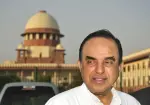


 “The recent scare story about unauthorized movement of an army unit to Delhi was a non-event that was blown up to make it look like a coup against the government. It is part of the continuing effort to discredit the army chief for his tough stand against corruption. Sonia Gandhi confidante Brajesh Mishra seems to be a key figure in this campaign against the Army and its chief .” – Dr Navaratna S. Rajaram
 A strange thing happened on the way to a supposed coup attempt that apparently ‘spooked’ Raisina Hill (where the PM lives) in January. It just melted until it reappeared suitably sensationalized ten weeks later, not in the streets of Delhi but the front page of The Indian Express. Needless to say the financially struggling Express sold many more copies than it normally does on that day. This was followed by its editor-in-chief Shekhar Gupta being a prime exhibit on the news channels helping his paper boost its sagging sales, at least temporarily.
The story was absurd to begin with. Delhi has one of the largest military cantonments in the world in which more than 30,000 troops are stationed, while the units moving into Delhi numbered a total of some 400 soldiers—hardly a major threat. Such movements, which are routine exercises, are needed to test the preparedness and speed of response of security forces. For example, can security forces respond rapidly enough in the event of a terrorist attack in the capital? When there was a terrorist attack on the Indian Parliament a few years ago, the security forces were ready to respond thanks to which lives of the MPs and the Vice President were saved though several security guards including a brave woman laid down their lives. This was possible only because of mobility drills like the one that spooked The Indian Express.
Even more absurd, the website Rediff.com had carried a detailed and factual account of this army drill on 13 March 2012 in which it was reported said Army had discovered some deficiencies in its logistical preparations and deployment [read full report here]. The drill was intended to correct them. The Express reporters including its editor-in-chief Shekhar Gupta had trumpeted their story using the whole front page without doing their homework. Gupta didn’t actually spell out the word “coup” but carried enough insinuations as to leave the reader in no doubt about it.
Even if it was meant as a warning it was nearly three months too late; the exercise was over in January while the sensational story appeared only in April. Had there really been a coup in January, the reporters who wrote the story, including the “spooked” Shekhar Gupta would have been shot by the new rulers! In short it was a hatchet job pure and simple on the army and its chief. The Express story will go down in journalism textbooks as a classic case of “plant journalism”.
 Sensationalism
For a long time The Indian Express used to be controlled by the late Ramnath Goenka whose name has become a by-name for fierce independence. Several important journalistic awards like the Excellence in Journalism Awards are named after him. It has had a distinguished roster of journalists and writers like Arun Shourie, S. Gurumurthy and others writing for it. The present chief editor Shekhar Gupta is neither in their independent mould nor does he have the character to rise above partisanship and petty politics. In short, he is easily manipulated by the powers that be. This is what R. Kashyap who has observed the Indian media for a long time noted:
“Printing almost 11 weeks after the alleged episode, Gupta should have asked himself – and his sources—that if the danger of a coup indeed existed at the time, why had Government not asked the General to resign after it was aborted? Alternately, why had it not either relieved him from the charge by asking the next man to take over, or why had it not just sacked him?”
Why indeed? Mr. Kashyap provided the following explanation: “Gupta and his colleagues were probably too beholden to their source(s) to say no—and delivered a command performance. Its success depended upon the readers of his newspaper falling for the fable. But the Indian people have always had the uncanny knack of skirting propaganda and arriving at the truth by their own means. So it was the Great Editor who made a fool of himself, for he could not fool the people.”
In other words Gupta and his paper were acting as conduits for planting propaganda as “news” at the bidding of some political masters. In other words, the “command” to plant the story came from someone so high that they dared not refuse. Willingly or unwittingly, Shekhar Gupta and his colleagues at the Express have brought to light two evils that plague journalism today—sensationalism and “planted news”. In the words of Mr. Kashyap:
“Sensationalism is currently the bedrock of Indian journalism. In keeping with the decline in every aspect of our private and public life, our media has also deteriorated. But even by the known standards of our degradation, the full page story on the front page of The Indian Express (2 April 2012), bearing the byline of the editor in chief himself, strikes a new low. Never in living memory has a single story grabbed the entire front page of a newspaper; a major event like the Bangladesh war might have dominated page one, but there would be other supporting stories on the same issue.”
 Puppet and the puppeteer
To their credit both the Prime Minister and the Defence Minister denounced it calling the fabricated story the work of anti-national interests and the story soon began to unravel as Shekhar Gupta ran for cover. He will have to live the rest of his life carrying the label of an agent of anti-national interests trying to create a divide between the armed forces and the government. But Gupta was just a puppet, the million (or billion) dollar question is—who was the puppeteer?
It will probably be some weeks, possibly months before the whole story unravels, but there are some straws in the wind. Soon after the coup to plant a coup in the news unraveled, an eighty-four year old fossil called Brajesh Mishra came out of the woodwork and denounced the army chief General V. K. Singh as the “worst army chief in India’s history.” Why, when Gen. Singh has never lost a battle, and has a distinguished record in fighting insurgencies and terrorists? To go with it, he has drawn public attention to corruption in military procurements. And that is his problem—for he stands in the way of people interested in what in a previous column I called the “Bofors Paradigm”. It is a paradigm that looks at the military as a source of procurement rather than as a force to defend the nation. (It was introduced by a family that escaped to Italy during the Bangladesh War.)
 And who is this Brajesh Mishra who called V. K. Singh the “worst army chief in history” and demanded that he be sent on forced leave? Is he a military expert? Hardly, he was the National Security Advisor in the NDA Government where he had a most undistinguished record. Mr. Kashyap makes the following interesting observation: “If the intent was to ensure the immediate sack of Gen Singh—to augment a previous demand by the NDA’s national security adviser Brajesh Mishra who inexplicably received a Padma Vibhushan from the UPA, allegedly for reasons of proximity to its reigning monarch—Gupta should have paused before leaping without looking.”
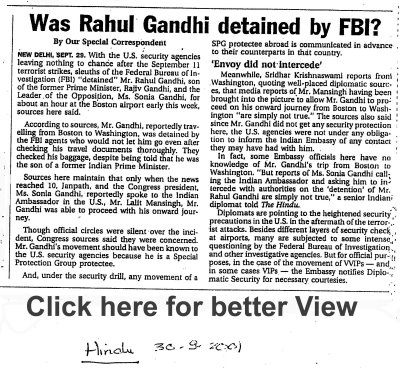
So here is the clue—Brajesh Mishra is close to the dynasty though he served in the NDA. It may be noted that his daughter Jyotsna is married to an Italian and lives in Italy. But more significantly, as Prime Minister Vajpayee’s secretary during the NDA regime, Mishra rescued Rahul Gandhi when he was detained in the Boston Logan Airport by the U.S. Drug Enforcement Authority (or the FBI) for carrying a huge amount of unaccounted cash—more than $200,000—in his briefcase. (U.S. law limits the cash that can be carried to $10,000.) This was reported in The Hindu on September 30, 2001. [The news item with reference to cash amount has been deleted from the Times of India website and edited out of The Hindu report – Editor.]
So that was what earned a Padma Vibhusan for Brajesh Mishra. Padma Vibhushan is a very high civilian award. As a basis for comparison here are two awardees—Field Marshal Manekshaw and nuclear physicist Dr. Raja Ramanna. They are now joined by one Brajesh Mishra. (It is fortunate they are not here to witness it.) It is not just in journalism that standards have deteriorated. Look at who was the President that gave the award to Brajesh Mishra.
 A real coup that failed
While Shekhar Gupta and some politicians have raised a hue and cry over this non-existent coup of their own imagination, it is instructive to recall that the last time there was an attempt to drag the army into politics was during the 1975-77 Emergency. Prime Minister Indira Gandhi asked for the Army’s support in the venture, but the then Army Chief of Staff General Tapishwar Narain Raina bluntly told the Prime Minister that the army would not be used to “further her ends” but obey only those orders of a “legally construed government.” This was considered a crucial moment that kept the Indian Army out of politics at a critical juncture. The real dictator during the Emergency was Sanjay Gandhi who was head of the Youth Congress but held no elective office. Just think of what horrors might have been inflicted on the country had Sanjay Gandhi gotten hold of the army for his murderous activities.
This is not the end of the story, for Sanjay tried once more. Two years later, when the Congress had lost the election, General Raina accompanied by his deputy General S. K. Sinha came to see Indira Gandhi to commiserate with her over her election defeat. Sanjay coolly suggested that the Emergency could be re-imposed with the Army’s cooperation. As he saw it there were enough battalions in the Indian Army to occupy the country using one battalion per district, while the police could be used to control the people. His mother sat with a blank face as Sanjay floated this outlandish suggestion.
 As General Sinha later observed, Sanjay’s calculation was “mathematically correct, militarily unsound and politically immature.” General Raina, a man of imposing presence, his military bearing enhanced by a black eye patch that he often wore as the result of a war injury, ignored Sanjay and addressed Indira Gandhi directly. He told her that history would honor her as one who respected the people’s verdict by voluntarily giving up her office. This means, when called upon to intervene the Army opposed the coup. But history books don’t mention it.
So let us get this thing straight: as one who comes from an army family and enjoys close relations with the armed forces both of India and the U.S., I can say that a military coup in India is no more likely than a military coup in the United States. The idea of the military’s non-involvement in politics is too firmly entrenched in India. If Indians lose their freedom again it will be because of blundering and greedy politicians (and bureaucrats) who have no notion of what it takes to defend the nation but are drawn by the Bofors Paradigm. – Folks Magazine, 9 April 2012
Filed under: india | Tagged: brajesh mishra, coup d'etat, india, indian army, indian politics, media, newspaper, paid news, planted news, politics, psychological warfare, rahul gandhi, shekhar gupta, the indian express | 8 Comments »





 BHARATA BHARATI