














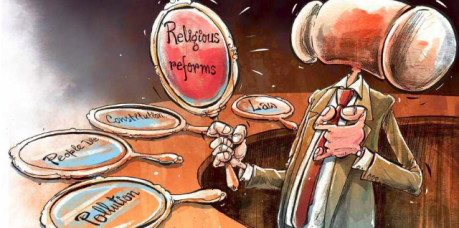
 The judiciary trying to assert its supremacy over religion is a recipe for disaster that can lead to a collapse of the social contract held together by the counter balancing forces of many legal fictions, just as the universe is held in place by the opposing gravitational pulls of millions of planets. – Avay Shukla
A legal fiction is a term coined by sociologists to describe widely held beliefs that may not be capable of being proved; they may even run contrary to natural principles of the universe and nature. The most common and important examples are religion, justice and equality. The first cannot be proved scientifically, the second and third are both against the laws of nature and exist more in the ideal than in the real world. But legal fictions have evolved because they are necessary for a stable and peaceful social order. Precisely for that reason they should not be tinkered with. India’s higher judiciary seems to be missing this point.
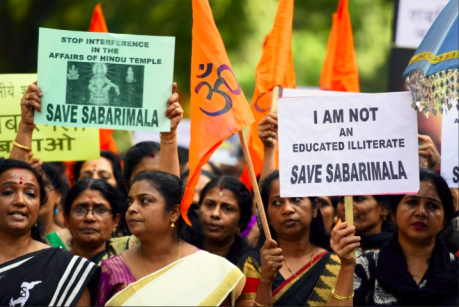
Starting (in recent times) from the Jain santhara case in Rajasthan (in which the Rajasthan High Court held that the voluntary taking of samadhi by a Jain was illegal and amounted to attempt to commit suicide), to the banning of animal sacrifice in temples by the Himachal High Court, jallikattu in Tamil Nadu, triple talaq and finally Sabarimala, our courts appear to have mounted a full scale assault on the dogmas and traditional beliefs and practices of different religions. In some cases they have had to roll back orders in the face of large scale outrage and defiance, sometimes even by state governments and ruling dispensations. But, as the Sabarimala order shows, they are unwilling to learn the appropriate lessons. And the primary lesson is this: do not test one legal fiction by the standards of another, or by the standards of the ideal or logic or science, for then all will fail the test.
If, for example, the concept of justice was subjected to the test of equity, fairness and common sense it too would fail and be found wanting. Not without basis did [George Chapman] declaim that the law is an ass. Therefore, the judiciary trying to assert its supremacy over religion is a recipe for disaster that can lead to a collapse of the social contract held together by the counter balancing forces of many legal fictions, just as the universe is held in place by the opposing gravitational pulls of millions of planets.
As long as a religious practice or tradition does not physically harm a person or deprive them of a basic fundamental right, there should be no reason for a secular state to interfere. Religious reforms have to come from within, not imposed by the courts at the behest of opportunistic political parties or publicity seeking activists. The reforms in Christianity and Hinduism were driven by people like Calvin, Martin Luther, the Buddha, Vivekananda and Raja Ram Mohan Roy, to mention just a few, not by judges acting on PILs. There are no short cuts to religious reform, it is painstaking work to change centuries old mindsets, and the law invariably follows the change, not precede it. As George Burns said:
We should not mix up the legal with the legitimate: for a law or a judicial pronouncement to be legitimate it must be accepted by the majority of people.
So far it has not happened in India.
Even worse than unilateral judicial dictats simpliciter are those which are selective in nature and lack consistency—for example, the Sabarimala and firecrackers judgments of the Supreme Court. Firstly, there cannot be any comparison in the unconstitutionalities involved in the two cases. The first involved only the grievance of a few ladies (none of them, as far as I know, devotees of Lord Ayyappa) that they were not allowed to enter the temple, which is not a fundamental right. The second case involves the health—indeed, life and death—of tens of millions: the report of WHO released on the 29th of October this year says that 100,000 children below the age of five died of air pollution in India in 2016. Eighty people die of the same cause in Delhi every day. And yet, the Supreme Court saw it fit to allow the entry of all women into Sabarimala but did not deem it necessary to completely ban the manufacture, sale and use of firecrackers. I fail to see the logic or consistency of “reform” in these cases.
Secondly, one would expect our jurisprudence would be mature and wise enough to sift the essential from the collateral. Surely, the restriction on entry into a place of worship is more integral to a religion than the bursting of crackers? It doesn’t make sense to apply the same standards of constitutionality to both, but even that was not done in this case—in Sabarimala the full weight of the Constitution was lowered on the temple, while in the firecrackers case the law was relaxed to partially permit the freedom to “practice religion” and “conduct business”! Where is the judicial logic in this? We allow a practice that kills millions (more than sati ever did) but declare illegal something that just inconveniences a few.
These are the pitfalls of the lately discovered concept of “constitutional morality”.
There is no such thing. The Constitution is a legal document, not a moral one, and should be so read: the job of the courts is to interpret law, not morality, for then they intrude into the sphere of faith and widely held beliefs and traditions. The latter is a slippery slope without end, for what else will they question next—the denial of priestly roles to women? Hereditary practice of appointment of priests and ulemas? Lack of reservation in such appointments? Monopoly of higher castes in the religious hierarchies? Will they order the Catholic church to approve abortion? Will they insist on scientific proof of the existence of various gods? Faith cannot be subjected to the rigours of cold, impersonal, sceptical rationality. Sometimes it takes a poet to express this troubling dilemma in suitable words; here are the words of one of the greatest of them: Khalil Gibran:
Faith is an oasis in the heart which will never be reached by the caravan of thinking.
It should not, for then there will be no oasis left. – The New Indian Express, 13 November 2018
» Avay Shukla served in the IAS for 35 years and retired as Additional Chief Secretary of Himachal Pradesh. He is a keen environmentalist and loves the mountains.
Filed under: india | Tagged: law, reason and morality, religious reform, sabarimala temple entry, supreme court of india | 3 Comments »











