









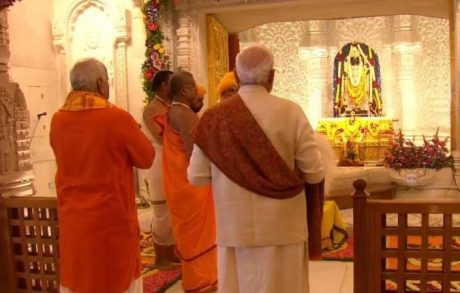
Top functionaries at the Ayodhya Sri Ram Temple, all with an RSS-VHP background, may be nationalists of impeccable integrity. But their incompetence is obvious. They cannot escape moral accountability for the donation theft happening under their very noses. Ram did not suspect Sita’s character. Yet he abandoned her because his subjects did. RSS is expected to follow his example. – Virendra Parekh
The recent revelations about embezzlement of offerings at the Ram Temple in Ayodhya have caused a great shock and deep embarrassment to millions of devotees across the world. They never expected such dishonesty on the part of those who were entrusted with handling the torrent of offerings. And they certainly expected better competence and greater accountability on the part of those in charge of managing this symbol par excellence of Hindu pride, of a ceaseless struggle lasting over five centuries against the Mughals, the British and the secularists. Supervision of the investigation launched by the state government has now been virtually taken over the Supreme Court even as the Shree Ram Janmabhoomi Teerth Kshetra Nyas, which runs the temple, is looking for a CEO who would be a practising Hindu and a Rambhakt.
The Sangh Parivar in general and RSS in particular is in a dharmasankat or dilemma. Should it protect its senior, loyal workers with decades of service or should it protect its reputation? Its delayed, low-key comments give the impression that it has opted for the former and is downplaying the issue. If it is so, it is a Faustian bargain. RSS may pay for it with its reputation. While the sankat is acute, Dharma is obvious. RSS should have been pro-active in seeking resignation of the top functionaries. Top functionaries at Ayodhya, all with an RSS-VHP background, may be nationalists of impeccable integrity. But their incompetence is obvious. They cannot escape moral accountability for the theft happening under their nose. Ram did not suspect Sita’s character. Yet he abandoned her because his subjects did. RSS is expected to follow his example.
These developments have handed over powerful ammunition to the secularist ecosystem, which is playing up the issue with unconcealed glee. Parties and leaders who denied in court affidavits the very existence of Lord Ram, who showered bullets on the karsevaks in Ayodhya, killing hundreds of them and took pride in the act, who strenuously opposed construction of the temple and fought tooth and nail against it in every forum with every means, have suddenly turned conscience keepers of Hinduism, vociferously demanding stern action against the guilty. They are salivating at the prospect of denting BJP’s core support base in the forthcoming elections in several states including UP.
Now similar happenings have been reported about the ancient temple of Badrinath in the Himalayas. Irregularities at Sabarimala temple in Kerala and Tirupati in Andhra Pradesh are being recalled. It is not hard to discern a concerted attempt to discredit some of the most sacred centres of Hinduism and shake people’s faith in them. Especially for the young minds, impatient and impressionable, the fatal transition from misdeeds of a handful of scoundrels in a few sacred places to the loss of faith in the whole tradition would be an easy step. Such cases of fraud are also used as an argument against freeing Hindu temples from government control.
The bull has to be taken by the horns. Hindu leaders, especially those connected with temple management and the current Hindu-friendly government must seek to address four core interrelated issues. The first is sustaining the faith of the devotees with preservation of Dharma. This leads to two related issues. The foremost is complete transparency and accountability in handling the cash and other offerings in the temple. Equally important is the management of properties, movable and immovable, owned by the temple. Another related issue is the infrastructure of travel, lodging and boarding facilities for the pilgrims and system for crowd control and regulation of darshan so as to make a visit to the temple a hassle-free experience. The last but not the least is the utilisation of funds by the temple management.
As to the cash and valuable offerings first. Devising sound procedures to ensure transparency and accountability in handling cash donations is the easy part for professionals. Banks have been doing it routinely for decades. The hard part is their strict and consistent implementation as a routine affair. The SIT findings in the Ayodhya affair have flagged a near-total breakdown of safeguards. The findings suggest that the counting personnel were not frisked either while entering or while leaving the cash-counting hall. The mandatory pocket-less uniform prescribed for the counting staff was never enforced. Employees were allowed to carry personal belongings to the counting room. Instead of maintaining separate accounts for every donation box, cash from hundis was mixed which destroyed the audit trail at the first stage and reduced the possibility of detecting discrepancies. No denomination-wise inventory, vouchers or certification records were prepared during the counting. Some cash bundles were seen on camera being handed over to specific individuals instead of being placed in collection trays or sealed containers. Consequently, there was no verifiable record of how much currency was received, counted or deposited. While CCTV cameras were employed, surveillance was not utilised as a preventive mechanism. Some employees restricted the camera’s field of view by sitting very close to them. In a word, everything went on Ram bharose (trust, faith) and that bharosa was broken with impunity.
The scale and complexity of these tasks increase in direct proportion to the number of footfalls and flow of cash offerings in the temple. For a long time, large temples are run like family fiefdoms. The same lineage of priests that conduct rituals also controls new appointments and succession, often on the basis of heredity. This fusion of religious authority and administrative control provides incentives for resistance to outside agency. Beyond a point, the system becomes vulnerable to malpractices. The hereditary and/or privileged nature of temple staffing sometimes creates problems. Is it a pure accident that six out of the eight arrested suspects in the embezzlement of donations at Ram Temple got the job in cash-counting room on the basis of recommendations of functionaries linked to the Shree Ram Janmabhoomi Teerth Kshetra Nyas?
The time has come to recognise that in addition to the traditional priesthood, two more entities—the government and the faithful followers also have a stake in proper management of large temples. The present government is actively promoting religious tourism by creating spiritual corridors and schemes like Prashad and Swadesh Darshan. This represents a welcome convergence of faith, livelihoods, regional development and tourism. And, needless to say, it is the faith of the faithful that sustains any religious institution or tradition. Those in charge of religious institutions have a sacred obligation to discharge their responsibilities in a manner that strengthens that faith, and do nothing that may undermine it.
The doctrinal, ritual and spiritual activities of the temples must be left with traditional priests. The government ought to enact a law regulating the secular activities related to the temple wherein it may borrow a few ideas from the listed private sector corporations. The law should contain an accounting structure designed to prevent malfeasance including independent observers and mandatory audit. It would be a good idea to encourage the devotees to deposit their offerings electronically directly into the designated bank account. It would vastly reduce both the scope for mischief and the flow of raw cash into the temples. The handling of cash, right from opening the boxes to denomination-wise sorting, counting and depositing in the banks should be monitored both manually as well as electronically. Most importantly, the structure should be so designed as to fix the responsibility for any transgression from top to bottom. The procedures for operating bank accounts should be similar to those in large companies.
The law should also stipulate that temple funds should be utilised only for protection, preservation and promotion of Dharma. These includes lodging, boarding and travel facility for the visitors, upkeep of premises and crowd management systems. It may also include humanitarian aid in the surrounding areas in times of natural calamities and distress. But more importantly, temple money should be used for promotion of study of Sanskrit language, Vedas, Upanishads, epics and other scriptures, preservation of local spiritual traditions, education into proper rituals related to birth, death and marriage and such other activities. Most importantly, the law should forbid use of temple funds for non-dharmic purposes. Prime Minister Modi is widely credited with an ability to convert crisis into opportunity. This may be one.
› Virendra Parekh writes on economics and politics, also on issues related to Indian civilization, history and cultural nationalism.
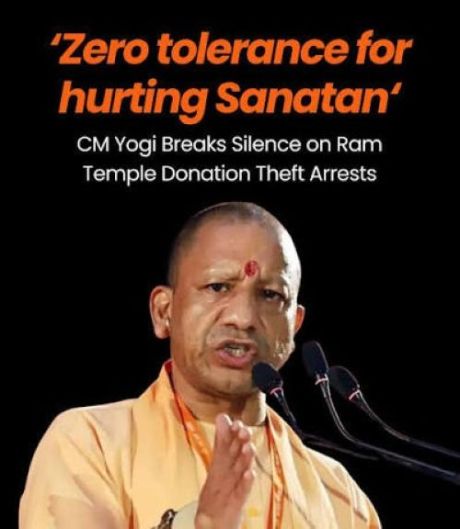
Filed under: india | Tagged: criminal negligence, moral responsibility, ram lalla virajman, ram temple donation theft, special investigation team | Comments Off on Ram Temple Donation Theft: Run rich temples as listed corporations – Virendra Parekh