














 “If we take out the Hindu element from Indian society, history and culture, it will no longer remain Indian. Even the so-called Muslim and British periods in Indian history are narratives of what foreign invaders did to the Hindus and how the Hindus coped with or resisted the invasions. History shows that every part of India where Hindu civilization was eclipsed and Hindus reduced to a minority has eventually seceded from India. Every separatist movement in the last hundred years (Muslim, Christian, Sikh, Dravid, Communist or tribal) has been anti-Hindu in character. In contrast, there is not a single leader, single organisation or single movement that called itself Hindu and yet was secessionist. Hindus cannot secede from India because they constitute India.” – Virendra Parakh
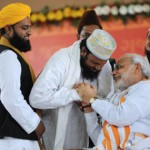 “You seem to be a Congress sympathizer in disguise. You want BJP to project Narendra Modi as its commander-in-chief in the next Lok Sabha election so that its allies and Muslim voters desert it and the ground is cleared for another UPA victory,” commented a friend, who thinks highly of himself as a shrewd political observer, on my article Narendra Modi and the Muslim vote bank on Bharata Bharati, 14 July 2012.
“The sectarian thinking which runs through this article is sad, better avoided,” counselled a reader who went on to ask, “What about a scenario where no religious vote bank exists?”
It is no part of this writer’s job to brighten or dim prospects of any political party or leader. Truth and national interest is the sole criterion he applies to evaluate any action, policy, trend or phenomenon. Even here, there is enough scope for honest differences of opinion and perception, as distinct from motivated posturing.
The charge of sectarian thinking is more serious, as it touches deeper issues of the nature of Indian society, interpretation of Indian history, and the role and direction of the Indian state.
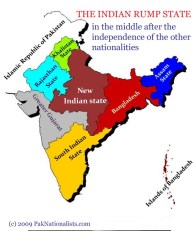 There are two ways of looking at Indian society. The one that dominates the current political discourse regards India as an unwieldy conglomeration of several religions, communities, races, castes, languages and provincial identities, held together by the institutions of a modern state.
This view of India is paraded as modern and secular. But it is neither. It is a legacy of the colonial rulers which has been adopted wholesale by the establishment put in place at the time of independence, which has since perpetuated itself. Implicit in it is the repudiation of India’s age-old cultural unity and civilisational ethos, which has defined its national identity through millennia.
Denying the basic unity of India (now fashionably called the Indian sub-continent), the Britishers taught us that India was a hotchpotch of disparate groups, a geographical expression which they welded together into a single country through the British Indian army, administrative apparatus, English education, railways, post and telegraph etc. Advancing this representation of India as an artificial country held together by force of British arms, Jinnah was encouraged to carve out Pakistan.
The British have long gone, but the wrong lessons they imparted are still intact. We are told that India is a multi-religious, multi-lingual, multi-racial, multi-ethnic (and, I had almost added, multi-national) country striving to evolve some principle of unity out of its bewildering diversity. Votaries of this view – politicians, academicians, opinion makers – look upon Indians as Brahmins, Rajputs, Yadavs, Marathas, Reddys, Nairs, Dalits, tribals, Muslims, Christians et al. From their Olympian heights of secularism, they exhort the laity to overcome caste and communal loyalties and become  Indians first and last. Gandhi sought India’s national unity in Hindu-Muslim brotherhood. Jawaharlal Nehru sought it in (of all things) anti-imperialism. Both failed because their views ran against the torrent of historical truth.
History tells us that India had been a united civilization for thousands of years before the British came. Hindu civilization gaveruvian it its identity and unity. Through gradual assimilation, adoption and Sanskritisation stretching over millennia, Indian culture managed to weave hundreds of strands of diversity of every type into a strong national society.
India has been seen as one country [1] both by Indians and foreigners since time immemorial, and its people have had a common way of life for thousands of years. The sacred spots which the Pandavas visited during their one and only pilgrimage (Vanaparva, Mahabharata) draw millions of devotees in our own days as they did in the distant past, long before the Pandavas appeared on the scene.
The Ramayana, the Puranas and the Dharmashastras describe the same ancient land, every spot of which is sacred due to some cultural memory or the other. The Jain Agamas and the Buddhist Tripitaka speak again and again of sixteen Mahajanapadas which spanned the spread of Bharatavarsha in the life-time of Bhagvan Mahavira and the Buddha. Even Panini’s Ashtadhyayi, a dry compendium on grammar, lists nearly all the Janapadas in ancient India. The epic poetry poured out by Kalidasa, Magha, Bharavi and Sriharsha talks endlessly about Bharatavarsha as a single and indivisible geographical entity, as a karmabhûmi for Gods and Goddesses, Brahmarshis and Rajarshis.
 When Chandragupta Maurya, who had his seat in Patliputra (Patna), forced the Greek general Seleucus Nicator to part with the provinces of Kabul, Kandahar and Herat, he had the satisfaction of liberating his motherland from the foreigners’ yoke. Shankaracharya, born in Kerala, held dialectical disputations in Varanasi, was received as a royal guest in Dwarka and Nepal, and established Maths in Jagannath Puri and Badrinath. Nowhere was he treated as a foreigner. Mughal emperors proudly called themselves Shahenshah-i-Hindostan.
What I wish to show is that Indian history, pertaining to a well-defined geographical region, is not just old. It is a continuous history. The way of life (varnashramadharma), people’s beliefs and practices can be traced to what was taught and practised thousands of years ago. Moreover, this way of life, these beliefs and practices, permeated every class of society and every corner of the country. Ramayana can be gleaned in one folk tradition after another. Images of Shiva of the Veda, of Krishna of Puranas are made by tribals of Bastar to this day. Finally, these common ways of life permeated every aspect of life – art, architecture, music, literature, dance.
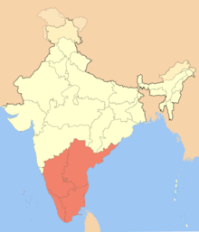 Viewed against this vast backdrop of history, Hindus are not one of several communities inhabiting India. They are the national society, the nucleus around which everything else has to fall in place.
If we take out the Hindu element from Indian society, history and culture, it will no longer remain Indian. Even the so-called Muslim and British periods in Indian history are narratives of what foreign invaders did to the Hindus and how the Hindus coped with or resisted the invasions. History shows that every part of India where Hindu civilization was eclipsed and Hindus reduced to a minority has eventually seceded from India. Every separatist movement in the last hundred years (Muslim, Christian, Sikh, Dravid, Communist or tribal) has been anti-Hindu in character. In contrast, there is not a single leader, single organisation or single movement that called itself Hindu and yet was secessionist. Hindus cannot secede from India because they constitute India. It is they who have imparted Indian-ness to India. No other group can claim this for itself. However you define the word Hindu – a way of life, religion, community, civilization – the above facts will remain unaltered.
Two caveats are in order. Non-Hindus have contributed to the enrichment of Indian civilization. Whatever is rooted in this soil and is not inimical to Hinduism has to be recognized as national. The positive contribution of Muslims and other non-Hindu communities to India’s economy, art, literature and professions is acknowledged ungrudgingly. By the same token, however, ideas and activities directed against Hinduism – mosques standing at the site of demolished temples, conversions carried out by Christian missionaries, separatist movements in certain parts of the country, to name a few – are by definition anti-national.
 Secondly, whatever is Hindu is national, but everything that is Hindu is not necessarily the perfect, best, desirable or worth preserving. The short-sightedness and disunity of Hindu rulers, practices like untouchability and casteist notions of superiority and inferiority and several other infirmities and deformities, though national, must go. History shows that when Hindus started regarding themselves as perfect and stopped learning from others, their downfall began. Hindu society needs thinkers who can reinterpret its eternal heritage in the context of modern times and can provide it a dynamic, forward-looking vision of its tradition. It has produced such thinkers in every age. Its past encourages us to believe that it will successfully meet the challenges of the future.
Hindu intellectuals and leaders, blinded by ‘secularism’, have understood neither the nature of Indian society nor the challenges facing it. The problem of Indian society (and polity) is not diversity. The problem is the presence of elements which not only refuse to assimilate but pursue a single-point agenda of replacing that diversity with monotheistic uniformity.
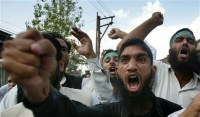 The post-independence period has seen a tendency to negate India’s civilisational ethos and banish Hinduism from public life in the name of secularism and communal amity. Secularism, elevated to the status of India’s official religion, has been distorted into a grand alliance of all anti-Hindu ideologies – Islam, Christianity, Communism and Macaulayism. This has clouded our vision, confused our intellect and sapped our political will. Society has become more fragmented, national ethos has weakened and the state has lost the determination to deal firmly with separatism and terrorism. We are paying the price of self-forgetfulness induced by imbibing false notions floated by foreign rulers.
P.S.: “What about a scenario where no religious vote-bank exists?” I am all for it. There can be no Hindu vote-bank in India just as there can be no ‘Gujarati Association’ in Rajkot or Vadodara. The only religious vote-banks in India could be non-Hindu ones. I would welcome the scenario where no religious vote-bank exists. – Vijayvaani, 4 August 2012
Notes
- Uttaram yad samudrasya himavatascha dakshiñe / Tad varsham bharatam nama bharati yatra santatih (The country to the north of the ocean and to the south of the Himalayas is Bharatavarsh where dwell the descendants of Bharat.)
» Virendra Parekh is the Executive Editor of Corporate India and lives in Mumbai.
Filed under: india | Tagged: british india, christian, civilization, cultural relativism, culture, dismembering india, dravidian, geopolitics, hindu, hindu culture, hindu dharma, hindu nationalism, hinduism, hindustan, hindutva, history, indian politics, literature, multicultural, nation-state, nationalism, nehruism, nehruvian secularism, partition of india, patriotism, politics, psychological warfare, religion, religious vote banks, sanatana dharma, sanskrit literature, sanskritisation, secularism, vote banks | 4 Comments »











