












 “Joshi cites the statement of Nobel Laureate Amartya Sen, during the Infosys Science Prize ceremony in Kolkata, in which he said Indian research was deeply influenced by the knowledge of foreign works on the subject. ‘But there was no specific mention of what India has given to others. There should be an objective view as far as sharing of knowledge is concerned,’ says the veteran BJP leader.” – Navtan Kumar
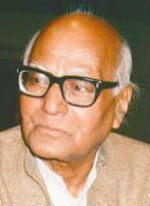
 Senior BJP leader and former Union minister, Dr Murli Manohar Joshi is peeved that all talk of ancient Indian science is being branded as jingoism by a section of the “intellectual” class. He says there is no doubt that India has learnt many things from the West, but wonders why there is no talk about what India has given to others.
Speaking to this correspondent, Joshi says the time has come for a “reappraisal” of the history of science. “This is the responsibility of the academic institutions, authors and thinkers to ponder over this issue. The government can only act as a facilitator, which can encourage people to explore space and time and compare that with rest of the world,” he says.
Joshi cites the statement of Nobel Laureate Amartya Sen, during the Infosys Science Prize ceremony in Kolkata, in which he said Indian research was deeply influenced by the knowledge of foreign works on the subject. “But there was no specific mention of what India has given to others. There should be an objective view as far as sharing of knowledge is concerned,” says the veteran BJP leader.
He says that there is plenty of evidence, mainly documentary, to suggest that India has made significant contribution to science in the past. “And this is not me (talking), but many Western experts and academicians have said this for a long time. Please have a look at their writings in several books.”
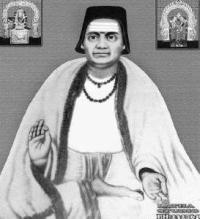 He points out that according to Jean Filliozat, the trigonometric “sine” is not mentioned by Greek astronomers and mathematicians. But it was used in India from the Gupta period onwards: the Surya Siddhanta gives a table of sines, which the Arab astronomers picked up from their Indian contacts and passed them to Europe in 12th century. The only conclusion possible is that the use of sines was an Indian development and not a Greek one, he adds.
John Playfair, in 1789, referred to certain astronomical tables received from the East Indies by European scholars at an early stage in their contact with the East. Some of these tables were received from Siam (Thailand) and their “epoch” corresponded to 21 March 638 AD. But interestingly, the “meridian” of these tables was not Siam but Benares, now Varanasi.
Other tables received from South India had one thing in common. Their epoch coincides with the era of “Kali yuga”, that is, with the beginning of 3102 BC. Playfair finds that the positions of the planets given in these tables is close to the positions calculated with the help of modern integral calculus and the theory of gravitation. So, for him, the inescapable conclusion is that these positions were observed by the Brahmins and it is rather a wonder that the Brahmins could do so rather precisely at so distant a past.
 Similarly, E. J. Urwick has said that Pythagoras accepted the most popular Indian theories of the time. Almost all the religious, philosophical and mathematical doctrines ascribed to him were known in India in the 6th century BC. According to Urwick, the transmigration theory, assumption of five elements, the Pythagorean theory in geometry etc., have their close parallels in ancient India.
Seidenberg, while discussing the origin of geometry, argued that the Babylonians knew the algebraic aspect of this theorem as early as 1700 BCE, but they did not seem to know the geometric aspect. The Shatapatha Brahmana, which precedes the age of Pythagoras, knew both the aspects.
Joshi feels that there should be an “academic debate” on the issue. “I am saying this as a student of science. No political colour should be attached to it,” says Joshi, who did his PhD in Spectroscopy and then taught physics at the Allahabad University.
Asked to comment on the papers presented by some scientists at the Indian Science Congress, suggesting things like aeroplanes existed 7,000 years ago, and thus creating much controversy, he says, “That is not the issue. The issue is whether there was scientific tradition in India or not; whether or not India made original contribution. What were the landmarks in these areas? Sadly, nobody is discussing this. As a result, people are taking extreme positions. Some say it was developed while others say it was under-developed. But there is a need to take an objective view on the issue. While talking about Western contribution, we should also discuss what India has given to others.”
“We have also made ample contribution in science. Talking about India’s contribution should not be taken or misunderstood as ‘jingoism’ or ‘distorted nationalism’. There is always a case to be studied objectively. Rather than condemning the Indian view all the time, we should discuss how others got ideas from us, like how Pythagoras got the Buddhist concept,” he says.
 On the role of the government, he says, “The government should create conditions so that India becomes the ‘principal contributor’ to science once again. For this, there should be a proper vision and encouragement. Science should have no monopoly for the rich or affluent. Rather, it should be used to work for the overall well-being of civilisation.”
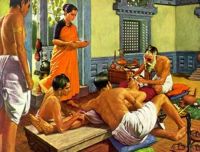
He says, as Minister of Human Resources Development, he started the process. “I tried to discuss ancient Indian science, traditions, context and level of scientific theory. We should talk about these things.” Joshi also defends Prime Minister Narendra Modi’s remark that plastic surgery existed thousands of years ago. “When he said this, he basically highlighted the achievements of Indian science. Sushrut had done it 500-600 BC,” he says. – The Sunday Guardian, 18 January 2015
Filed under: india | Tagged: bhaskaracharya, hindu, hindu civilisation, history, india, indian history, indian mathematics, indian scientists, plastic surgery, sanskrit literature, science, sushruta | 2 Comments »






 BHARATA BHARATI