








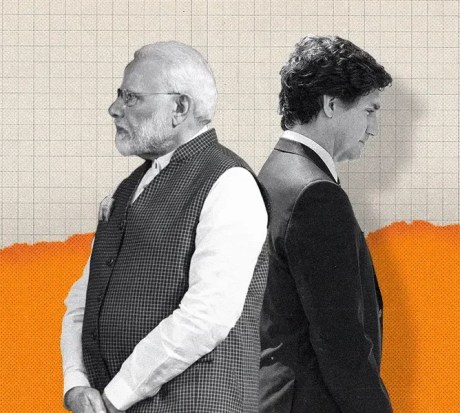
 The Canadian Underground Railroad still exists, but not to carry slaves seeking freedom. Travelling first class are criminals, secessionists, anti-Semitics, Islamic radicals and Sharia seekers, all protected by Justin Trudeau’s government, its judicial system, an incompetent intelligence apparatus and the police. Their targets: India and Israel. – Ravi Shankar
The context of liberty is civilisation. The marker of civilisation is law and order, not the amorality of power politics. Once upon a time, before the Trudeaus—father and son—entered politics, Canada was multicultural, like a falafel stall in Tel Aviv, patronised by a Turkish man with a Hindu wife. It was different from 1880s’ America, where even presidents owned slaves. Canada was free man’s land where the euphemistic Underground Railroad was the route to freedom for slave fugitives and freed Blacks.
The phrase appeared in 1839 in a Washington newspaper that reported a young slave escaping his owners on a train that “went underground all the way to Boston”. The Underground Railroad was a vast network of clandestine routes and safe houses in America that lasted till the mid-19th century operated by free African Americans, liberal sympathisers and abolitionists to reach Canada.
By 1850, around 1,00,000 slaves had escaped to the Land of Maple Syrup. Canada, however, refuses to escape its anti-India legacy. Last week, the Canadian Security Intelligence Service (CSIS) accused India of foreign interference and espionage activities on its soil. The Indian government simply scoffed.
Canada’s NSA Jody Thomas named India as one of “a number of state and non-state proxies” interfering in Canadian politics. At a recent conference at the Canadian Global Affairs Institute, she named Russia and Iran too. CSIS incompetence is legendary; leaks of internal documents indicated China has the most sophisticated election interference network in Canada. David Vigneault, director of CSIS, lost his job after the leaks.
The Canadian Underground Railroad still exists, but not to carry slaves seeking freedom. Travelling first class are criminals, secessionists, anti-Semitics, Islamic radicals and Sharia seekers, all protected by Justin Trudeau’s government, its judicial system, an incompetent intelligence apparatus and the police. Their targets: India and Israel.
In June, the Canadian Parliament observed one minute silence in the memory of Khalistan extremist Hardeep Singh Nijjar, who was gunned down in British Columbia: a cynical cause celebre for Trudeau and a diplomatic travesty for India. Why is Trudeau’s Canada so imbalanced psychologically and diplomatically? Three reasons: DNA, political survival and the PM’s naiveté about complex cultural crises.

His father Pierre was the patriarch of India-negativism. In 1974, when India under Indira Gandhi carried out nuclear tests, Pierre turned his back on India’s nuclear energy programme. Canadian nuclear scientists working on a new reactor in India were asked to pack their bags. The restless ghosts that haunt Indo-Canadian ties are those of 329 dead passengers of Air India Flight 182 that was blown up mid air on its way from Canada to India: the deadliest act of aviation terrorism until 9/11.
Prior warnings by IB about the bombing, and requests by the Indians on June 1, 1985 to act were brushed aside. Later reports revealed that Canadian spies heard about an explosives test in a forest carried out by Babbar Khalsa International boss Talwinder Singh Parmar: the bomb test was dismissed as a gunshot, probably fired by a local hunter.
“There was enough evidence for Pierre Trudeau to have stopped that act of terror. But he did not. Even after the tragedy, they took their own time in tracing the accused and putting them on trial. That shows the lack of purpose on their part—for some local political reasons—to actively pursue terrorists who are anti-India,” says Rajiv Dogra, former Indian ambassador to Italy and Romania.
Hunting is legal in Canada, except hunting terrorists. Trudeau Senior comes across as a racist bigot, if historians are to be believed: he turned down Indira Gandhi’s request to extradite Parmar. His explanation bordered on colonial paranoia: “India was insufficiently deferential to the Queen (of England)—the Queen/King of England is also the constitutional monarch of Canada, but acts entirely on the advice of the Canadian Government.”
What Justin learned at his father’s knee is being applied to Canadian politics. “This anti-India bias seems to have been inherited in the Trudeau family. Justin has carried on from where his father left off. He is motivated by the same factors—number of extremist Sikhs who form a voting block in some constituencies,” says Dogra.
His political survival depends on pandering to minorities such as Muslims and Sikhs because wining margins in Canadian elections are notoriously thin, which makes minority votes crucial. “The Sikh community is not big enough to ever rule the country, but they are good enough to tip the scales. That’s how Trudeau has benefitted hugely.
He understands that if he is to remain in power, it will have to be on the basis of support from the Sikh party. That’s the reason why he has to prove to this votebank that he is their man. If Khalistan is what they are ostensibly looking for, he will support it. Trudeau doesn’t really care whether Indo-Canadian relations prosper and reach new heights. He cares for his domestic support base,” says Bharat Karnad, emeritus professor, Centre for Policy Research, Delhi.
Trudeau is stuck like many British politicians between nationalism and an Islamic immigrant invasion. Way back in 2017, a study found that Canadian attitudes to government policy mirror variable underlying values in every region of Canada. Many white Québeckers joined Muslim rights activists to publicly protest Bill 21, a law that bans wearing the hijab at work; while other residents in other provinces supported the restrictions.
In a poll held last year, the largest segment of Quebec’s population (30 per cent) have “Very Negative” views toward Islam: twice that of in the rest of Canada (16 per cent). This percentage of “Very Negative” segment in Quebec is similar across the rest of Canada with one important exception: negativity towards Jews and, surprise, surprise, Christians, compared to elsewhere in the country.
Being Hindu in Canada could be dangerous to health in some circumstances. The US-based secessionist group, Sikhs for Justice (SFJ), released a video that asked “Indo-Hindus” to “leave Canada; go to India” last year. The Indian government recently declared SFJ as an “unlawful association”. Since 2021, threats and attacks by Khalistanis and Islamists are part of Hindu temple life in Canada. Temples have been vandalised, broken into and their walls defaced with anti-India slogans. Statues of Mahatma Gandhi are vandalised.
The unkindest cut came from Environment Canada, the nation’s environment department, which classified Diwali as a “cause for air pollution”, while Canada Day or New Year’s Eve see similar fireworks. The Canadian police is one of the most biased forces in the Western world: when a 21-year-old Indian university student was kidnapped, stripped naked, kicked in the face in 2022, and told “you don’t belong here”, the cops denied it was a race crime.
In July, at Khalsa Day festivities in Toronto, Trudeau smiled as separatists raised pro-Khalistan slogans. South Block has advised Indians in Canada to “exercise extreme caution and remain vigilant”, pointing at a “deteriorating security environment”, which could put the tens of thousands of Indian students at risk. Canada has been a favourite destination for Indian students and job seekers, because it had a reputation for being more tolerant and less racist than other white countries; that is, until now.
When Trudeau was exposed as a pro-Khalistani public advocate—there are five pro-Khalistani Sikhs in his cabinet—Indian student applications began to drop. In 2023, there were around 3,19,000 Indian enrolled students, which was 37 per cent of international students. In 2022, it was 41 per cent. New Delhi-Toronto vibes have never been so bad.
During G20, Trudeau experienced plane trouble; intelligence sources say off the record that he wasn’t allowed to land until an acceptable statement was arrived at. Worse, Canadian investigators refused to back his claim that “Indian agents” did it (Nijjar killing). Justice Marie-Josée Hogue, in charge of overseeing the public inquiry into foreign interference in Canadian elections that names China as the worst offender, wrote that CSIS, is “circumspect with details when informing others of the intelligence it has gathered and the conclusions it has drawn”. The Canadian ambassador, when contacted, refused to be interviewed on the subject.
The political clout of Canadian Sikhs, however, is a legacy of history and not just a Trudeau trope. Sikhs arrived in Canada in the late 19th century and integrated into Canadian society as cops, soldiers, professionals and politicians: that’s almost two centuries of homogenisation. Canada is still where Sikhs and Punjabis like to migrate to. India must come to terms with the fact that the Canadian-Sikh population will only grow stronger.
Diplomatic engagement and back-channel reachouts have been on for years, say diplomatic sources that also believe the separatists do not reflect the majority views of Sikhs. Ironically, behind Canada’s policy of tolerance is the pragmatism of intolerance: after the October 7 invasion of Israel by Hamas and the IDF’s military response, anti-Semitism went public across Canada.
The country’s national newspaper, The Globe and Mail, published a list of hate crimes against Jews: firebombing of a Toronto deli, shots fired at a Jewish school, the vandalising of Jewish-owned Indigo bookstore, targeting of Jewish neighbourhoods, synagogues and businesses and vandalisation of private homes with anti-Semitic images and words. Imitating the American model, Canadian universities have become fertile sites for inflammatory slogans and anti-Israel rallies in Vancouver and Ottawa.
As hordes of Muslims wearing Palestinian scarves, hijabs and face masks march through Canadian streets waving Palestine flags and chanting “Long live October 7”, “Go back to Europe” and “Globalise the intifada”, Canadian Jews are perplexed and terrified. Trudeau has justified the hatred by attributing Israeli military action in Gaza as the cause.
His damning doublespeak pointed at the “terrifying” rise in anti-Semitism in Canada, and worldwide, by saying, “This is not who we are as Canadians. This is something that is not acceptable in Canada, period. … Canadians are scared in our own streets right now.”
Can you blame them? Living with criminals in their midst—Islamic radicals who exploit lax immigration laws, organised crime syndicates and a thriving narcotics trade—it is not a safe place for not just Jews, but also Canadians themselves. “The irritant in the relationship between India and Canada is not new, which is the presence of a diaspora that includes Khalistani extremists in Canada.
This is not a large diaspora, but they are well organised. The same group is active in other democracies like the US, UK, Australia and even Germany. The difference with Canada is that they manage to capture political space and have their Parliament and PM speak sympathetically about this group,” says Ajay Bisaria, former High Commissioner of India to Canada.
Canada has always welcomed immigrants with open arms; a policy that has come back to bite it as has happened in many European countries. Islam, not Sikhism, is the second most popular religion here. Mirroring the change in value systems and Islamic political infiltration in the UK and Europe, a 2011 study by the Pew Research Center warns that Canada’s Muslim population will nearly triple by 2030, reaching 2.7 million and comprising 6.6 per cent of the population.
In 2010, 9,40,000 Muslims lived in Canada. A 2012 report, titled “Islamic Radicalism in Canada”, fingers Islam as the fastest-growing religion in the country. Canadians are worried. The Gaza problem has stamped its bloody handprint in the Canadian liberal psyche, but not to its advantage. Last Christmas, pro-Palestine Muslim mobs terrified children in malls who were going to meet Santa Claus, screaming at them for celebrating Christmas while Palestinians suffered.
Toronto police reported 53 per cent of hate crimes in Canada are against Jews—up by a monstrous 211 per cent—which Trudeau is letting go with some mild “tsk tsks”. It is 3,75,000 Jews versus 2 million Muslims. Any bets on the winner? Ninety per cent of Muslim immigrants are from the Middle East (35 per cent), South Asia (27 per cent) and Africa (25 per cent)—countries where misogynistic and savage judicial values hold sway. Palestinian apologists are outraged at local incidents that do not support their worldview: a high school guidance counsellor in Ontario was criticised for telling a student that the keffiyeh reminded her of a terrorist.
Independent MP Sarah Jama has been repeatedly ejected by the Speaker of the House from the Legislative Assembly of Ontario for sporting hijab fashion, defying the law. The crisis of liberalism worldwide is an imperfect understanding of Islam; religion trumps civil law. In May 2024, Canada announced a five-fold increase of 1,000 visas for Palestinians in Gaza seeking to join their family members in the country.
It fortunately flopped since only 14 visas had been approved out of 984 applications. Vivian Bercovici, a former Canadian Ambassador to Israel, blames the newly rampant rise in anti-Semitism on Trudeau who, she believes, lacks a sophisticated grasp of the geo-political reality. Sources say he, like Trump, doesn’t like reading written reports. Instead, he prefers verbal explanations.
“I don’t read the newspapers, I don’t watch the news,” he confessed to The Globe and Mail newspaper. “I figure, if something important happens, someone will tell me.” According to Bercovici, Trudeau is surrounded by a “large Muslin caucus from Pakistan, Saudi Arabia, and mostly Syria”, which perhaps explains his anti-Israel policy.
“The rise of the noise around Sikh extremism has been present in other countries as well—Australia, the UK and the US. But those countries not only took India into confidence, but also tried to assuage Indian concerns. In the case of Canada, we continued to see deterioration and a lack of desire on the part of the Canadian government even to understand where India is coming from. I think Trudeau has become symptomatic of this problem. So long as he is there, things are unlikely to change,” says Harsh V Pant, professor, King’s College London.
Terrorism and Islamist thuggery is not Canada’s only bane. It is now the unhallowed sanctuary of global crime. Last September, India officially labelled Canada a safe haven for terrorists, extremists and organised crime. That’s not all. “Canada has become a safe zone for the world’s most notorious crime groups and threat networks that are harming Canada’s national security and imperilling the security of other nations,” warns a report published last November by the International Coalition Against Illicit Economies (ICAIE).
The report also notes that “production and trafficking or narcotics, fentanyl and fake pharmaceuticals, cross-border money laundering and illegal alcohol are growing in Canada and threatening national security”. Today, Canada is not merely a consumer of illicit goods and contraband, “but increasingly serves as a hub of illicit trade, production and distribution of illicit goods, an exporter of such contraband, and a money laundering safe haven for a potpourri of criminal networks”, wrote the report’s authors, anti-financial crime experts Calvin Christie and David M. Luna, and a “financial haven for kingpins, kleptocrats, oligarchs and corrupt officials to reinvest stolen funds from their countries in real estate, energy, mining and other sectors”.
Tens of billions of dollars are laundered through Canada annually from the proceeds of crime such as human, drug and weapons trafficking. Multinational crime syndicates are increasingly setting up shop in Canada. In this dark context of global crime and terror, Trudeau’s accusation that “agents of the Indian government” shot down Khalistan Tiger Force chief Hardeep Singh Nijjar rings hypocritical; Nijjar was designated a “terrorist” by India.
Unfortunately for the Liberal PM, he couldn’t present the necessary evidence but left it to “credible reasons”. “Assassination is state craft and the US has been most blatant in using it. Then, there is Israel. We come way down in the order. Our problem is that our external agencies are ham-handed and amateurish. The result is that the finger points right up to the top. If you are going to be ruthless, be ruthless, just do it in a professional way,” says Karnad.
Transnational crime networks and their dirty money enjoys Trudeau’s hospitality, “including the world’s most notorious networks and their leaders like Joaquín ‘El Chapo’ Guzmán and the Sinaloa Cartel, Chinese drug kingpin Tse Chi Lop, Hezbollah Financier Altaf Khanani, and other bad actors,” according to ICAIE. Unlike India’s R&AW, which is considered a versatile and formidable intelligence agency, Canadian spycraft is about as strong as a geriatric in a boxing match with Oleksandr Usyk.
The Canadians should be taking the help of Indian intelligence if it is serious about tackling terrorism. “At a time when the voices around Sikh extremism in Canada were rising, there was nothing been done as a friendly nation to stamp down on them. It created a bit of a distance and no attempt was made to bridge that distance. The more it escalated in the Canadian domestic political landscape, the more it became difficult for Trudeau to take a step back. Domestically it was seen as something that was politically profitable,” says Pant.
A former Israeli ambassador to India calls R&AW one of the world’s best intelligence forces that would be at par with Mossad, had it the resources: a gap plugged by the Modi-Doval team. R&AW’s realistic philosophy reflects the national interest; Sarah Adams, a former CIA officer and global threat advisor with extensive domestic and international experience, revealed the Indian government uses the Taliban to take out prominent terrorists living in Pakistan. CSIS, which had put R&AW under its radar years ago, is taking itself out with leaks like the one that cost its boss his job last week.
A National Security and Intelligence Committee of Parliamentarians of Canada indicates that the CSIS has “a history of bad blood and mistrust with Indian intelligence agencies” going back to the 1980s, and that it has been investigating R&AW activities much before the Nijjar case; India has denied Trudeau’s allegations. During a discussion on national security held at University of Ottawa Professional Development Institute in May, its National Security Director said that Canadian Intelligence is prone to attracting conspiracy theories or looking in the wrong places.
The service is so bureaucratic and unprofessional that it destroys sensitive intelligence that goes against its narrative. A top Canadian newspaper scooped the unredacted contents of a joint, clandestine probe by the CSIS and Royal Canadian Mounted Police called Project Sidewinder. The then CSIS director ordered all copies of the 23-page document be destroyed because he considered it a “rumour-laced, conspiracy theory” that was politically explosive. Only one survived, which reached the hands of the reporter.
In spite of the Underground Railroad and Canada being a haven for escaping slaves, the dirty secret is that slavery was a reality in the country. The Upper Canada Act in 1793 did not give free slaves freedom; only to slaves who arrived in Upper Canada. The conditions were so brutal that average life expectancy of a Black slave in New France averaged at 25. Such contradictions show that nothing is black and white in Canadian politics, and society either. Being a bedfellow of terrorists and anti-Semites for political survival, Trudeau may be leading his country into irredeemable darkness.
Ottawa rollercoaster
1947: Diplomatic relations established between India and Canada
1951: Canada’s aid programme to India begins, through which it provides food, project financing and technical assistance
1968: Shastri Indo-Canadian Institute founded to promote academic relations
1974: Relationships sour due to India going ahead with nuclear tests
1976: Canada grounds bilateral nuclear cooperation with India
1985: Sikh militant separatist group Babbar Khalsa implicated in the Air India Flight 182 bombing that claimed 329 lives
1990: Thanks to economic liberalisation of India, trade and investment relationship with Canada begins to expand
2010: Nuclear Cooperation Agreement signed between the two nations
2011: The Year of India events organised across Canada
2015: Bilateral ties and strategic partnership between the two nations elevated
20??: Agreement signed to exchange experiences in nuclear safety and regulatory issues
2019: Canadian government designates April as Sikh Heritage Month
2021: India became Canada’s 14th largest export market
2022: India was Canada’s 10th-largest trading partner
2023: Bilateral trade between the two countries reached $12 billion
◊ Justin Trudeau alleged India’s hand in the killing of pro-Khalistani Canadian activist Hardeep Singh Nijjar
◊ Canada removed 41 diplomats from India, after New Delhi threatened to revoke their diplomatic immunity
◊ Canada announced a pause in “in-person services” at its consulates
◊ Canadian Parliament has more than 15 Indian-origin MPs
◊ Canada is the 18th largest foreign investor in India
◊ Canada is India’s fourth-largest source of tourists – The New Indian Express, 14 July 2024
› Ravi Shaankar is a columnist and author in New Delhi.
› Inputs by Medha Dutta Yadav

Filed under: canada, india | Tagged: drug trade, india-canada relations, khalistani separatists, money laundering, muslim jihadis | Comments Off on Canada’s disastrous relationship with India – Ravi Shankar





 BHARATA BHARATI