









 “Indian society stands at cross-roads today, and it must act decisively to preserve its tolerant and just character. We really need to understand if pre-existing perceptions between various community groups intensely dominate perceptions of the actual issue thus making impotent the ‘facts’ related to debatable issue at hand. It must be realised and communicated to the public that intolerant individuals are not entitled to complain of intolerance. In line with the contentions of Popper, the safety and security of India and its institutions of liberty may be at danger if we continue to exhibit unlimited tolerance.” – Dr Dheeraj Sharma
 According to past research, tolerance can be conceptualised by understanding three major facets of majority-minority relations. Facet 1: The values and principles of the minority that the majority endorses, appreciates, and sometimes even promotes. Facet 2: The values and principles which the majority rejects and forbids by the process of censorship and law. Facet 3: Values and principles which the majority objects to but doesn’t forbid by process of censorship and law. It is the third facet that actually defines tolerance.
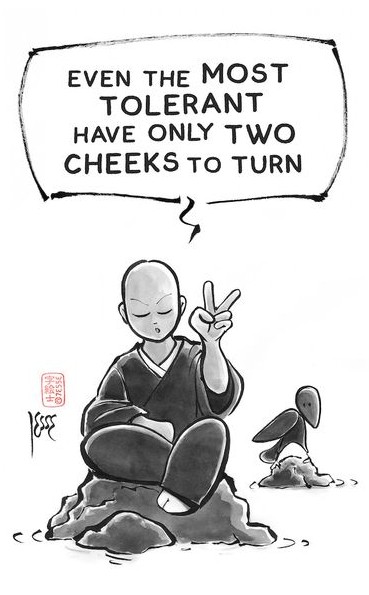
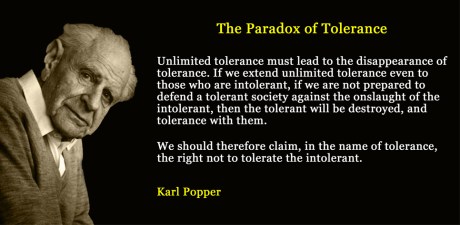
However, past researchers suggest there is a threshold to such tolerance. It is in this regard, in 1949, philosopher Karl Popper in The Open Society and Its Enemies said, “Less well-known is the paradox of tolerance: Unlimited tolerance must lead to the disappearance of tolerance. If we extend unlimited tolerance even to those who are intolerant, if we are not prepared to defend a tolerant society against the onslaught of the intolerant, then the tolerant will be destroyed, and tolerance with them”.
Contrary to the view of Popper, the primary contention of the so-called liberals and pseudo-seculars is that it is requisite for a just society to tolerate the intolerant; else, it would become intolerant and, thereby, unjust. In other words, Popper and many other philosophers state that every just society must overlook the principle of tolerance to preserve a sense of tolerance and justice in it. This is the paradox of tolerance. Overall, the contention of Popper is that there are limits to tolerance for the intolerance.
The recent Jawaharlal Nehru University (JNU) incident appears to reflect the same paradox of tolerance and indicate that we, as a nation, need to draw limits on tolerance.
The tolerance paradox cane be best presented in the form of major dilemma that has been considered by Aguiar and Parravano in their work titled “Tolerating the Intolerant: Homophily, Intolerance, and Segregation in Social Balanced Networks” (pdf), published in Journal of Conflict Resolution. They argue that intolerance is not only a universal phenomenon, which exists even in countries with a history of tolerance. Furthermore, they warn of the contagious nature of intolerance, largely to due to homophilic pressures created in institutions, organisations and even nations.
They also explain that most tolerant individuals are caught up in a major dilemma of either tolerating in-group intolerants or not tolerating them. The tolerance of in-group intolerant is primarily due to homophilic pressures and intolerance of in-group intolerant can only come from isolation of the intolerant. Thus, the tolerant strategies can only endure with adequate support from out-group members.
 In order to test the dilemma of Aguiar and Parravano in the JNU context, an online survey was conducted by research associates at IIM Ahmedabad and the data was analysed. The survey contained questions that measure the individual’s attitude towards JNU incident anchored on “highly favourable” and “highly unfavourable”. Next, the survey measured the respondent’s political standing anchored on “Definitely Left Wing” to “Definitely Right Wing”.
Further, the survey measured how likely an individual was willing follow her political standing irrespective of how factual or to the contrary the issue at hand was. Last, the survey contained questions on whether a) there should be limits to tolerance in India, b) non-response to anti-national activities is not exhibition of tolerance, c) anti-national individuals exploit the tolerance in Indian society, d) individuals who commit sedition go largely unpunished India and e) the government should take strong action against individuals who commit sedition.
Results were astounding. There was a strong and positive correlation between individual’s attitude towards JNU incident and her political standing, such that the more left-wing an individual claims to be more favourable her attitude towards JNU is. Furthermore, there was strong and positive correlation between political standing and willingness to follow the political standing such that individuals are likely to follow their strong political standing irrespective of the merits or accuracy of the issue. Finally, 98% of the respondent believe that there should be limits to tolerance in India; 93% of the individual believe that non-response to anti-national activities is not exhibition of tolerance; 95% of the individuals believe that anti-nationals exploit the tolerance in Indian society; 96% of the individual believe that individual who commit sedition get away with it and 92% of the individual believe that government should act strongly against individual who commit anti-national acts.
Overall, it is quite evident that the Indian society stands at cross-roads today, and its must act decisively to preserve it tolerant and just character. We really need to understand if pre-existing perceptions between various community groups intensely dominate perceptions of the actual issue thus making impotent the “facts” related to debatable issue at hand. It must be realised and communicated to the public that intolerant individuals are not entitled to complain of intolerance. In line with the contentions of Popper JNU, the safety and security of India and its institutions of liberty may be at danger if we continue to exhibit unlimited tolerance. I suggest that a broader legislation on sedition and hate-speech is need of the hour. For instance, holocaust denial is a crime in a number of democratic countries such as Belgium, France, and Germany. – The Financial Express, 23 February 2016
» Dr Dheeraj Sharma is professor of marketing and organisational behaviour and chairperson of marketing area, Indian Institute of Management Ahmedabad.
Filed under: india | Tagged: india, indian society, intolerance, JNU, karl popper, law and order, psychological warfare, sedition, society, tolerance | 4 Comments »