








 The intrinsically tolerant and federal structure of Hinduism, historically brought together communities scattered across widely varying geographies of this subcontinent—with quite distinct diets, languages and customs—without force. – Jawhar Sircar
Many have often wondered how ancient Indic religions like Hinduism, Buddhism and Jainism (Sikhism is not that ancient) survived and prospered for millennia without a designated holy book like the Bible or the Koran and with no Mecca, Vatican or Jerusalem to guide people. With a little introspection, we come to realise that it is actually this absence of a central command and non-uniform format that account for this. In fact, the intrinsically tolerant and federal structure of these faiths, especially Hinduism, historically brought together [communities] scattered across widely varying geographies of this subcontinent—with quite distinct diets, languages and customs—without force.
To appreciate this phenomenon, we may need to understand how major pan-Indian festivals offered different meanings to Hindus in different regions. The overarching common theme served mainly as an umbrella under which unique local traditions and cultural expressions found universal acceptance and legitimacy within the Hindu belief system. Since Navaratri is still fresh in our minds, let us traverse its terrain and observe how dissimilar customs and rituals came together in harmony and mutual respect— with no single theme thrusting itself on any.
All Hindus agree on the same nine days and ten nights in autumn, but beyond that, the observances in different regions vary quite a lot—as the parochial adjusts itself within the universal. The important point to note, however, is that these are not really local variants of some national-level standard as is often claimed—for no standard exists at all.
Many old regional traditions have actually taken several steps forward to sanskritise, if one may use this term for want of an exact expression, and operate within the framework. Broadly, we can decipher three zonal themes in Navaratri—the first in the North and West, the second in the East and parts of the Northeast, and the third in the South. In the first zone, the Goddess is worshipped through fasts and rigorous dietary restraint over nine days, but it is ultimately Rama’s victory over the evil Ravana on Dussehra that is really the climax. The East and Northeast celebrate not Rama but Durga, in her most belligerent form, and on the tenth day, Vijaya Dashami, commemorate her triumph over evil—as personified by Mahishasura.
We see how plural the Hindu mode actually is, when we note that Andhra and Mysore celebrate neither Ram nor Durga, but the victory of the Pandavas. In the South, different Devis are worshipped during Navaratri, and Tamilians dedicate the first three days to Lakshmi, the next three to Parvati or Durga, and the last three days to Saraswati. We come across fascinating displays of many dolls placed on wooden planks, called Bommai Kolu and other similar names. At the end of Navaratri, the southern states, Maharashtra and Odisha observe Ayudha or Astra Puja to worship instruments and tools, which, incidentally, is done in the Gangetic plains, Bengal and the East during Vishwakarma Puja a month earlier.
Then, while both the North and the South agree on worshipping nine forms of the Goddess on nine days, the East remains ambivalent. Bengal and neighbouring states celebrate only the last three days and from the tenth one, observe no dietary restrictions and feast on fish and meat. Some Rajput families of Rajasthan also shatter Navaratri’s vegetarian tradition by slaughtering goats and buffaloes.
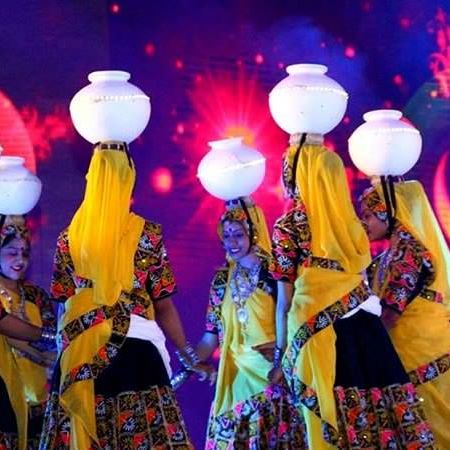
Let us view some more interesting modes of celebration of the same Navaratri in different corners of India—to understand that regional customs actually prevail during most pan-Indian festivals. In Maharashtra, for instance, Navaratri is celebrated as the Ghatsthapana Utsav, when an earthen pot is filled with water and sits on a base of wet clay, in which seven types of food grains are sown, which sprout in these nine days. For Gujaratis, the pitcher represents fertility and is called garba or womb. Their famous Garba dance is around this pot, into which they place a lighted lamp. Much of Garba was, however, re-fashioned after it was merged with the Dandiya Raas.
In Goa, the pot is of copper and many other communities also start sowing pulses, cereals, barley and other seeds around it during this period. Even in far-off Bengal, Nava-Patrikas or leaves of nine plants like banana, turmeric, wood apple, pomegranate and paddy are consecrated in knee deep water on the first day (Saptami) of Durga puja. The banyan plant and other leaves are then draped in a sari and worshipped along with the Goddess as Kola Bou—obviously a carry-over from a fertility cult. Frankly, this spirit of accommodation of diversity is what brought millions together, not only through this festival but all others as well.
Anthropologists can note and mark the individual rites and observances that signify how sundry seasonal rites and festivals of disparate regions gradually inched closer towards each other—under Brahmanical persuasion, often aided by ruling groups. Proselytisation is theoretically not a component of Hinduism, but acculturation of entire fringe communities into the Hindu way of life has been a recurrent feature, throughout history. What is striking, however, is the almost total absence of force or any pre-planned mission to homogenise belief and custom within Hinduism. It is clear, therefore, that any attempt to homogenise Hinduism is bound to be antithetical and counterproductive. – The New Indian Express, 30 October 2020
› Jawhar Sircar is a retired civil servant, former culture secretary and ex-CEO of Prasar Bharati.
Filed under: india, world | Tagged: dharmic religions, federalism, hinduism, indic religions, navaratri | Comments Off on Navaratri: How Indic religions are intrinsically federal – Jawhar Sircar