










 There cannot be true secularism unless all the religions in India are treated equally under Indian laws and politics is liberated from the hegemony—not necessarily influence—of religion. – Prof Prakash Nanda
A constitutional bench of the Supreme Court hearing the case of using religion during elections to seek votes asked a question on Thursday (28 October) that should have been asked a long ago.
In our public discourse, we hear a lot about “secularism”. But can secularism remain aloof from religion?, the Apex Court asked, saying “ it will be difficult to accept as a proposition that a political party should have nothing to do with religion and those who have something to do with it must cease to be political parties”. But this was not all. The Bench then went on to ask, “Secularism does not mean aloofness to religion but giving equal treatment to every religion. Religion and caste are vital aspects of our public life. Can it be possible to completely separate religion and caste from politics?”
While an answer to the ticklish question that the Supreme Court has asked will be different from different parties that have approached (are approaching, something the CPM did on Thursday) the Court, the most notable component of that question happens to be “secularism”. The Apex Court now defines secularism to be “equal treatment to every religion”, a definition that has eluded the political and intellectual consensus in this country so far.
In my considered view, the absence of a clear definition of secularism in our political parlance has created two problems. One, it has resulted in a situation where we witness “communal politicians” becoming “secular” overnight and vice versa, with everything depending on the political convenience of the parties and their supporters. Secondly, the way it has been practiced in India, secularism has been reduced to be essentially anti-Hindu but pro-minorities viewpoints or measures. And this has been systematically promoted by what is known as Nehruism, the Left-Liberal framework that dominates Indian public discourse. Ironically, “secularism” has been never defined by its political and intellectual champions in India. Though the 42nd Amendment in 1975 by Indira Gandhi’s Congress government did incorporate the word “secularism” to the preamble of our Constitution, it did not define what secularism was. Ironically, her 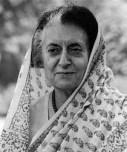 Congress party, which dominated the then Rajya Sabha in 1978, foiled an attempt to actually define secularism as “equal respect to all religions” by defeating an amendment bill to that effect, the bill that had already been cleared in the Lok Sabha during the Janata regime of Morarji Desai.
It is instructive here to note that in 1949, Nehru had said that “to talk of Hindu culture would injure India’s interests”. He had admitted more than once that by education he was an Englishman, by views an internationalist, by culture a Muslim, and a Hindu only by accidental birth. In 1953, Nehru had written to Kailash Nath Katju: “In practice, the individual Hindu is more intolerant and more narrow-minded than almost any person in any other country.”
Of course, Nehru did the right thing by trying to remove some degraded practices within Hinduism, but the problem with him was that he was not bothered about the similar reforms in other religions. Nehru codified the Hindu personnel laws (concerning Hindus’ diverse customs, rituals and practices) in 1956, but he backtracked on doing so towards Muslim personal law. No wonder why J. B. Kriplani, a veteran socialist, opposed the Hindu Code Bill on the ground that the Nehru government was “communal”. Kriplani had told Nehru, “If you want to have a divorce for Hindu community, have it; but have it for Catholic community also. I tell you this is the democratic way, the other is the communal way. It is not the Mahasabhites who alone are communal, it is the government also that is communal, whatever it may say. I charge you with communalism because you are bringing forward a law about monogamy only for the Hindu community. You must bring it to the Muslim community. Take it from me that the Muslim community is prepared to have it but you are not brave enough to do it.”
It is under Nehruvian secularism that the Government appoints trustees to manages Hindu temples (and maths) of Viswanath, Tirupati, Puri, Nathdwara and Guruvayur. But the same Government considers it “communal” to do likewise in the case of masjids, churches and gurudwaras. Secularism of the Nehruvian variety says that it is “progressive” to denounce a Hindu swami for trying to influence his or her followers, but it is “communal” to raise finger at those who issue fatwas and hukamnamas.
As Arun Shourie has pointed out in his book Religion in Politics, “during the freedom struggle, if you looked upon a Muslim as being someone apart, as being someone other than just a human being like yourself, the “progressive” was bound to brand you “communal”. Today, unless you look upon the Muslim as separate, that is, unless you see him as a Muslim rather than as just a human being like yourself, the “progressive” brands you “communal”. Fifty years ago when a Hindu scholar by his deep study perceived and wrote about The Essential Unity of All Religions—the title of Bhagwan Das’ famous work—that was looked upon as  humanist scholarship at its best. Today when a scholar points to the identity of what is taught in Granth Sahib and what is taught in say, the Hindu Bhakti tradition, it is taken as proof positive of a deep conspiracy to swallow Sikhism”.
In fact, India today is much more divided than what it was at the time of partition in 1947, thanks to the perverse manner in which secularism or for that matter “the identity politics” is being practiced in the country. The victims of any crime or injustice these days are being seen in terms of their religions and castes, not as normal human beings who are all equal under Indian laws. What is worse, depending on their identities, both the victims and the guilty must get “different” treatments, if we go by the demands of the so-called secularists.
And these “secular” double standards are seen in the politics of the country.
In fact, the Congress manifesto in January 1989 for the Mizoram election promised to promote “Christian socialism”. It stated “As Christians, it is our bounden duty to proclaim the gospel. To fulfill this irreversible responsibility we need secularism in letter and spirit…. It is but reasonable that the Christian should lend support to the Congress.”
Similarly, in his book Communal Road to Secular Kerala, sociologist George Mathew has described how late Indira Gandhi wooed the Church to issue directives to vote in favor of the Congress lead UDF in the early 1980s. The Christian bishops appealed for support to only those candidates who believed in God, with an obvious reference to UDF led by the Congress. And we all know how the Rajiv Gandhi government overturned the Supreme Court judgment on the famous Shah Bano case by bringing about a fresh legislation in the Parliament, with a clear motive to woo the Muslim electorate.
The moral of the story is thus clear. There cannot be true secularism unless all the religions in India are treated equally under Indian laws and politics is liberated from the hegemony (not necessarily influence) of religion. The Supreme Court has done well in providing a definition of secularism. In that sense, the ongoing case should be the referral point for defining secularism, not Hinduism. – FirstPost, 28 October 2016
» Prof Prakash Nanda is editor of Uday India, a national weekly, and Geopolitics a niche monthly devoted to defence, security and diplomacy. Previously he was a National Fellow at the Indian Council of Historical Research. He has also been a Visiting Professor at Yonsei University, Seoul and FMSH, Paris.
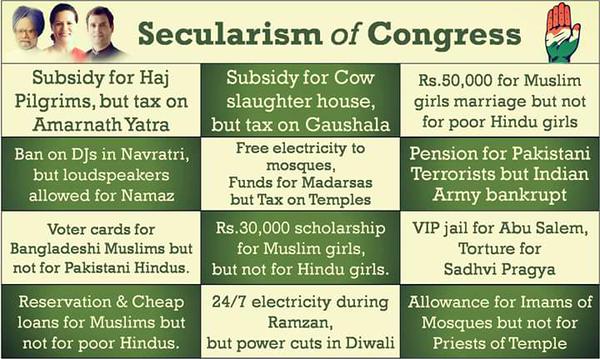
Has Modi Sarkar corrected these anti-Hindu inequities?
Filed under: india | Tagged: communalism, india, indian politics, nehruism, politics, pseudo secularists, secularism, secularism-nehruism, supreme court of india | 4 Comments »