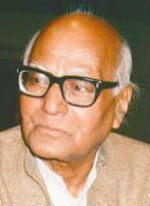









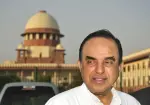


 “AAP’s present crisis is due to its leaders’ rank opportunism. They can swing from one end of the political spectrum to another simply in search of a support base. They are Indian Fabians, socialist in rhetoric but capitalist in action. Individualism is another bane of this fledgling party; it seems stuck in adolescence and possibly may not attain adulthood.” – Prof Rakesh Sinha
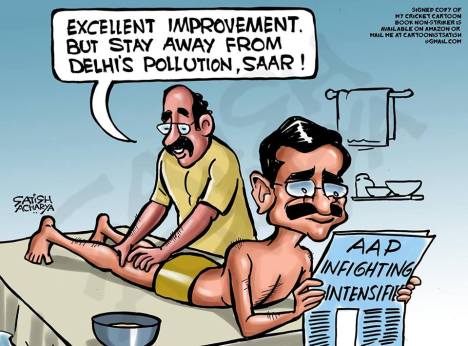
 Talk about political degeneration. The Aam Aadmi Party is in the throes of one, wracked by its severe internal crisis. Its deep fissures are no more a secret, coming to the fore with two prominent leaders Yogendra Yadav and Prashant Bhushan turning rebel. The duo, once seen as Kejriwal’s confidants, has now turned his bête noire. Yadav-Bhushan’s outburst has unmasked many evils that gripped the party right at its infancy, though it has been sought to be portrayed as a clash of personalities for domination in the party. After ascending Delhi’s chief ministership, Kejriwal’s priorities are now the capital’s complex civic problems. Having promised the moon, the challenger is now discovering that his challenges far exceed his capacity to deliver.
Kejriwal’s meteoric rise in politics was built on challenging the ruling class, promising hope for a new politics to those disenchanted with traditional politicians. The Anna movement was reminiscent of the 1974 Jayaprakash movement, which was a battle for change in the system. The Anna movement’s leaders were seen as mutiny men.
Compulsions of parliamentary democracy stymied JP’s “total revolution”. The democratic political alternative to Indira Gandhi’s dictatorial regime emerged in the form of the Janata Party, created by the merger of the Jana Sangh, Lok Dal, Congress (O) and socialists. This was a turning point in Indian politics but movement for systemic change was bogged down in old-fashioned discourse. Kejriwal does not have the excuse of compulsion of parliamentary democracy for his backtracking from Anna’s movement.
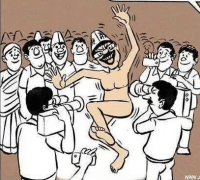 The AAP boss is not a man with vision and thus, could not articulate any agenda for the masses. He has the knack for consolidating anti-establishment sentiments. Those who today feel betrayed by him are all armchair revolutionaries, careerists and academics, who desire change, egalitarianism and revolution but will not sacrifice their luxurious lifestyles. No systemic change can ever be a short-term agenda. It has to be a well-articulated vision for alternative socio-economic and political structure and process. Neither Kejriwal nor his detractors in his party have any theoretical clarity. They’re no more that “here and now” activists, deluded by their media-manufactured image.
Doubtlessly, Indian politics is characterised by the tendency of qualitative degeneration. The influence of moneybags is growing, and is a cause of serious concern. There is no well thought-out plan or agenda among parties on how to combat the evils of neo-liberalism, which legitimises income gaps, encourages inequity and deconstruction of culture. Its impact on society is now a reality. The neo-rich have supplanted the middle class’s influence in politics. Concomitantly, the neo-poor have also emerged as a new conscious economic-political category, which views conventional politics with contempt and wants change in the system. The neo-poor are educated but underprivileged. This is also indicative of the trend of the traditional party system that faces grave challenges while satiating its social support base.
Kejriwal has so far been the beneficiary of all such currents, but has encashed them for short-term gain. Clearly, he has no remorse at his metamorphosis from a mutiny man to a municipality man. Yadav and Bhushan are old-fashioned socialists, which the AAP’s mainstream wants to jettison. AAP leader Ashutosh’s denunciation of the rebels as 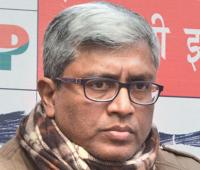 extreme Leftists and of Bhushan for his support to referendum in Kashmir is significant, for it is the first attempt to draw some theoretical contours of AAP. It is also a shrewd futuristic move to garner support of those who prefer centrist politics with a nationalist flavour.
AAP’s present crisis is due to its leaders’ rank opportunism. They can swing from one end of the political spectrum to another simply in search of a support base. They are Indian Fabians, socialist in rhetoric but capitalist in action. Individualism is another bane of this fledgling party; it seems stuck in adolescence and possibly may not attain adulthood.
AAP’s failure, however, to become a credible political force is no gain for others. The growing class consciousness among the underprivileged and the aspiration to resurrect idealism and ideology-based developmental agenda are the twin progeny that need to be sincerely addressed by parties both in and out of power. Failure to do so will only open the door to more anarchy. – The New Indian Express, 8 March 2015
» Prof Rakesh Sinha is Hony Director of India Policy Foundation. Contact him at rakeshsinha46@gmail.com
Filed under: india | Tagged: AAP, arvind kejriwal, india, indian politics, new delhi, political rebels, politics, shanti bhushan | 2 Comments »