











 To understand the basis of Tilak’s approach, let us first look at the way the earth spins around its axis as it goes round the sun. It is because of that spin that we see the heavenly bodies go westward in the sky in a 24-hour cycle. Only the Pole Star appears to be fixed in space, because it lies on the axis of spin. – Dr. Jayant V. Narlikar
The Vedas are described as apaurusheya, that is, written by no man. They were transmitted down from one generation to the next without anyone having a clue as to who wrote them. This question of authorship of the Vedas is linked with another, perhaps more tractable, question: When were they written? From the study of the contents, the language and allusions to events, Western scholars arrived at the figure of around 3.5 to four thousand years ago as the age of Vedic literature.
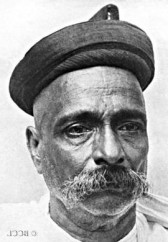 Lokamanya Bal Gangadhar Tilak, known to most Indians for his leadership of the Indian national movement for Independence, before the arrival on the scene of Mahatma Gandhi, had a multifaceted personality. He was well versed in mathematics, had written a learned commentary of the Bhagavad Gita called the Geetarahasya, had a philosophical bent and took great interest in social issues besides running a national newspaper, Kesari, of which he was also the editor. Last, but not the least, he possessed basic knowledge of astronomy which he put to use in a highly original fashion to decide the antiquity of the Vedas.
To understand the basis of Tilak’s approach, let us first look at the way the earth spins around its axis as it goes round the sun. It is because of that spin that we see the heavenly bodies go westward in the sky in a 24-hour cycle. Only the Pole Star appears to be fixed in space, because it lies on the axis of spin. An excellent comparison with the earth’s spin is provided by a spinning top, which can be spun by pulling the string wrapped around it. With sufficient practice, one can toss such a top on the floor and watch it move round as it spins.
Such a spinning top shows another feature. Its axis of spin is not fixed in space, but it precesses, that is, moves along a cone thus making the top wobble. The same applies to the earth: its spin axis too precesses in space. But, did we not say that it is fixed in the direction of the Pole Star? Well, that was an approximate statement. It will be more accurate to say that the axis precesses very slowly, making a single round on the cone in around 26,000 years. So to us mortals it seems fixed in space within our sub-century lifespan. However, if we compare astronomical records over several centuries we would discover this motion. For example, the star Polaris (or the star Dhruva in Indian literature) was not the Pole Star 5,000 years ago. Another star, today known as Thuban, had that status because the earth’s spin axis pointed in its direction then.
But can a layman notice any change in the stellar or terrestrial environment when looking at the astronomical records? The answer is “yes” and to see how that happens, let us see how, when viewed from the earth, the sun changes its direction through the year. Observers over the centuries have used known stellar groups to identify this change of direction. These are the so-called signs of the zodiac. So the sun moves against the zodiacal background and can be located with reference to the sign of stars at its back. The calendar of the year identifies the 12 signs of the zodiac with 12 months and the apparent path of the sun is called the ecliptic.
We learn in school geography that the length of the day changes through the year, being the longest on June 21 and the shortest on December 22. In between, there are two locations on the ecliptic where the day and night are equal. These are called the spring equinox and the autumn equinox. These fall on March 21 and September 21 respectively. This variation in the length of the day would not have occurred if the earth’s spin axis were perpendicular to the ecliptic. In reality, the axis makes an angle of approximately 66 degrees. And as we saw earlier, the spin axis is slowly precessing. The result is that the points of equinox also slowly move along the ecliptic, taking 26,000 years to make one round.
We also learn in geography texts that seasons arise because of the above configuration. Spring begins when the sun is at the spring equinox and autumn when it is at the autumn equinox. However, as we just saw, the equinoxal points slowly change their positions against the zodiacal groups of stars. Therefore, in the annual calendar, the months identified with a season will slowly change. In particular, if we decide to start the year with the sun at the spring equinox, the first month of the year would change because of the slow shift of the spring equinox.
 This was the clue that Tilak worked on. He was led to it by a shloka from the Bhagavad Gita in which Lord Krishna, identifying himself with the best and most important in any class of objects or people, says: “I am Margashirsha amongst the months and spring amongst the seasons”.
In modern times Margashirsha does not fall in the spring season; rather it falls closer to the autumn. So why this discrepancy? The discrepancy is resolved if we argue that the statement was made when Margashirsha fell in the spring season. By turning the earth clock backwards, we move the equinoxes backwards until the spring equinox was in the zodiacal group identified with Margashirsha. This gave him an estimate of the antiquity of the statement.
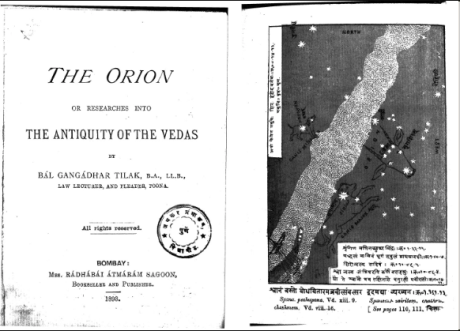
Tilak used this approach to look at astronomical allusions in Vedic literature and from them sought to build up the stellar framework that must have existed when the statement was made. His monograph, The Orion: Research into the Antiquity of the Vedas, is a scholarly discussion of this approach. He arrived at an age for the Vedas much older than the age estimated by Western scholars. This opened the door to controversy as to which method is correct. While Tilak’s reliance on astronomical data gave him a reliable clock, the weakness of his method probably lay in the authenticity of the allusions he had used. Whatever the eventual outcome of this ongoing exercise of dating our ancient literature, we have to give credit to Tilak for his ingenious approach. – Deccan Chronicle, Chennai, Dec 22, 2010
› Jayant V. Narlikar is a professor emeritus at Inter-University Centre for Astronomy and Astrophysics, Pune University Campus, and a renowned astrophysicist.
Filed under: india | Tagged: astronomy, bal gangadhar tilak, date of vedas, indian literature, vedas | 1 Comment »