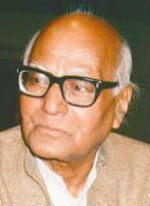






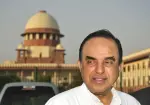


 “The Maharaja proved his conviction as a democrat and nationalist when he drove by himself with the Maharani and his son Yuvraj Karan Singh from Srinagar to Jammu to sign the Instrument of Accession. Mr. V.P. Menon had requested the Maharaja to come to Jammu to sign the Accession. Several historians and politicians have blamed the Maharaja for having delayed his decision to sign the Instrument of Accession before 14 August 1947. Had the Maharaja signed the Instrument Accession at that time, the same critics would have blamed him for hastening the process!” – Bhim Singh
 Since time immemorial, there have been many kings and crowns. Many of them ruled with grace and dignity, yet not a single ruler in any part of the world had courage to declare his religion as justice. On 9 July 1925, immediately after being crowned as Maharaja of Jammu and Kashmir, Hari Singh declared, “My religion is justice”. This might have annoyed several religious persons, yet Hari Singh stood by his commitment. In 1927, Maharaja Hari Singh issued a Royal Decree introducing a great revolutionary legislation, State Subject, which now has been renamed as ‘Permanent Resident’.
What a great imagination the King of Kashmir had at a time when there was no religious conflict or inner tension in the state though 86% of the population fraternity from Gilgit to Kashmir belonged to the Muslim. This concept shows the unique farsightedness of Maharaja Hari Singh to save not only the land and properties of the residents of J&K, but also put in place a permanent mechanism to save the identities of the Ladakhis, Kashmiris, Baltis, Dogras, and others. Had there been no such legislation, the Kashmiris in particular would have lost not only their land but their cultural identity too.
It is a misunderstanding that the identity and the land of the residents of J&K are protected under Article 370 of the Indian Constitution. This is totally incorrect. The identity and property stand protected under the unique law enacted by Maharaja Hari Singh in 1927.
 The High Court of J&K was established by another Royal Decree by Maharaja Hari Singh in 1928. The protection of civil and political rights of the residents of J&K was guaranteed by the Maharaja, authorizing the High Court and even Sessions Judges to issue writs, including the writ of habeas corpus, in J&K way back in 1928.
J&K was perhaps the first Princely state in India which enacted laws opening all public places, temples, wells etc. for every citizen, including the members of the depressed classes (Scheduled Castes). Maharaja Hari Singh declared the practice of untouchability as an offence and banned child marriage, prostitution, and use of drugs. The Maharaja issued an Ordinance putting a strict ban on the transfer of females from Baltistan to other areas.
Maharaja Hari Singh introduced the parliamentary system by holding election to the State Parliament called as ‘Praja Sabha’ in 1934. Great legal luminaries and political activists like Mirza Afzal Beg were introduced in his cabinet. J&K was the first state under the leadership of Maharaja Hari Singh which evolved an independent constitution which introduced the concept of elected representatives, members of Praja Sabha, and established an independent judiciary.
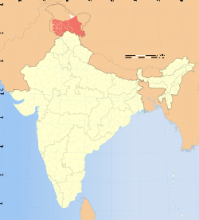 It was Maharaja Hari Singh who brought Kashmir on the map of world tourism. It was he who developed Pahalgam, Gulmarg, Dachigam for international tourism. Students of history may agree that not a single spot has been developed for world tourism in Kashmir since 1947.
The Maharaja having absolute power at his command ensured that his opponents were not harassed or harmed by the administration or police. Sheikh Mohd. Abdullah, Mirza Afzal Beg and several others who were agitating against the Maharaja were not harmed or subjected to any kind of oppression by the administration. There was not a single instance of custodial killing during the time of Maharaja Hari Singh or any other Dogra ruler during 101 years of their rule from 1846 to 1947.
In 1931, the police resorted to firing on an angry mob of protesters in Kashmir resulting in death of several people. The Maharaja suo moto ordered a probe under a British officer – the Glancy Commission. The recommendations of the Commission were implemented within a couple of months and the guilty policemen brought to justice. Can anybody compare the justice delivery system of the Maharaja with the rule of the so-called democrats today?
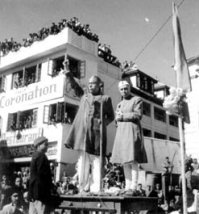 The Maharaja proved his conviction as a democrat and nationalist when he drove by himself with the Maharani and his son Yuvraj Karan Singh from Srinagar to Jammu to sign the Instrument of Accession. Mr. V.P. Menon had requested the Maharaja to come to Jammu to sign the Accession. Several historians and politicians have blamed the Maharaja for having delayed his decision to sign the Instrument of Accession before 14 August 1947. Had the Maharaja signed the Instrument Accession at that time, the same critics would have blamed him for hastening the process!
Sheikh Abdullah, the leading politician and leader of Kashmiri Muslims, might have joined with Jinnah to counter the Maharaja. The situation would not have favoured the sentiments of the people of Kashmir nor would it have worked in favour of the Union of India. It is a great tragedy that Indian intellectuals, particularly historians, have not realized the great wisdom of Maharaja Hari Singh.
 The Government of Pakistan led by Jinnah signed a no-war pact (Stand Still Agreement) with the Maharaja on 16 August 1947. Yet it was Pakistan which invaded J&K in violation of its agreement to grab Kashmir. The people of J&K stood as one to oppose the aggression from the Pakistani side. Brig. Rajinder Singh, a Dogra hero, sacrificed his life with 125 Dogra soldiers at the outskirts of Baramullah on 26 October 1947. The Maharaja had to hasten the process of joining India to save the people of J&K from the wrath of the Pakistani raiders.
The greatness of the Maharaja and his commitment to the cause of India is demonstrated when he swallowed all insults and humiliations to which he and his family were subjected after signing the Instrument of Accession. The Maharaja was forced to go into exile from his home state, J&K. During 14 years of exile in Bombay, the Maharaja never uttered a word on the subject despite heavy provocations and unlimited temptations by the Anglo-American Bloc to denounce the Accession. He died at the age of 66 years in Bombay leaving a clear message to the people of J&K that our future lies with India. – Vijayvaani, 23 Sept. 2012
» The author is a Senior Advocate; Chairman of the National Panthers Party; and Member, National Integration Council
Filed under: india | Tagged: article 370, british india, child marriage, civic administration, democracy, demography, dogra rulers, geopolitics, hari singh, history, human rights, india, indian army, indian independence movement, indian national congress, indian politics, instrument of accession, jammu, jammu & kashmir, justice, karan singh, kashmir, maharaja hari singh, mirza afzal beg, multicultural, nation-state, patriotism, politics, psychological warfare, rajas, rajinder singh, religion, royal decree, secularism, sheikh abdullah, sikhism, untouchability | 2 Comments »