












 “The most important message from the budget is not economic but political. It lies in the unmistakable shift in the focus from the urban to the rural, from the aspirational to the downtrodden, from the factory to the farm. Obviously, the loss in Bihar and the impending elections in several states have forced a change in the National Democratic Alliance’s market positioning.” – Punarvasu Parekh
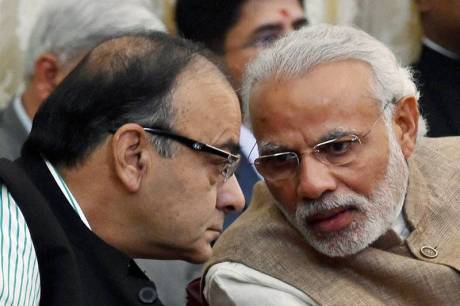
 In music, it is said, if you could repeat a feat three times in a row without making any mistake, then you have mastered it. With that, Mr. Arun Jaitley can be said to have mastered the art of disappointing those who have pinned their hopes on his budget. For him, it has not been a hard job. Last year, when he had everything going for him, he managed to produce a lackluster budget. This year, with headwinds from abroad and at home, he had stronger excuses for lack of imagination.
The finance minister has received bouquets and brickbats. But the fact is that this budget has been driven by compulsions of political economy. Grasp it, and you will get a key to understand why he has done what he has done. Retain credibility among investors at home and abroad and deploy money where the votes are. Mr. Jaitley’s skill lies in the tight rope-walking between conflicting imperatives.
Thus, he has chosen to stay the course on fiscal deficit. Sticking to the deficit control timetable (pompously called fiscal consolidation roadmap) in a world afflicted by uncertainties and adversities has enhanced the country’s credibility and gone down well with investors.
The fiscal deficit, excess of expenditure over income before borrowing, has been contained to the budgeted level of 3.9 per cent of GDP in the current year and planned to be reduced to 3.5 per cent next year. Revenue deficit, the bad part of fiscal deficit, has been contained to 2.8 per cent of GDP this year and planned to be cut further to 2.5 per cent next year. In the process, FM has reduced the government’s borrowing programme for a second successive year, and controlled the share of revenue that is eaten up by interest payments. He has got a response in terms of lower interest rates in the bond market, and put the onus on the Reserve Bank of India (RBI) to respond by lowering policy rates.
Another thing for which he has been rightly complimented is the emphasis on infrastructure. At a time when growth is low (whatever the official GDP numbers may say) and private investment is not forthcoming due to excess capacity in the industry and debt hangover, the government has to lead from the front by pushing up public investment in infrastructure that will create jobs and boost productivity across the economy.
 Mr. Jaitley has also introduced, to his credit, the most sweeping set of announcements yet for facilitating tax compliance, reducing the scope for disputes and clearing the backlog of cases in appeal. The widening of the window for a presumptive tax regime will bring relief to small businesses, as do the steps for reducing personal interaction between the taxman and the taxpayer, for reducing the scope for harassment (which is still widespread), and for increasing transparency. These are significant steps in the broader programme for improving the ease of doing business in the country. The voluntary disclosure scheme for local black money may work better than the unsuccessful scheme announced last year, provided the taxpayers (or evaders) are assured that they will not be harassed later on.
 The most important message from the budget, however, is not economic but political and it lies in the unmistakable shift in the focus from the urban to the rural, from the aspirational to the downtrodden, from the factory to the farm. Obviously, the loss in Bihar and the impending elections in several states have forced a change in the National Democratic Alliance’s market positioning.
This shift is reflected in the finance minister’s acts of omission and commission. Until last year, the prime minister was rightly criticising the Mahatma Gandhi National Rural Employment Guarantee (MGNREGA) scheme as an acknowledgement of the state’s failure to create productive jobs and, therefore, a shame. Now, his finance minister takes pride in making the highest-ever allocation to it. Against the backdrop of agricultural distress, the enhanced attention to the rural areas is wholly welcome. The problem is that we have been hearing these promises and resolutions for decades. One can only hope that the schemes announced and money allocated will produce tangible results.
The shift in focus is also visible in the squeezing of aspirational sections of the economy by expanding the breadth of indirect taxation and extracting as much as possible even from the salaried middle class. There is another cess under a pious name and tax on withdrawal of EPS at a time when the government spends lavishly on its own staff widely perceived as inefficient and corrupt work shirkers. The promised reduction of corporate tax in return for withdrawal of some tax concessions has been confined to small companies with annual turnover of less than Rs. 5 crore.
The budget is one more proof that those who expected Narendra Modi to be a Margaret Thatcher or Lee Kuan Yew with Indian roots are in for a disappointment. The “minimum government” is out of window, nanny state is back. There is no real relaxation for foreign direct investment in newer sectors or an increase in ceilings, except in agro-processing. Privatisation has not merited even a single reference. The talk of strategic sale is not about sale of equity but of physical assets of public sector undertakings (PSUs) such as land. The whole tone and tenor of the budget speech signals a return to the tired rhetoric of bad old socialist days.
Overall, the budget does not offer any approach to a transformation of India’s economy. It is unlikely to leave the Indian economy any better off.
» Punarvasu Parekh is an independent senior journalist in Mumbai.
Filed under: india | Tagged: arun jaitley, budget, budget 2016-17, india, indian budget, indian government, indian politics, narendra modi, NDA, politics, state elections | Leave a comment »




 BHARATA BHARATI