














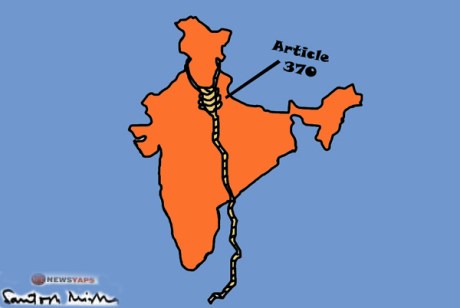
 The Supreme Court on Tuesday (August 19) issued a notice to Centre on a plea challenging the provisions of Article 370, which provides special status to Jammu and Kashmir. The plea was filed by a Delhi-based NGO, asking why a law passed by the J&K Assembly “deprives people from other parts of the country from acquiring immovable assets or seek employment in the state.”
Revocation of Article 370 which contains provision for Jammu and Kashmir has been in demand for long time. The Article was added temporarily and was to be removed within a time- period but till date nothing has happened.
What is Article 370?
- According to the Constitution of India, Article 370 is a law that grants special autonomous status to Jammu and Kashmir.
- The article is drafted in Part XXI of the Constitution (in Amendment section) which relates to Temporary, Transitional and Special Provisions.
- The original draft explained “the Government of the State means the person for the time being recognised by the President as the Maharaja of Jammu and Kashmir acting on the advice of the Council of Ministers for the time being in office under the Maharaja’s Proclamation dated the fifth day of March, 1948.”
- On November 15, 1952, it was changed to “the Government of the State means the person for the time being recognised by the President on the recommendation of the Legislative Assembly of the State as the Sadr-i-Riyasat (now Governor) of Jammu and Kashmir, acting on the advice of the Council of Ministers of the State for the time being in office.”
The special status to Jammu & Kashmir
- Unlike other State legislative Assemblies, J&K legislature has a six-year term.
- Jammu & Kashmir has two flags; a separate State flag along with the National Flag.
- Insulting of national symbols is not cognizable offence in Jammu & Kashmir.
- Most of the laws except defence, foreign affairs, finance and communication, passed by Indian Parliament need to be approved by the State Government before they are made applicable in the State.
- The citizens of J&K are governed by State-specific laws which come under the Constitution of Jammu and Kashmir, instead of those for the rest of India.
- Under Article 370 the Indian Parliament cannot increase or reduce the borders of the State.
- The Supreme Court has no jurisdiction in the State of Jammu & Kashmir.
- The residents of J&K enjoy dual citizenship, but they could loose the J&K citizenship if they marry residents of other States.
- If a woman marries a man in other Indian States, she loses her citizenship. Whereas if any woman marries a Pakistani, she will be entitled to have a citizenship of Jammu & Kashmir.
- The Article also gives Pakistan’s citizens entitlement to Indian citizenship, if he marries a Kashmiri girl.
- Majority of Indian laws including RTE, RTI and agencies like CBI, CAG are not applicable in J&K.
- No outsider can purchase land in the State.
- The Centre has no power to declare financial emergency under Article 360 in the State.
- It can declare emergency in the state only in case of war or external aggression.
History of Article 370
- Dr B.R. Ambedkar, who drafted Indian Constitution, had refused to draft Article 370.
- In 1949, the then Prime Minister Jawaharlal Nehru had directed Kashmiri leader Sheikh Abdullah to consult Ambedkar in preparation of suitable draft.
- Article 370 was then drafted by Gopalaswami Ayyangar, former Diwan to Maharajah Hari Singh of Jammu and Kashmir.
Article 370 and related controversy
- J&K Chief Minister Omar Abdullah had earlier warned that any attempt to reopen the debate on Article 370 would force the State to revisit its terms of accession to the Indian Union.
- In its election manifesto ahead of the Lok Sabha elections, the BJP had said it is in favour of abrogating Article 370, but said the issue will be discussed thoroughly before a decision is made.
- During electioneering, Narendra Modi had suggested that it should be probed whether Article 370 has indeed benefited the people of Jammu & Kashmir. OneIndia, 19 August 2014
Filed under: india | Tagged: article 370, india, indian politics, jammu, jammu & kashmir, kashmir, kashmir autonomy, ladakh, supreme court of india | 1 Comment »











