










 Dharma is not a matter of dogma, but of adapting our principles to what is required according to the changing needs of time, place and person in order to further the higher forces in the world. – Dr David Frawley
The Bhagavad Gita remains the book that can be best described as India’s national book. For thousands of years, up to the present, the Gita has been the most popular, commonly read, widely translated and commented upon teaching from India, far beyond any competing text, of which there are many wonderful depictions in the vast literature of the region.
One cannot know India, its essence and identity, without having first examined the Gita in depth and looked into its profound instruction about life, human interactions, the secrets of human psychology, and the keys to higher consciousness. The Gita reflects all the complexity, paradox, mystery and beauty of India/Bharat, its perennial search for the eternal and infinite, yet its ability to reflect the abundance of life on all levels as well.
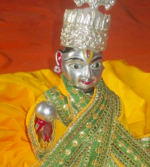
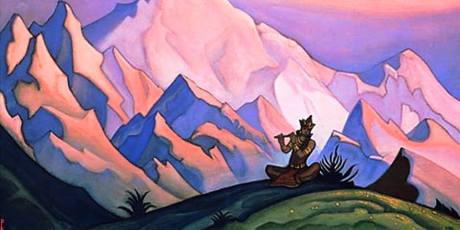
Sri Krishna remains the figure who best represents India’s profound yogic culture and civilisation to the world. He is known as a divine incarnation, a yogavatara, and a sage of the highest order, who was able to teach a variety of paths to all temperaments of people, motivating humanity to its achieve its highest potential. Sri Krishna has a divine personality with an incomparable charisma that serves to inspire the divine within all of us, yet teaches us with great clarity and precision as well.
The way forward
The genesis of the Gita on the battlefield is one of its most compelling factors. All life is a battle or a struggle between the many dualities within and around us, both in nature and in humanity, particularly the forces of dharma and adharma. Yet life is not a simple face-off between good and evil, delineated in black and white, a moralistic clash in which the right choice of action cannot be questioned.
Life is a struggle to go forward in a maze of competing forces moving in multiple directions, carrying contrary influences. Like Arjuna at the start of the Gita, it is easier for us to not want to fight in order to avoid the pain and complications, but this is to let life pass us by and condemns us to the limitations of what we have already become.
The Bhagavad Gita shows us how to achieve the best possible in less than ideal circumstances, in the battlefield of Kurukshetra, which is among the worst and most complicated of all imaginable clashes, involving taking up arms against ones own kinsmen and gurus. Yet not to act would only allow the forces of negativity and inertia to prevail, and irreparably damage the society for long periods to come.
It is often easier to stand on the sidelines when there are no clear options without notable side effects. But life does not work that way. Pain, sorrow, disease, enmity are also challenges to the soul to grow beyond its outer limitation and discover its inner reality. If we do not face and overcome the difficulties of life, we remain weak and fail to discover the divine within us.
Svadharma and the Universal Dharma
Dharma is not a matter of dogma, but of adapting our principles to what is required according to the changing needs of time, place and person in order to further the higher forces in the world. The Bhagavad Gita teaches us our svadharma or individual dharma. Yet this is not in modern terms a path of mere individual freedom and self-assertion. It is how we are connected to the whole, how the entire universe exists within and around us. We cannot find fulfilment at a personal level without serving our highest duty to the whole of life. The Gita shows us our individual essence but as part of the universal being that is Sri Krishna.
The Gita’s ultimate message is that there is no death. No one is truly born or dies. We are immortal in our inner divine nature as pure consciousness. Birth and death only belong to the body and are no more than a mere change of clothes for the soul. It is not salvation we need but Self-knowledge, getting back to the core of our being that cannot be disturbed by any external forces.
The dilemma of Arjuna represents our essential challenge in life. We are all imperfect, but have the sense of a higher perfection that we can manifest with great effort. Getting Arjuna to arise within us is the key to our success in life, but it also requires that we seek the grace and guidance of Sri Krishna in his innumerable forms. – Vedanet, 11 December 2016
» Dr David Frawley (Pandit Vamadeva Shastri) is the director of the American Institute of Vedic Studies and the author of more than 30 books on yoga and vedic traditions.

Filed under: india | Tagged: arjuna, bhagavad gita, bhagavad gita, dharma, hinduism, india, krishna, national book, sanskrit literature | 2 Comments »