








 India was among the 27 countries that voted for removal of cannabis and cannabis resin from the list of prohibited substances. This decision flowed from a series of recommendations made by the World Health Organisation (WHO) on marijuana and its derivatives. – Prabhash K. Dutta
Cannabis, also known loosely as hemp, marijuana or pot, may be on its way to being reclassified in India. Cannabis transaction is largely illegal and strictly controlled in India. But now, the United Nations has decided to remove cannabis and cannabis resin from the list of dangerous narcotic substances. And, India voted in favour of the decision.
Regulation of cannabis and its products has been under public lens in India in the wake of high-profile arrests including that of actor Rhea Chakraborty in recent times. There have been demands to legalise cannabis in India.
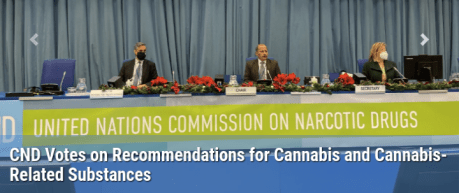
The decision was taken by the UN Commission on Narcotic Drugs (UNCND) by a majority voting. India was among the 27 countries that voted for removal of cannabis and cannabis resin from the list of prohibited substances. This decision flowed from a series of recommendations made by the World Health Organisation (WHO) on marijuana and its derivatives.
What does the UN’s cannabis decision mean?
“The CND zeroed-in on the decision to remove cannabis from Schedule IV of the 1961 Single Convention on Narcotic Drugs—where it was listed alongside deadly, addictive opioids, including heroin,” the UN said in a statement.
Cannabis was on the CND’s prohibited list for nearly 60 years warranting strict control on its production, supply, consumption and even use for medical purposes.
The UN said the decision has “opened the door to recognise the medicinal and therapeutic potential of the commonly-used but still largely illegal recreational drug”.
An important emphasis of the UN was that the reclassification of cannabis could “act as catalyst for countries to legalize the drug for medicinal use, and reconsider laws on its recreational use”.
It was the recreational aspect of cannabis and its derivatives that came under investigation of the Narcotics Control Bureau (NCB), which earlier charged Rhea Chakraborty, her brother Showik and several others in a case of illegal use of narcotics. Rhea was charged with possessing curated marijuana.
Cannabis: Illegal yet legal
Cannabis and its derivatives are banned in India under the Narcotic Drugs and Psychotropic Substances (NDPS) Act of 1985. Cannabis is a generic name, according to the WHO, for a range of preparations of the Cannabis Sativa [and Indica] plant. Marijuana, a Mexican word, is a frequently used name for products made from Cannabis’s leaves or other parts.
The NDPS Act strictly regulates cannabis plant and its products. Charas is separately mentioned as regulated substance under the law. Charas is resin extracted from the cannabis plant. Hashish or hash is another name for charas. Cannabis oil or hashish oil is also regulated in India.
The NDPS Act describes another cannabis product, ganja, separately. Ganja is derived from the flowering or fruiting part of the cannabis plant. It is this formation that is commonly referred to as “weed” or marijuana.
The law does not ban use if seeds and leaves of the cannabis plant if these are not mixed with other parts of the vegetation. This is why bhang, commonly consumed by people in northern and eastern parts of India during Holi festival, is not illegal to consume. Similarly, chutney made from cannabis seeds and popular in the Himalayan regions particularly Uttarakhand is not banned.
This was a defence given by Rhea Chakraborty’s lawyer during the bail hearing. The NCB in its probe had found WhatsApp chats about CBD oil, which is apparently different from the cannabis oil as it is derived from the leaves.
History of cannabis regulation in India
Cannabis has a long history in India. Its oldest origin is not known in the world but what is certain is that around 3,000 BC, cannabis was consumed by people in some form. In India, evidence from 1,000 BC onward supports its use by people here. It has been used in India and elsewhere for both medicinal and recreational purposes. Its association with Lord Shiva is part of Indian folklore.
Regulation of cannabis or its bhang form began with the British becoming a colonial power in India. The British Parliament enacted a law to tax bhang, ganja and charas on the pretext of the “good health and sanity” of the “natives”. But the British did not criminalise its use.
Criminalisation of cannabis in various forms happened after 1961 convention of the UNCND that placed the plant and its derivatives on Schedule IV. India had opposed the move against cannabis citing its social and religious link to consumption of cannabis. But later on, when the 1961 convention found its expression in India’s NDPS Act, cannabis became highly regulated. India, however, kept bhang out of its purview.
The UN decision to reclassify cannabis, however, would not immediately change the way it is being regulated by countries across the world. Still, it is expected that the UNCND decision would lead to an international protocol to legalise cannabis.
Many being arrested or investigated by the NCB in connection with possession or suspicion of possession of cannabis or its derivatives may rue that the decision of the UN agency came a little late for them. – India Today, 4 December 2020
› Prabhash K. Dutta is a senior assistant editor at India Today.
Filed under: india, world | Tagged: cannabis, cannabis decriminalisation, ganja, hashish, UN reclassifies cannabis | 1 Comment »