














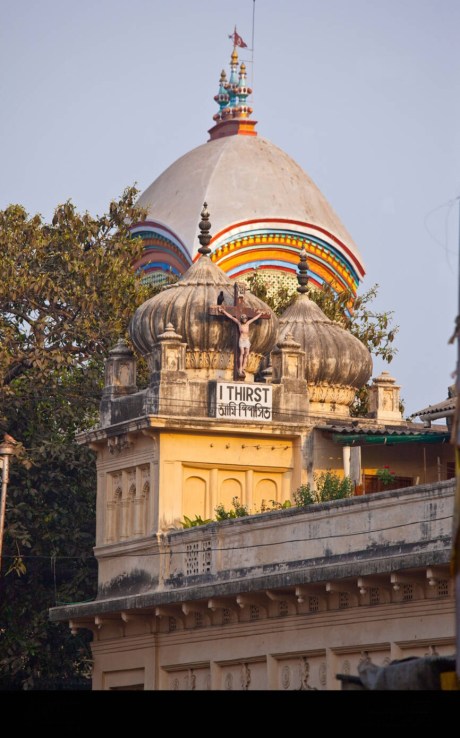
The Kolkata in which Mother Teresa built her ministry is eager to shed its tag of being the city of poverty and gutters, as much as being the city of bhoy (fear). The elimination of the latter tag was an election goal of the BJP, which is now in power. Even the earlier branding—begging, pity and largesse—was sought to be discarded as soon as Mother Teresa passed away. – Reshmi Dasgupta
The French author Dominique Lapierre was not being literal when he famously called Kolkata the “City of Joy”. Like many other foreigners before and after him, he romanticised the unrelenting poverty of those he saw in the beleaguered city, choosing instead to praise their “resilience” amid the suffering, and their ability to be content with the bare minimum—and charity. He saw that as joy. Indians, including those in Kolkata, are no longer content with that interpretation.
That is possibly also why Kolkata no longer identifies closely with the other icon of charity, Mother Teresa, either. At one point, Mother Teresa’s stature, at least among certain vocal and visible sections, dwarfed even that of Ma Kali, the traditional deity of Kolkata. But the destitution that she saw and based her Christian mission on is not valorised anymore as an inevitable condition or one that needs the ministrations that her Missionaries of Charity undertake.
It is not coincidental, actually, that as a Christian missionary, Mother Teresa chose to open one of her most controversial projects, Nirmal Hriday, a hospice for the dying destitute, right next to Ma Kali’s most important temple at Kalighat in south Kolkata. She even managed to get the Kolkata Municipal Corporation to hand over a building that used to house pilgrims visiting Kalighat and actually abuts the Shakti Peeth itself. That concession in 1952 was indicative.
Also indicative is the fact that the current US Secretary of State Marco Rubio, himself not only a practising Catholic but also prone to supporting evangelical Southern Baptists, chose to start his India visit last weekend by making a pilgrimage to Mother Teresa’s grave in Kolkata. With Christian nationalism being given plenty of play by the Trump administration, Rubio’s harking back to the “Saint of Kolkata” at this juncture cannot just be coincidental or innocuous.
Rubio described Mother Teresa’s work as “a living example of Catholic faith in action”, which may have embarrassed sections of Indian elites who had made her out to be a “secular” icon, ignoring the fact that she was a nun and therefore emphatically religious. They had tried to portray her as just a dedicated social worker who empathised with India’s destitute millions rather than a “bride of Christ” duty-bound to bring the heathens into the arms of the Saviour.
Hindu organisations, especially in the financially constricted days of “socialist” India, were not seen to be as driven as she was to minister to the poorest of the poor. But nor did Hindu organisations have such a media-magnet face to highlight their activities and prompt generous donations. For the many elite Indians who donated and volunteered with the Missionaries of Charity, there was more cachet in associating with a famous foreign nun than with any Hindu or Indian ones.
The fact that most people do not even know who heads that body now proves the point. More importantly, the Kolkata in which she built her ministry is also eager to shed its tag of being the city of poverty and gutters, as much as being the city of bhoy (fear). The elimination of the latter tag was an election goal of the BJP, which is now in power. Even the earlier branding—begging, pity and largesse—was sought to be discarded as soon as Mother Teresa passed away.
Today, Kalighat Temple is still flanked by squalid slums, but the kind of heart-rending poverty that made Kolkata the stuff of donation-triggering nightmares in the West is long gone. “Destitutes” have options other than Nirmal Hriday, that too with no “ticket to St. Peter”, as Mother Teresa famously called the conversions to Christianity of terminally ill inmates at the hospice. Harking back to the tropes of lepers and starving “poorest of the poor” is patently unfair to the city.
Mother Teresa is certainly the best-known “Indian” Christian saint now, though two other nuns (both Indian) were canonised before her: St. Alphonsa Muttathupadathu in 2008 and St. Euphrasia Eluvathingal in 2014. St. Thomas the Apostle, a contemporary of Jesus, [allegedly] came to India 2,000 years ago, … while St. Francis Xavier arrived 500 years ago and is buried in Goa. But Rubio and the American Embassy here probably do not know about them.
So, amid concern in Bengal about Christian conversions, Rubio went to Mother House, perhaps to assert his support for missionary activity worldwide for the benefit of his Christian audience at home. But the protocol for his Kolkata stop—the first visit there by a US Secretary of State in 14 years—was telling: the Chief Minister did not receive him at the airport, nor did any other minister, state or central; just officials of the External Affairs Ministry. India was not amused.
That the US Embassy decided to go ahead with Rubio’s Missionaries of Charity Kolkata pitstop despite such obvious signals from India underscores the impression that there was an unspoken agenda. More so because Mother Teresa had the distinction of being awarded honorary US citizenship (one of only eight people to be given that status) and was also bestowed the Presidential Medal of Freedom by Ronald Reagan, indicating her importance to American Christians.
Her address after receiving the medal was revealing too: “And remember that whatever you do to the least, you do it to Him, Jesus said. You did it to me. What a wonderful opportunity for each one of us to be 24 hours with Jesus. And in doing what we are doing, as he said, if you receive a little child in my name, you receive me. If you give a glass of water in my name, you give it to me. What wonderful and beautiful tenderness and love of Christ for each one of us.”
Helping the poor and destitute in the name of God—any God—is commendable, but in light of Mother Teresa reaching out even to dictators and tyrants for that purpose (as has been highlighted by several writers who contest her saintly image), the abiding support for her by the notoriously fickle US is intriguing. By stopping off in Kolkata on his way to the Quad meeting in Delhi just to pay his respects to her, what exactly was Rubio communicating, and to whom?
The scuttlebutt was that Rubio wanted to pressure India to let the Missionaries of Charity off the hook on foreign donations, but the organisation retains permission for that. Another group says Rubio was asked to persuade India not to fiddle with the Foreign Contribution Regulation Act, as new proposed amendments may lead to Christian entities in India, including Mother Teresa’s organisation, forfeiting their assets if they are found to have done anything illegal.
Arguing that Christian outfits—or any other religious organisations—should be allowed to conduct activities with minimal government monitoring or punitive provisions in the name of “religious freedom” is tenuous. The role of such organisations in fomenting trouble in India has long been known and has prompted action to monitor how foreign funds are used in India. Rubio wisely skirted what could have been seen as bullying by not raising the FCRA issue with India.
All top diplomatic visitors to Kolkata should now consider going instead to pay their respects first to Ma Kali at the Kalighat temple. She is the city’s patron deity, after all, and reigns supreme. – Firstpost, 26 May 2026
› Reshmi Dasgupta is a freelance writer in New Delhi
Filed under: india, USA | Tagged: geopolitics, kalika at kalighat, marco rubio, mother teresa, US-india relations | Comments Off on Kolkata is Ma Kali’s city again, not Mother Teresa’s – Reshmi Dasgupta











