














 “Prof Vamsee Juluri faces Hinduism’s critics frontally, be it the categorisation of Amarnath as a “penis-shaped lump of ice”, pornographic depictions of Ganesh, or Wendy Doniger’s flawed writings that put the Vedic people at par with the white settlers who destroyed the Native Americans and Hitler’s Nazis. While anti-Hindu writings of the colonial era can be explained as racial prejudice, the contemporary bias is disguised as an attack on ‘Hindu extremism.’ The writers savage the faith and pervert every meaning because they are waging war on the fundamental validity of Hinduism.” – Sandhya Jain
 It took a gentle but artful communicator to nail the lies and distortions about the predominantly Hindu history of India, its faith, culture, indeed the entire gamut of this ancient civilisation, by the academic discourse of the Western world. That the West’s Christian ethos (including its Catholic, Protestant and Secular manifestations) is at the root of the near-pathological hatred of this once exalted but now dormant civilisation, is skilfully exposed.
Vamsee Juluri, a US-based professor of media studies, punctures Western academia’s Hindu-phobic worldview by juxtaposing it with the depth of Vedic thought with its emphasis on the sanctity of all life, in contrast to the homo-centric dogma that Man is the master and legitimate consumer of all non-human life.
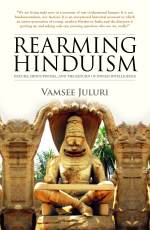 In Rearming Hinduism: Nature, History and the Return of Indian Intelligence (Westland, 2014), Juluri identifies Wendy Doniger as the symbol of writing that must be judged poor in authenticity and understanding of the world’s oldest living civilisation, one that offered space and solace to the hounded – from the destruction of Solomon’s Temple, from the vendetta against the Prophet’s family, from religious prejudice, even from secular Maoism; the list is endless. How, in the absence of a unified political authority, did India unfailingly provide refuge through the ages, unless it is a civilisational unity?
A civilisation is not buildings and machines, but its people, their thought and culture. It is a way of knowing the world, of giving meaning and value to the contents of life. This is an unwitting admonition of those who, defensive at being labelled ‘communal’, claim Hinduism (Sanatana Dharma) is not a religion but a way of life, and thus denigrate and disown the forms in which the civilisation gives meaning and value to life.
The moot point, Juluri recognises, is that one billion Hindus still call God by the same names given to the Divine thousands of years ago. Put simply, there is a marvellous continuity in the diversity of India, which is intrinsic to the unity of its civilisational ethos and sets it apart from monotheistic traditions that have historically experienced stress in coping with plurality within their own faiths, and hence, naturally, with others. Christianity tried to overcome the brutal legacy of the Inquisition and Catholic-Protestant wars with inter-denominational tolerance (secularism), but though this was formally extended to other faiths, the bigotry against Hinduism persists as academic and media bias.
The reason, he hints, is the West’s inability to attain the exalted heights Hindu philosophy scaled thousands of years ago, which Hindus struggled to preserve and protect in the face of grievous assaults on their civilisation, gods, temples, people, especially women, and their land. Faced with the hostility of the proponents of One God, Hindus (all native Indians) continued to believe that God is One, a Unity and not a Number, a divine intelligence that pervades all creation and whose best gift to humanity is intelligence, comprehension, perception.
This is the essence of the Gayatri Mantra, which informs our spiritual quest to this day. It is this intelligence that will help India rise again, for, as Sri Aurobindo said, “… the Sanatana Dharma is life itself; it is a thing that has not so much to be believed as lived…. India has always existed for humanity and not for herself and it is for humanity and not for herself that she must be great….”
 Juluri faces Hinduism’s critics frontally, be it the categorisation of Amarnath as a “penis-shaped lump of ice”, pornographic depictions of Ganesh, or Wendy Doniger’s flawed writings that put the Vedic people at par with the white settlers who destroyed the Native Americans and Hitler’s Nazis. While anti-Hindu writings of the colonial era can be explained as racial prejudice, the contemporary bias is disguised as an attack on ‘Hindu extremism.’ The writers savage the faith and pervert every meaning because they are waging war on the fundamental validity of Hinduism.
Beyond Zero and Arabic numerals, which the Arabs recorded as receiving from India, the West got many of its humanistic ideals from India. Juluri claims it cannot be a coincidence that the Enlightenment closely followed the West’s encounter with India, via the Arab world, though this is academically unmentionable. One could add that this explains why the Renaissance (rediscovery of knowledge banned by the Church) led to colonialism, for the latter was as much a quest for material resources as for intellectual resources.
The negation of Hinduism creates peculiar academic contortions. We are told there is no religion called Hinduism as it was invented by the British and the Brahmins in the 19th century. At the same time, Hinduism is responsible for the caste system, patriarchy, and oppression of women, and was full of violence until Buddhism, Islam and Christianity somehow civilised it. Above all, Hindus (Aryans) were invaders of India; but there is no trace of their religion in the places from where they allegedly originated!
 This is classic orientalism, long denounced by Edward Said, wherein what could be said or could not be said in academia is strictly controlled through unspoken rules. Orientalism about Hinduism was driven by colonial interests, evangelism, and the white man’s burden, so Hindus were projected as evolutionary inferiors. After World War II, it continued due to America’s Cold War alliance with Islamic Pakistan.
Juluri does not dodge uncomfortable issues like the rising anger against Muslims since the 1980s, but notes that the only place in India where a mass expulsion occurred was Kashmir, where Hindus were forced to leave. As for the caste system, the Ramayana was written by a thief turned sage (Valmiki), the Mahabharataby a fisherman’s grandson (Ved Vyasa), both were non-Brahmins, as were the two most popular deities, Rama and Krishna. While modern India accepted the need to address forms of caste discrimination, it never experienced civic apartheid like America, where seats in public buses were segregated till the mid-twentieth century! This is because the Purush Sukta is not so much about hierarchy as about perceiving all individuals as manifestations of the divine.
 Juluri tackles every prejudice thrown at Hindus over the ages, making jejune fantasies dissolve before the ideals of ahimsa, samskara, satya, sabhyata, karma, dharma…. Hinduism is the adoration of the mystical force behind life, evoked as Tvameva, you alone are worthy of knowing. It is impossible to do justice to this effort; the book is a must read for those who wish to experience what is it to be Hindu. It is also a charge-sheet against the moral and civilisational failures of the West. – The Pioneer, 19 May 2015
» Sandhya Jain is a senior journalist in New Delhi and columnist for The Pioneer.
Filed under: india | Tagged: defending dharma, dharma, hinduism, hinduphobia, hindus, india, orientalism, psychological warfare, sanatana dharma, vamsee krishna juluri, wendy doniger, western academics, western scholars | 1 Comment »











