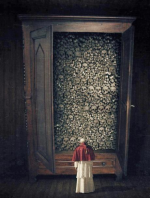












 “There is no record of the final days of Jesus, says Thiering. He had married Mary Magdalene, fathered a family, and later divorced. He was seventy years old in AD 64, and it is probable that he died of old age in seclusion in Rome. That leaves the legend about Jesus having died in Kashmir open to conjecture.” – Abu Abraham
 The text for my sermon this morning is from Barbara Thiering, Australian theologist and scholar extraordinary. For over twenty years she has been involved in research into the Dead Sea Scrolls, and the result is a new version of Christ’s life, titled Jesus the Man.
This is not a book for fundamentalists but for those who have a curiosity about the actual life of Jesus and the historical and social background of the time.
My text is the opening paragraph of Chapter Twenty-Five, “A death that failed.” Here it is: “Jesus did not die on the cross. He recovered from the effects of the poison, was helped to escape from the tomb by friends, and stayed with them until he reached Rome, where he was present in AD 64.”
The “poison” referred to here was in the “vinegar” that had been given to him on the cross. It was snake venom, taking a number of hours to act but which rendered him unconscious in a short time. It was 3 pm then, after six hours on the cross. He was thought to be dead but wasn’t.
This is not conjecture, asserts Barbara Thiering, but comes from a reading of the texts of the Dead Sea Scrolls by the pesher method. Pesher is a technique that she had to master before interpreting the Scrolls. The Hebrew word is used in the Old Testament to mean “interpretation of dreams.” Pesher in the context of the Scrolls is like a solution to a puzzle, something like a cryptic crossword. “The clues do not look as if they make sense, but anyone who knows the technique and has the necessary knowledge can solve the puzzle.”
Pesher apparently was known to the Greeks as well as the Jews. Allegorical meanings were often found in the Old Testament, but the Scrolls, says Thiering, give us, for the first time, historical meanings.
The Dead Sea Scrolls, it appears, reveal many more historical facts about the life of Jesus and his followers than do the gospels. The gospels quote Jesus as saying, “To you (his inner circle) is given the mystery of the Kingdom of God, but for those outside, everything is in parables.” The insiders, those who ‘have ears to hear’, will understand the mystery.
The miracles and the parables, understood this way, indicate that much in the gospels, as in the Scrolls, have two levels of meaning, one for the common people, the other for the sophisticated. On the surface are found the magic and the miracles, the raising of the dead, the turning of water into wine, the feeding of the multitudes with five loaves and two fish; but on a deeper level, a more realistic historical-account is revealed of the life of Christ and the origins of Christianity.
 If Jesus didn’t die on the cross but recovered inside the cave where he was laid, and walked out of it, then his “appearances” need no explanation. When Jesus “appeared” in a “vision” to Peter and Paul in subsequent years as recorded in the Acts of the Apostles, it was the real flesh and blood Jesus holding an audience with the ministers.
The evidence for resurrection has always been weak; an empty tomb providing only that it was empty. But the disciples wanted to believe in the resurrection. Paul goes to the extent of saying (in the first part of Corinthians), “If Christ has not been raised, your faith is in vain.”
But in the newly-discovered Gospel of Philip, says Thiering, there is a passage that denies resurrection: “Those who say that the Lord died first and then rose up are in error, for he rose up first and then died.”
Theologians and critical thinkers outside the Church have pointed out that throughout Christian history, the resurrection was not treated as central to the faith but something that developed in recent times. What is new, according to Thiering, is that we now have knowledge of a technique for reading the gospels “which shows us that the Evangelists themselves did not believe it, and which shows us what really happened.” They had a difficult task—how to meet the religious need for myth and at the same time to be truthful.
 There is a detailed description in this book of a “final journey” by ship, of Jesus, Luke, Paul and Peter. This was in June AD 60 and it took them to Crete, Malta and to Rome, where they remained. The emperor was the fanatical tyrant, Nero. When Rome was partly destroyed by fire in July AD 64, the rumour spread that Nero started it, and he immediately looked for scapegoats. The Christians were an obvious choice.
The book records: Knowing the danger he was in, Peter tried to flee from Rome. He got as far as the church near the Appian Way, now called Domine Quo Vadis. Jesus met him there and persuaded him to go back and face martyrdom. “The legend says that a visionary Jesus appeared to him, but it was the real Jesus.” Peter was crucified “in imitation of his master”, and Paul was put to death.
Tacitus, the Roman historian has recorded details of Nero’s persecution: “To scotch the rumour (that he started the fire), Nero substituted as culprits, and punished with the utmost refinements of cruelty, a class of men, loathed for their vices, whom the crowd styled Christians. Christus, the founder of the name, had undergone the death penalty in the region of Tiberius, by sentence of the procurator, Pontius Pilate, and the pernicious superstition was checked for a moment, only to break out once more, not merely in Judea, the home of the disease, but in the capital itself….
 “First, then, the confessed members of the sect were arrested; next on their disclosures, vast numbers were convicted, not so much on the count of arson as for hatred of the human race. And derision accompanied their end: they were covered with wild beasts’ skins and torn to death by dogs; or they were fastened on crosses, and, when daylight failed, were burned to serve as lamps by night.”
There is no record of the final days of Jesus, says Thiering. He had married Mary Magdalene, fathered a family, and later divorced. He was seventy years old in AD 64, and it is probable that he died of old age in seclusion in Rome. That leaves the legend about Jesus having died in Kashmir open to conjecture. – Deccan Herald, Bangalore, 19??
Editor’s Note: We have learned to our astonishment that the RSS promotes the Jesus-in-India story as official propaganda. If it is true, then the old men who guide and manage the great nationalist organisation are to be condemned for their cynicism. They offend all Indians, Christian and Hindu alike, with this fabulous story created by Nicholas Notovitch and published in Paris in 1894. Notovitch was immediately exposed and his travel tale debunked by Prof. Max Muller who asked him for proofs. Notovitch could not provide any proofs. The Abbot of Hemis Monastery in Ladakh, where Jesus allegedly studied and where the alleged manuscripts of “Saint Issa” were kept, condemned Notovitch as a liar, and the British official who administered the Ladakh area stated that Notovitch had never visited the monastery or its environs. In fact Hemis Monastery did not exist until the 11th century. Later renditions of the story by various authors declare the Hindu religion to be superstitious and degenerate and present Hindus as bigots who will not accept the superior teachings of Jesus. But the question that should concern Hindus in India, is why the RSS would accept and promote this Hindu-baiting, anti-national tale in the first place. What can be their possible motivation? – IS
» Abu Abraham (1924-2002) was a cartoonist, journalist and author. This article originally appeared in the Deccan Herald at an unknown date.
» Barbara Thiering is an Australian historian, and Biblical exegete specialising in the origins of the early Christian Church.
See also
- Swami Devananda’s letter to Sadhu Rangarajan concerning his Jesus-in-India story on Sulekha
- Jesus Christ: An Artifice for Aggression by Sita Ram Goel
Filed under: india | Tagged: christian history, christian mythology, christian theology, jesus christ | 5 Comments »