













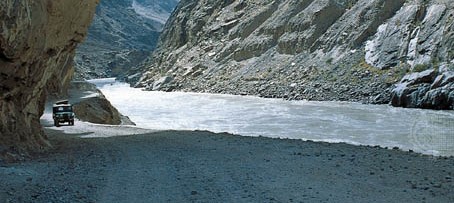
 The Indus Waters Treaty, signed in 1960 between India and Pakistan, … seems completely outdated today. – Claude Arpi
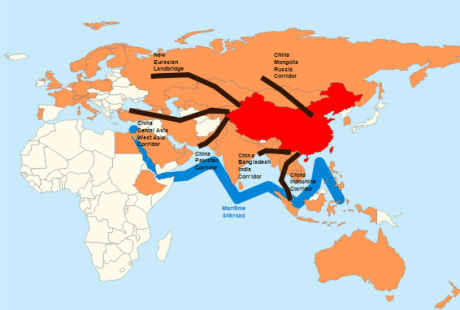
On the occasion of the opening of the One Belt One Road (OBOR) forum in Beijing, President Xi Jinping urged countries across the globe to join hands with China in pursuit of globalisation: “We have no intention to form a small group detrimental to stability. What we hope to create is a big family of harmonious co-existence.”
India has some doubts about the “big family”. Take the example of the China-Pakistan Economic Corridor (CPEC), an OBOR’s offshoot; it crosses Gilgit-Baltistan (GB), considered by India an integral part of Jammu & Kashmir.
Not only has China pushed Islamabad to make GB a fifth province of Pakistan, but according to CNN-News18.com, “Information and interviews exclusively accessed by CNN-News18 showed that the land was procured mostly by force by Pakistani generals for the CPEC and those resisting are either killed off or incarcerated without a trial.”
Wajahat Hasan, chairman of the Gilgit-Baltistan Thinkers Forum, told the same channel: “Thousands had their land snatched and occupied by the military authorities and their agencies. Under this black draconian rule, nobody can raise their voices against the CPEC.”
Issue
Another worrying issue: when Prime Minister Nawaz Sharif visited China to attend the forum, a memorandum of understanding (MoU) was signed to fund and build five mega hydroelectric power (HEP) projects.
The Pakistani press spoke of an Indus cascade of dams, two of them costing $27 billion (Rs17,000 crore), being located in GB.
The Pakistani newspaper, The Express Tribune, had earlier claimed that Pakistan and China would develop the North Indus River Cascade with an investment of $50 billion (Rs32,000 crore) to generate up to 40,000 MW hydro power.
According to Pakistan’s Water and Power Development Authority (WAPDA), the Indus cascade will start from GB to reach the existing Tarbela dam downstream, not far from Islamabad.
At the MoU-signing ceremony, Nawaz Sharif affirmed: “Development of the North Indus Cascade is a major focus of my government and the construction of Diamer-Basha Dam is the single most important initiative in this regard.”
He added, “Water and food security are of paramount importance for Pakistan keeping in view the challenges posed by climate change.”
A 7,100 MW HEP project will be built at Bunji on the way to Skardu, the capital of Baltistan.
Though described by WAPDA as a run-of-the-river (RoR) project, it is clearly not one, as it will have a 22-km-long reservoir which will inundate 12 km of the road between Gilgit and Skardu.
The next dam is the Diamer-Basha HEP with a potential of 4,500 MW. The Diamer-Basha reservoir will submerge some 104 km of the Karakoram Highway and displace about 30,000 people, admits the WAPDA.
It will cost $15 billion (Rs965 crore). Both projects follow the Karakoram Highway in GB. Joydeep Gupta, a water expert, explained in a news portal: “The Diamer-Basha dam is being promoted by WAPDA as a sediment trap and therefore good for downstream hydropower projects. But the same sediment—mainly silt—rejuvenates the soil downstream every year and has been the main reason why agriculture has been sustained in the Indus valley for millennia.”
But this does not bother the Pakistan politicians.
Projects
The other projects (the 4,320 MW Dasu HEP, the 2,200 MW Patan HEP, the 4,000 MW Thakot HEP using four head-race tunnels to divert waters and generate electricity) are located in Khyber Pakhtunkhwa province.
A “lost” Saraswati river in the making? It has now been scientifically proved that big dams are not sustainable for several reasons; the first one being the amount of silt retained behind the dam, which stops nourishing downstream areas.
Interestingly, there is a movement in the United States to progressively decommission all large dams, which “kills” the river, with many species of fishes unable to migrate upstream.
Another important factor is the strong “dam lobby” in China which smells the billion dollars; it has been active since the time of Premier Li Peng and his mega Three Gorges dam.
Nepal too seems to have fallen prey to this lobby. Nepal’s ministry of energy recently signed an MoU with China Gezhouba Group Corporation (CGGC) for the development of a 1,200 MW Budhigandaki HEP, which will be the biggest hydro project in Nepal.
The agreement was signed at the prime minister’s residence, with the Chinese Ambassador to Nepal in attendance.
The dam will be built under the “engineering, procurement, construction and finance” model. It means that CGGC will help arrange soft or commercial loans from China.
Warning
Already in August 2010, warning bells have been ringing in the corridors of South Block in Delhi.
The well-informed journalist, Selig Harrison, then wrote in The New York Times that according to “a variety of foreign intelligence sources, Pakistani journalists and Pakistani human rights workers”, two important new developments in Gilgit-Baltistan were taking place: “a simmering rebellion against Pakistani rule and the influx of an estimated 7,000 to 11,000 soldiers of the People’s Liberation Army”.
Tomorrow, tens of thousands of Chinese workers (17,000 for the Daimer-Basha HEP only) will come to GB; a decade or so later, when the work is completed, many will “buy” land from Pakistan and settle for good in the area.
Further, China is bound to develop GB as a “special” tourist destination (once the basic infrastructure is in place for the dams) and ultimately hordes of Chinese tourists will pour in to visit the “last paradise on earth”.
How will India react? The time has perhaps come to think about this. Does Delhi want a China Town in Skardu or Gilgit? One of the solutions is to renegotiate the Indus Waters Treaty, signed in 1960 between India and Pakistan. With the latest developments, it seems completely outdated today. – Mail Online, 10 June 2017
» Claude Arpi is a French-born author, journalist, historian and tibetologist. He is the director of the Pavilion of Tibetan Culture at Auroville, Tamil Nadu, where he lives.

Filed under: gilgit-baltistan, india, pakistan | Tagged: china-pakistan relations, dams, gilgit-baltistan, india, indus, OBOR, pakistan, pakistan-occupied kashmir | Leave a comment »