







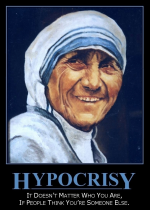







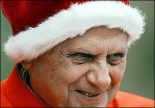
 “In the 1970s, paedophilia was theorised as something fully in conformity with man and even with children.” … “It was maintained – even within the realm of Catholic theology – that there is no such thing as evil in itself or good in itself. There is only a ‘better than’ and a ‘worse than’. Nothing is good or bad in itself.” – Pope Benedict to his child-abusing bishops and priests in 2010 in the Regia Hall, Vatican.
 Victims of clerical sex abuse have reacted furiously to Pope Benedict’s claim in his Christmas address 2010 that paedophilia wasn’t considered an “absolute evil” as recently as the 1970s.
In his traditional Christmas address to cardinals and officials working in Rome, Pope Benedict XVI also claimed that child pornography was increasingly considered “normal” by society.
“In the 1970s, paedophilia was theorised as something fully in conformity with man and even with children,” the Pope said.
“It was maintained – even within the realm of Catholic theology – that there is no such thing as evil in itself or good in itself. There is only a ‘better than’ and a ‘worse than’. Nothing is good or bad in itself.”
The Pope said abuse revelations in 2010 reached “an unimaginable dimension” which brought “humiliation” on the Church.
Asking how abuse exploded within the Church, the Pontiff called on senior clerics “to repair as much as possible the injustices that occurred” and to help victims heal through a better presentation of the Christian message.
“We cannot remain silent about the context of these times in which these events have come to light,” he said, citing the growth of child pornography “that seems in some way to be considered more and more normal by society” he said.
 But outraged Dublin victim Andrew Madden last night insisted that child abuse was not considered normal in the company he kept.
Mr Madden accused the Pope of not knowing that child pornography was the viewing of images of children being sexually abused, and should be named as such.
He said: “That is not normal. I don’t know what company the Pope has been keeping for the past 50 years.”
Pope Benedict also said sex tourism in the Third World was “threatening an entire generation”.
Angry abuse victims in America last night said that while some Church officials have blamed the liberalism of the 1960s for the Church’s sex abuse scandals and cover-up catastrophes, Pope Benedict had come up with a new theory of blaming the 1970s.
“Catholics should be embarrassed to hear their Pope talk again and again about abuse while doing little or nothing to stop it and to mischaracterise this heinous crisis,” said Barbara Blaine, the head of SNAP, the Survivors Network of those Abused by Priests,
“It is fundamentally disturbing to watch a brilliant man so conveniently misdiagnose a horrific scandal,” she added.
“The Pope insists on talking about a vague ‘broader context’ he can’t control, while ignoring the clear ‘broader context’ he can influence – the long-standing and unhealthy culture of a rigid, secretive, all-male Church hierarchy fixated on self-preservation at all costs. This is the ‘context’ that matters.”
The latest controversy comes as the German magazine Der Spiegel continues to investigate the Pope’s role in allowing a known paedophile priest to work with children in the early 1980s. – Soda Head, 13 Nov. 2011
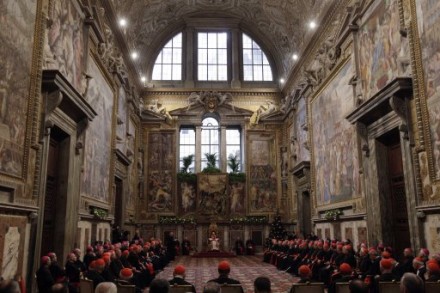
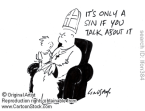 Sign of the Times
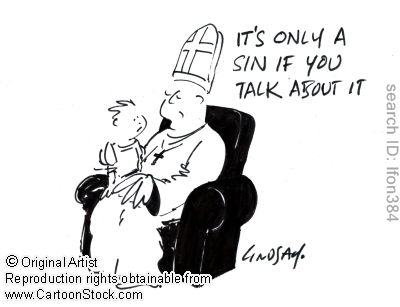
Victims of clerical sex abuse have reacted furiously to Pope Benedict’s claim yesterday that paedophilia wasn’t considered an “absolute evil” as recently as the 1970s.
In his traditional Christmas address yesterday to cardinals and officials working in Rome, Pope Benedict XVI also claimed that child pornography was increasingly considered “normal” by society.
“In the 1970s, paedophilia was theorised as something fully in conformity with man and even with children,” the Pope said.
“It was maintained – even within the realm of Catholic theology – that there is no such thing as evil in itself or good in itself. There is only a ‘better than’ and a ‘worse than’. Nothing is good or bad in itself.”
The Pope said abuse revelations in 2010 reached “an unimaginable dimension” which brought “humiliation” on the Church.
Asking how abuse exploded within the Church, the Pontiff called on senior clerics “to repair as much as possible the injustices that occurred” and to help victims heal through a better presentation of the Christian message.
“We cannot remain silent about the context of these times in which these events have come to light,” he said, citing the growth of child pornography “that seems in some way to be considered more and more normal by society” he said.
But outraged Dublin victim Andrew Madden last night insisted that child abuse was not considered normal in the company he kept.
Mr Madden accused the Pope of not knowing that child pornography was the viewing of images of children being sexually abused, and should be named as such.
He said: “That is not normal. I don’t know what company the Pope has been keeping for the past 50 years.”
 Pope Benedict also said sex tourism in the Third World was “threatening an entire generation”.
Angry abuse victims in America last night said that while some Church officials have blamed the liberalism of the 1960s for the Church’s sex abuse scandals and cover-up catastrophes, Pope Benedict had come up with a new theory of blaming the 1970s.
“Catholics should be embarrassed to hear their Pope talk again and again about abuse while doing little or nothing to stop it and to mischaracterise this heinous crisis,” said Barbara Blaine, the head of SNAP, the Survivors Network of those Abused by Priests,
“It is fundamentally disturbing to watch a brilliant man so conveniently misdiagnose a horrific scandal,” she added.
“The Pope insists on talking about a vague ‘broader context’ he can’t control, while ignoring the clear ‘broader context’ he can influence – the long-standing and unhealthy culture of a rigid, secretive, all-male Church hierarchy fixated on self-preservation at all costs. This is the ‘context’ that matters.”
The latest controversy comes as the German magazine Der Spiegel continues to investigate the Pope’s role in allowing a known paedophile priest to work with children in the early 1980s. – Sign of the Times, 21 Dec. 2010
Reference
Excerpt from the text of Benedict XVI’s address to the Roman Curia on Monday, 20 December 2010. Click here for full text.
“In the vision of Saint Hildegard, the face of the Church is stained with dust, and this is how we have seen it. Her garment is torn – by the sins of priests. The way she saw and expressed it is the way we have experienced it this year. We must accept this humiliation as an exhortation to truth and a call to renewal. Only the truth saves. We must ask ourselves what we can do to repair as much as possible the injustice that has occurred. We must ask ourselves what was wrong in our proclamation, in our whole way of living the Christian life, to allow such a thing to happen. We must discover a new resoluteness in faith and in doing good. We must be capable of doing penance. We must be determined to make every possible effort in priestly formation to prevent anything of the kind from happening again. This is also the moment to offer heartfelt thanks to all those who work to help victims and to restore their trust in the Church, their capacity to believe her message. In my meetings with victims of this sin, I have also always found people who, with great dedication, stand alongside those who suffer and have been damaged. This is also the occasion to thank the many good priests who act as channels of the Lord’s goodness in humility and fidelity and, amid the devastations, bear witness to the unforfeited beauty of the priesthood.
“We are well aware of the particular gravity of this sin committed by priests and of our corresponding responsibility. But neither can we remain silent regarding the context of these times in which these events have come to light. There is a market in child pornography that seems in some way to be considered more and more normal by society. The psychological destruction of children, in which human persons are reduced to articles of merchandise, is a terrifying sign of the times. From Bishops of developing countries I hear again and again how sexual tourism threatens an entire generation and damages its freedom and its human dignity. The Book of Revelation includes among the great sins of Babylon – the symbol of the world’s great irreligious cities – the fact that it trades with bodies and souls and treats them as commodities (cf. Rev 18:13). In this context, the problem of drugs also rears its head, and with increasing force extends its octopus tentacles around the entire world – an eloquent expression of the tyranny of mammon which perverts mankind. No pleasure is ever enough, and the excess of deceiving intoxication becomes a violence that tears whole regions apart – and all this in the name of a fatal misunderstanding of freedom which actually undermines man’s freedom and ultimately destroys it.
“In order to resist these forces, we must turn our attention to their ideological foundations. In the 1970s, paedophilia was theorized as something fully in conformity with man and even with children. This, however, was part of a fundamental perversion of the concept of ethos. It was maintained – even within the realm of Catholic theology – that there is no such thing as evil in itself or good in itself. There is only a “better than” and a “worse than”. Nothing is good or bad in itself. Everything depends on the circumstances and on the end in view. Anything can be good or also bad, depending upon purposes and circumstances. Morality is replaced by a calculus of consequences, and in the process it ceases to exist. The effects of such theories are evident today. Against them, Pope John Paul II, in his 1993 Encyclical Letter Veritatis Splendor, indicated with prophetic force in the great rational tradition of Christian ethos the essential and permanent foundations of moral action. Today, attention must be focussed anew on this text as a path in the formation of conscience. It is our responsibility to make these criteria audible and intelligible once more for people today as paths of true humanity, in the context of our paramount concern for mankind.” – Catholic Herald, London, 20 Dec. 2010
Filed under: india | Tagged: celibacy, child sex abuse, paedophile priests, roman catholic church, sex scandal, theology, vatican, vatican sex scandal | 2 Comments »






 BHARATA BHARATI