












 “I believe it’s time we debated Section 377 of the Indian Penal Code that criminalises sexual activity of LGBTs. It is an egregious and illiberal Section that must be repealed.” – Amish Tripathi
Section 377 of the Indian Penal Code that criminalises sexual acts “against the order of the nature”—which affects the rights of LGBTs (Lesbians, Gays, Bisexuals and Transgenders)—is an “egregious and illiberal section” and it “must be repealed”, says Amish Tripathi, whose mythological fiction titles have sold more than four million copies.
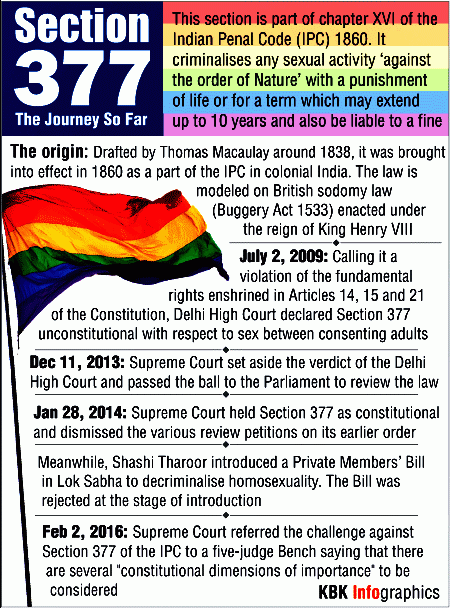
There is widespread support for the scrapping of Section 377 among writers and intellectuals in India and the likes of noted poet Vikram Seth and writer-politician Shashi Tharoor have openly advocated repealing of this Victorian-era statute. Banker-turned-writer Amish Tripathi is the latest public figure to join the chorus—but his arguments are slightly different.
In his first non-fiction book Immortal India (Westland/Rs 275/188 Pages), Tripathi lays out the vast landscape of ancient Indian culture and argues that it had a fascinatingly modern outlook.
“I believe it’s time we debated Section 377 of the Indian Penal Code that criminalises sexual activity of LGBTs. It is an egregious and illiberal Section that must be repealed. There are some who have reservations based on cultural and religious grounds. Well, let’s discuss them,” Tripathi writes in his essay on LGBT rights before presenting his arguments, validated by his research and knowledge of Hindu mythology.
“I am not an expert on religious mythologies of other religions, but as far as Hindu scriptures are concerned, I think there are ample examples to substantiate that LGBT rights were accepted in ancient India,” Tripathi told IANS when asked what made him reach this conclusion.
His essay in the book is written from a Hindu perspective and draws immensely from ancient scriptures. He cites several examples and anecdotes from Hindu religious texts to make his point — that LGBT rights were accepted in ancient India.
“Purush napunsak nari va jiv charachar koi / Sarv bhav bhaj kapat taji mohi param priy soi. (Any man, any transgender, any woman, any living being, as long as they give up deceit and come to me with love for all, they are dearest to me.)”
“These lines were said by Lord Ram in the Ramcharitmanas. He did not differentiate between man, woman or transgender. What does this mean? According to me, this shows our liberal ancient attitude towards LGBTs. And there are other examples in the Mahabharata too. Such stories were celebrated in ancient India and this, to my mind, reflects the liberal attitude we had towards LGBT communities,” he elaborated.
Tripathi also argues in the book that Section 377 does not reflect the traditional Indian attitude towards sex. It is, instead, he argues, a reflection of the British colonial mindset, influenced by medieval interpretations of Christianity.
“I think there is a great deal to learn from such examples. If we had such a society, which accepted LGBT communities with openness in ancient India, I surely think we can think on similar lines today as well. Also, on the principle of individual liberty, if heterosexuals can lead their lives in the way that they see fit, then LGBT communities should also have the same rights and freedoms to decide how they want to lead their lives,” he maintained.
The best-selling author with gross retail sales of over Rs 100 crore further asserted that religion is an integral part of most societies but, in his opinion, modern laws should be based on individual liberty rather than on any religion.
“I am a very proud Hindu and I am a very religious person, but I do not think that religious beliefs should lay the foundation of any laws in the modern world. Modern laws should be based on the concept of individual rights and liberty. Everybody should enjoy equal freedom and rights in all aspects. Religion has a very important place in society. But laws should be based on secular principles and individual liberty, and they should not be influenced by any religion,” he contended.
Tripathi’s books have been translated into about 20 languages. He worked for 14 years in the financial services industry and quit it only after, in his own words, his royalty check became greater than his salary. – The News Minute, 3 September 2017
» Saket Suman is a senior correspondant for various news media in New Delhi.
Filed under: india | Tagged: BJP government, homosexuality, homosexuality in india, india, indian government, LGBTQ, section 377, supreme court of india | Leave a comment »