














 The Darkening Age: The Christian Destruction of the Classical World. By Catherine Nixey. Illustrated. 315 pp. Houghton Mifflin Harcourt. $28.
Vandalizing the Parthenon temple in Athens has been a tenacious tradition. Most famously, Lord Elgin appropriated the “Elgin marbles” in 1801-5. But that was hardly the first example. In the Byzantine era, when the temple had been turned into a church, two bishops—Marinos and Theodosios—carved their names on its monumental columns. The Ottomans used the Parthenon as a gunpowder magazine, hence its pockmarked masonry—the result of an attack by Venetian forces in the 17th century. Now Catherine Nixey, a classics teacher turned writer and journalist, takes us back to earlier desecrations, the destruction of the premier artworks of antiquity by Christian zealots (from the Greek zelos—ardor, eager rivalry) in what she calls The Darkening Age.
Using the mutilation of faces, arms and genitals on the Parthenon’s decoration as one of her many, thunderingly memorable case studies, Nixey makes the fundamental point that while we lionize Christian culture for preserving works of learning, sponsoring exquisite art and adhering to an ethos of “love thy neighbor,” the early church was in fact a master of anti-intellectualism, iconoclasm and mortal prejudice. This is a searingly passionate book. Nixey is transparent about the particularity of her motivation. The daughter of an ex-nun and an ex-monk, she spent her childhood filled with respect for the wonders of post-Pagan Christian culture. But as a student of classics she found the scales—as it were—falling from her eyes. She wears her righteous fury on her sleeve. This is scholarship as polemic.
Nixey writes up a storm. Each sentence is rich, textured, evocative, felt. Christian monks in silent orders summoned up Pagan texts from library stores with a gagging hand gesture. The destruction of the extraordinary, frankincense-heavy temple of Serapis in Alexandria is described with empathetic detail; thousands of books from its library vanished, and the temple’s gargantuan wooden statue of the god was dismembered before being burned. One Pagan eyewitness, Eunapius, remarked flintily that the only ancient treasure left unlooted from the temple was its floor.
Christians became known as those “who move that which should not be moved.” Their laudable appeal to have-nots at the bottom of the pile, both free and unfree, meant that bishops had a citizen-army of pumped-up, undereducated young men ready to rid the world of sin. Enter the parabalini, sometime stretcher-bearers, sometime assassins, who viciously flayed alive the brilliant Alexandrian mathematician and Pagan philosopher Hypatia. Or the circumcellions (feared even by other Christians), who invented a kind of chemical weapon using caustic lime soda and vinegar so they could carry out acid attacks on priests who didn’t share their beliefs.
Debate—philosophically and physiologically—makes us human, whereas dogma cauterizes our potential as a species. Through the sharing of new ideas the ancients identified the atom, measured the circumference of the earth, grasped the environmental benefits of vegetarianism.
To be sure, Christians would not have a monopoly on orthodoxy, or indeed on suppression: The history of the ancient world typically makes for stomach-churning reading. Pagan philosophers too who flew in the face of religious consensus risked persecution; Socrates, we must not forget, was condemned to death on a religious charge.
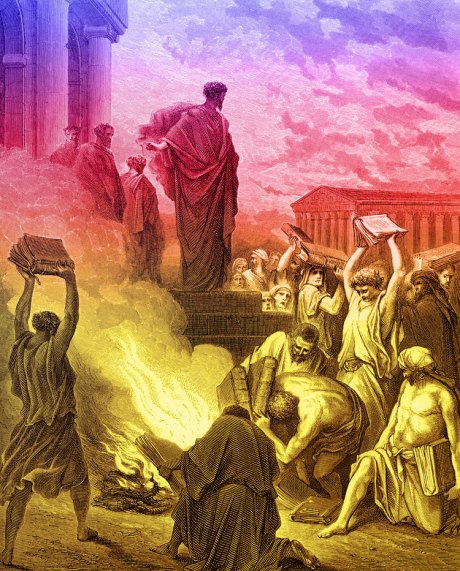
But Christians did fetishize dogma. In A.D. 386 a law was passed declaring that those “who contend about religion … shall pay with their lives and blood.” Books were systematically burned. The doctrinal opinions of one of the most celebrated early church fathers, St. John Chrysostom—he of the Golden Mouth—were enthusiastically quoted in Nazi Germany 1,500 years after his death: The synagogue “is a den of robbers and a lodging for wild beasts … a dwelling of demons.”
Actions were extreme because Paganism was considered not just a psychological but a physical miasma. Christianity appeared on a planet that had been, for at least 70,000 years, animist. (Asking the women and men of antiquity whether they believed in spirits, nymphs, djinns would have been as odd as asking them whether they believed in the sea.) But for Christians, the food that Pagans produced, the bath-water they washed in, their very breaths were thought to be infected by demons. Pollution was said to make its way into the lungs of bystanders during animal sacrifice. And once Christianity became championed by Rome, one of the most militaristic civilizations the world has known, philosophical discussions on the nature of good and evil became martial instructions for purges and pugilism.
Still, contrary to Nixey, there was not utter but rather partial destruction of the classical world. The vigorous debates in Byzantine cultures about whether, for example, magical texts were demonic suggest that these works continued to have influence in Christian Europe. The material culture of the time also lends nuance to Nixey’s story: Silverware and dining services in Byzantium were proudly decorated with images of the Iliad and Odyssey. And while 90 percent of all ancient literature has been lost, Paganism still had a foothold on the streets.
In Constantinople, the spiritual headquarters of Eastern Christendom, the seventh-century church was still frantically trying to ban the Bacchanalian festivities that legitimized cross-dressing, mask-wearing and Bacchic adulation. I read this book while tracing the historical footprint of the Bacchic cult. On the tiny Greek island of Skyros, men and children, even today, dress as half human, half animal; they wear goat masks, and dance and drink on Bacchus’ festival days in honor of the spirit of the god. It seems that off the page there was a little more continuity than Christian authorities would like to admit.
But the spittle-flecked diatribes and enraging accounts of gruesome martyrdoms and persecution by Pagans were what the church chose to preserve and promote. Christian dominance of academic institutions and archives until the late 19th century ensured a messianic slant for Western education (despite the fact that many Pagan intellectuals were disparaging about the boorish, ungrammatical nature of early Christian works like the Gospels). As Nixey puts it, the triumph of Christianity heralded the subjugation of the other.
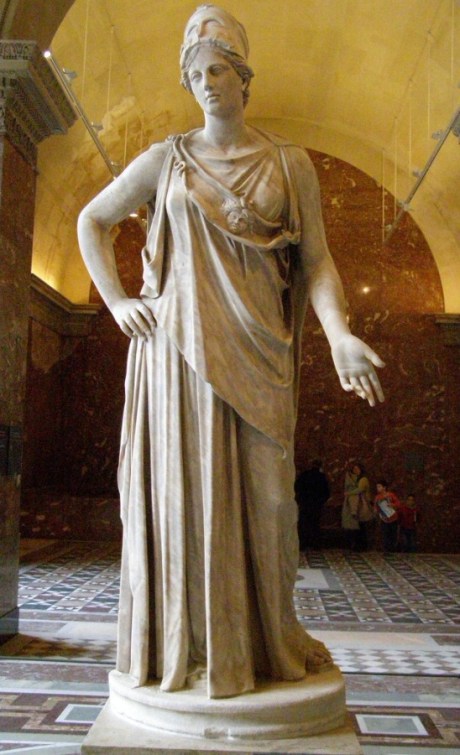
And so she opens her book with a potent description of black-robed zealots from 16 centuries ago taking iron bars to the beautiful statue of Athena in the sanctuary of Palmyra, located in modern-day Syria. Intellectuals in Antioch (again in Syria) were tortured and beheaded, as were the statues around them. The contemporary parallels glare. The early medieval author known as Pseudo-Jerome wrote of Christian extremists: “Because they love the name martyr and because they desire human praise more than divine charity, they kill themselves.” He would have found shocking familiarity in the news of the 21st century.
Nixey closes her book with the description of another Athena, in the city of her name, being decapitated around A.D. 529, her defiled body used as a stepping-stone into what was once a world-renowned school of philosophy. Athena was the deity of wisdom. The words “wisdom” and “historian” have a common ancestor, a proto-Indo-European word meaning to see things clearly. Nixey delivers this ballista-bolt of a book with her eyes wide open and in an attempt to bring light as well as heat to the sad story of intellectual monoculture and religious intolerance. Her sympathy, corruscatingly, compellingly, is with the Roman orator Symmachus: “We see the same stars, the sky is shared by all, the same world surrounds us. What does it matter what wisdom a person uses to seek for the truth?” – The New York Times, 8 June 2018
» Bettany Hughes is an English historian, author and broadcaster. Her speciality is classical history.
Filed under: india | Tagged: ancient civilizations, birth of christianity, christianity, paganism, psychological warfare, temple-breaking | 1 Comment »











