














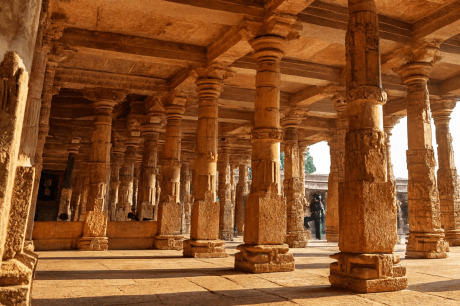
“Based on scientific investigations, survey and archaeological excavations, study and analysis of retrieved finds, study of architectural remains, sculptures, inscriptions, art and sculptures, it can be said that the existing [mosque] structure was made from the parts of earlier temples,” the 150-page ASI report said. – Shruti Tomar
The Archaeological Survey of India (ASI) told the Madhya Pradesh high court that the Bhojshala temple-Kamal Maula masjid in Madhya Pradesh’s Dhar district was built from the remains of earlier temples and the existing mosque at the site came up centuries later, adding the disputed structure to a string of similar conflicts roiling India for decades.
The 150-page report was submitted by ASI to the high court on Monday after conducting a survey between March 22 and June 30 at the one acre site. The exercise was ordered by the court on March 11 this year in connection with a petition filed by a Hindu group asking for namaz to be prohibited at the site.
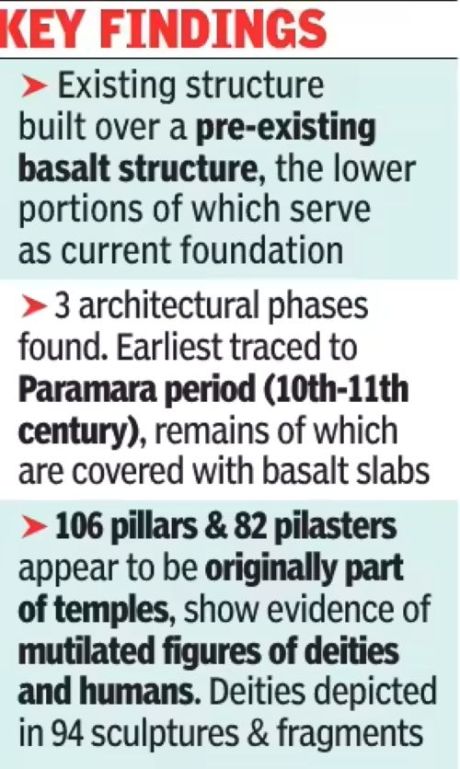
The survey claimed to have found 94 scriptures, 106 pillars, 82 pilasters, 31 ancient coins, 150 inscriptions, including images of Ganesh, Brahma with his consorts, Narasimha and Bhairava. The report also hinted that it may have been a temple dedicated to goddess Saraswati, a belief held by many Hindus.
“Based on scientific investigations, survey and archaeological excavations, study and analysis of retrieved finds, study of architectural remains, sculptures, inscriptions, art and sculptures, it can be said that the existing structure was made from the parts of earlier temples,” the 150-page report said.
“Fragments of these inscriptions, sculptures, and architectural members suggest that superstructure of this stone structure was later modified and converted into a mosque.”
The Hindu petitioners hailed the report. “We are sure that like Kashi and Ayodhya, Bhojshala will get back its original identity,” said Ashish Goyal, a member of the group Hindu for Justice that filed the petition in the high court.
Muslim organisations said the Supreme Court will take the final decision, referring to the top court’s decision on Monday agreeing to consider listing a plea against the survey. “The Supreme Court will take final decision on this and we can’t reveal the findings of the report as per the direction of the apex court,” said Dhar Shehar Qazi Waqar Saddique, a respondent in the matter who moved to the Supreme Court against ASI survey.
The dispute around the complex—Hindus worshipped at the centre of the Bhojshala dome and Muslims offer Friday prayers there—dates back to the early 1990s.
In 1997, the then Congress-led government banned the entry of common citizens, even as it allowed Muslims to offer namaz there. Under an arrangement devised by the Archaeological Survey of India on April 7, 2003, Hindus perform puja on the Bhojshala premises on Tuesdays, while Muslims offer namaz in the complex on Fridays.
The development holds striking similarities with suits filed by Hindu groups and petitioners in Varanasi and Mathura—all part of what experts have called the new temple movements, where Hindu groups and individuals have approached lower courts to file petitions seeking legal solutions to decades-old religious disputes, instead of using street mobilisations to push for change. In Varanasi, an ASI survey concluded earlier this year that a large Hindu temple existed before the construction of the Gyanvapi Masjid while in Mathura, a survey was stayed by the Supreme Court.
In all cases, Hindu petitioners argue that medieval-era Islamic structures were built by demolishing temples and demand praying rights. The Muslim sides reject the contention and say that any such legal action violates property and religious laws, including the 1991 Places of Worship Act, which locks the religious character of holy sites as they existed on August 15, 1947.
The act excluded the Ram Janmabhoomi-Babri Masjid dispute in Ayodhya, which gave rise to the most famous example of such a religious dispute. The title suit was decided by the Supreme Court in favour of the Ram Temple, which was consecrated earlier this year by Prime Minister Narendra Modi. But the Bharatiya Janata Party lost the Faizabad seat, under which Ayodhya falls, in general elections held in May-June.
The structure was first declared protected by the erstwhile Dhar state in 1909. In 1951, the complex was declared as a monument of national importance under the Ancient and Historical Monument and Archaeological Sites and Remains (Declaration of National Importance) Act, 1951. It is currently protected by ASI under the Ancient Monuments and Archaeological Sites and Remains Act, 1958. Monuments under this law aren’t covered by the 1991 act.
In May 2022, the Hindu Front for Justice filed the petition against the offering of namaz and ASI’s 2003 order that prohibited Hindus from offering daily puja in it. The Indore bench of the MP high court directed ASI to conduct a scientific survey of the complex by a committee of five members, and submit a report within six weeks which was later extended to 14 weeks.
In Dhar, ASI conducted the survey for 14 weeks between March 22 and June 30 on the directions of the high court and said the existing structure was built over the base of an earlier monument in the 11th century and the mosque probably came up in the 14th century. It also said the original structure of basalt was found during its digging.
“Existing structure appears to have been made hurriedly without paying much attention to symmetry, designs, material, etc. Although most of the superstructure is made of limestone, but some parts of the earlier basalt structure, and one pillar base of marble were also reused,” the report said.
The report mentioned a number of images and sculptures made of basalt, marble, schist, soft stone, sandstone and limestone.
“Images carved on (windows and pillars) included Ganesh, Brahma with his consorts, Narasima, Bhairava. … Images of animals in different mediums include lion, elephant, horse, dog, monkey, snake, tortoise, swan and bird. Mythical and composite figures include a variety of Kirtimukhas human face, lion face, composite face, vyala of different shapes, etc,” the report said.
It added that the kirtimukha—a motif with origins in the Shiv Puran—with human, animal and composite faces carved on a number of pillars in the western colonnade were not destroyed. “Small figures of deities carved on the frame of windows fixed in north and south walls of the western colonnade are also comparatively in good state of preservation,” the report said.
ASI said that as human and animal figures were not permitted in a mosque, at many places such as western and eastern colonnades, they were either chiselled out or defaced. It also said that some carvings on pillars, beams and windows were chopped off to reuse them in the present structure. “A large number of large size inscriptions in Sanskrit and Prakrit were damaged and reused,” the report said.
“Fragments of these inscriptions, sculptures, and architectural members suggest that superstructure of this stone structure was later modified and converted into a mosque,” the report said.
The report quoted inscriptions to Khilji king Mahmud Shah 1 in AH 859 (1455 CE) fixed on the gateway of the tomb of Abdullah Shah Changal at Dhar (Epigraphia Indo-Moslemcia 1909-10) and said that his men reached this old monastery with crowd of people and destroyed the effigies of idols and converted this temple into mosque violently.
The report said that the existing structure has long colonnades in all four directions decorated with 106 pillars and 82 pilasters. “Art and architecture of these pillars and pilasters in colonnades suggest that they were originally part of a temple. For their reuse in existing structure, figures of deities and human carved on them were mutilated,” the report said.
The report also claimed to be found more than 150 inscriptions and fragments, engraved on fine grained basalt in Nagari script, and dating to the 13th century CE. The Sanskrit and Prakrit inscriptions were earlier than the Arabic and Persian inscriptions, it added. “A large inscription fixed in the eastern colonnade contains two poems in Prakrit language consisting of 109 stanzas each. The first of them is called in the colophon as Avanikürmasatam and its authorship is attributed to Maharajadhiraja and Paramēśvara Bhöjadeva. Although, there is no colophon at the end of the second poem, it is also stated to have been composed by Paramara king Bhoja,” said the report, adding that these inscriptions start with the invocation of Gods such Om Sarasvityanamah, Om Namah Shivay etc.
Based on retrieved architectural remains, sculptural fragments, large slabs of inscriptions with literary texts and Nagakamika inscriptions on pillars, ASI said a large structure associated with literary and educational activities existed at the site. It also said that the pre-existing structure can be dated to the Paramara period of 11th century and was made from the “parts of earlier temples.”
ASI said the inscription on the eastern colonnade contained the first performance of Parijatamanjari Natika that took place in the temple of the goddess Saraswati. ASI found inscriptions such as Sarada (another name of Saraswati) Sadan and Om Sarasvityanamah. The inscription that the first performance of play Parijat Manjari written during King Arjunvarman, a descendant of Raja Bhoj of Dhar, was held at Saraswati temple, was also found.
Based on retrieved architectural remains, sculptural fragments, large slabs of inscriptions with literary texts and Nagakamika inscriptions on pillars, the ASI said a large structure associated with literary and educational activities existed at the site. It also said that the pre-existing structure can be dated to the Paramara period of 11th century and was made from the “parts of earlier temples”. – Hindustan Times, 27 February 2026
› Shruti Tomar is a senior reporter for the Hindustan Times.
Filed under: india, madhya pradesh | Tagged: ASI survey, bhojshala complex, defaced deity images, mosque replacing temple, muslims in india | Comments Off on Bhojasala ASI Report: Kamal Maula Mosque built over a Vagdevi Temple – Shruti Tomar











