














By framing an ancient civilisational consciousness as a modern political invention, Marxist scholars are trying to erase millennia of India’s spiritual, cultural, and national continuity. Hindu nationalism, rooted in the Rig Vedic vision of unity and expressed through sacred geography and shared devotion, represents an organic and enduring sense of nationhood—one that long predates European constructs of the nation-state.. – Arun Anand
The irony couldn’t be lost. The Left, after being done and dusted in India both electorally and ideologically, has kicked off a new campaign for a new narrative. Hold your breath! The new narrative of the Left is that it should be given credit for the birth and rise of Hindu nationalism post-independence!
A number of post-colonial studies by Leftist scholars, as well as research papers, have started getting published across the world around this theme. This appears to be a part of a concerted and well-planned campaign to hijack the Hindutva narrative that is driving the Indian polity right now. The latest intellectual heist by the Left is US-based Marxist academic Meera Nanda’s book Postcolonial Theory and the Making of Hindu Nationalism: The Wages of Unreason. Nanda’s book is an attempt to strengthen this latest narrative peddled by her fellow Marxist intellectuals—that the Left’s efforts to decolonise the Indian mind resulted in the birth and rise of Hindu nationalism.
Flawed Foundations and Academic Dishonesty
The core argument of Nanda and her fellow Marxist academia is deeply flawed, as their fundamental assumption is that ‘Hindu nationalism’ is a new ideology born in the 20th century. This argument not only betrays a lack of understanding due to shoddy academic rigour but also poor research and intellectual dishonesty, as she selectively picks reference material to support a preconceived narrative.
It is important to set the record straight in this context as far as ‘Hindu Nationalism’ is concerned.
Hindu Nationalism: An Ancient Civilisational Consciousness
‘Hindu Nationalism’ is quite different from European or Western nationalism. In this context, it is important to bust the myth propagated by Marxist scholars like Meera Nanda that the rise of nationalism in India was an outcome of British rule and hence followed the footsteps of ‘European Nationalism.’ The trajectories of European and Hindu nationalism are altogether different.
Radha Kumud Mookerji, known for his monumental work on the history and culture of India, explained this difference in his seminal work Nationalism in Hindu Culture (1921).
According to Mookerji, “It is a mistake readily to assume that the origin of that remarkable social phenomenon of nationalism is to be found in the West; that it is a genuinely Western product imported into the Eastern countries long after their growth and development; that the Eastern mind was completely a stranger to the very conception of the mother country, a sense of natural attachment to her, and a corresponding sense of duties and obligations which the children of the soil owe to her. Such misconceptions are due to a colossal ignorance of the culture of the East. Even in the dim and distant age of remote antiquity, unillumined by the light of historical knowledge, we find the underlying principles of nationalism chanted forth in the hymns of the Rigveda embodying the very first utterance of humanity itself. That book, one of the oldest literary records of humanity, reveals conscious and fervent attempts made by the Rishis (seers), those profoundly wise organisers of Hindu polity and culture, to visualise the unity of their mother-country, nay, to transfigure the mother earth into a living deity and enshrine her in the loving heart of the worshipper.”
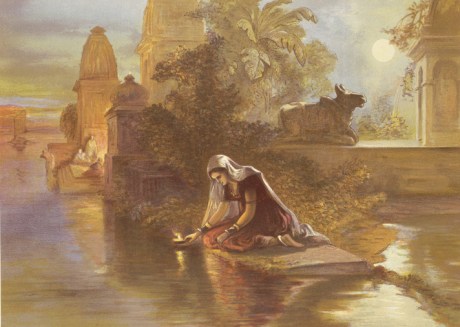
This is best illustrated by the famous river hymn, in which are invoked in an impassioned prayer the various rivers of the Punjab, eminently entitled to the nation’s gratitude for their invaluable contributions to the material making of their motherland. As the mind of the devotee calls up in succession the images of these different rivers defining the limits of his country, it naturally traverses the entire area of his native land and grasps the image of the whole as a visible unit and form.
“Certainly, a better and simpler, a more effective and soul-stirring formula could not be invented for the perception of the fatherland as the indivisible unit than the following prayer: ‘O ye Ganga, Yamuna, Sarasvati, Satadru, and Parusni, receive ye my prayers! O ye Marutbridha joined by the Asikni, Vitasta, and Arjikiya joined by the Sushoma, hear ye my prayers!’ It calls up at once in the mind’s eye a picture of the whole of Vedic India, and fulfils in a remarkable way the poet’s purpose of awakening the people to a sense of the fundamental unity of their country.”
The river hymn of the Rigveda, therefore, presents the first national conception of Indian unity. The pattern thus set in the Rig Veda, whereby a knowledge of the country was spread through association in daily prayers, was naturally followed by later literature bound to the Vedic tradition.
Thus, the following Puranic prayer is but an adaptation of the Vedic hymn to an expanded geographical horizon embracing the whole of India: “O ye Ganga, Yamuna, Godavari, Sarasvati, Narmada, Sindhu, and Cauvery, come ye and enter into this water of my offering.”
This holy text for the sacrificial purification of water is daily repeated as a mantra (hymn) by millions of devout Hindus all over the country during their baths and worship, lifting them above the limitations of domestic life to a higher plane where they realise the brotherhood connecting them all as citizens of a vaster country—the fundamental unity of India, welding together its distant and different parts into a common indivisible whole.
The same ennobling effect is produced on national consciousness by the Puranic couplet presenting India as the land of seven mountains: “Mahendra, Malaya, Sahya, Suktiman, Riksa, Vindhya, Pariyatra—these are the seven main hills of India.”
Equally efficacious is the text presenting India as the land of seven sacred cities: “Ayodhya, Mathura, Maya, Kasi, Kanchi, Avanti, and Dvaravati—these are the seven places conferring liberation on the pilgrim.” Here, India is represented as a sacred unity where all parts are equally revered.
Eternal Hindu Nationalism vs Europe’s Dark Ages
In fact, when Europe was going through the Dark Ages, nationalism was already well established in Hindu culture. India was preaching the gospel of nationalism when Europe was passing through what has aptly been called the Dark Age of her history, labouring under the travails of a new birth. It was truly a dark age for Europe, prey to the invasions of barbarians who overran and disorganised the Roman Empire but were not progressive enough to plant stable civilisations in its place. It took centuries for these nomadic people to settle and regroup into geographic entities that later became nation-states.
Conclusion
The attempt by Marxist scholars like Meera Nanda to appropriate the origins of Hindu nationalism reflects not just academic overreach but an intellectual heist. By framing an ancient civilisational consciousness as a modern political invention, Marxist scholars are trying to erase millennia of India’s spiritual, cultural, and national continuity. Hindu nationalism, rooted in the Rig Vedic vision of unity and expressed through sacred geography and shared devotion, represents an organic and enduring sense of nationhood—one that long predates European constructs of the nation-state. To attribute its rise to Leftist decolonial thought is to deny India’s own historical legacy and the spiritual foundations of Hindu nationalism. – News18, 11 November 2025
Filed under: india | Tagged: hindu nationalism, hindutva, marxist historians, marxist propaganda, vedic river hymns |










 BHARATA BHARATI