

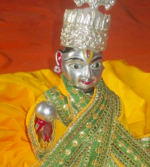






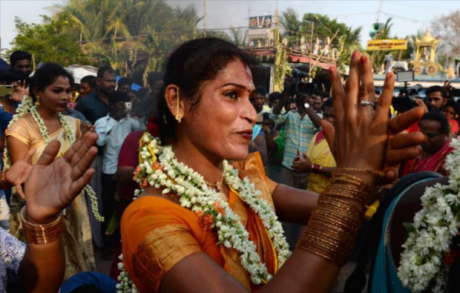
Despite a section of society refusing to accept gender-diverse communities, every May to July, vast numbers of indigenous gender-variant and diverse communities in south India honour their patron deities at temples such as those for Koothandavar Aravan in Tamil Nadu, and for Ellamma, Bhagavati and Mariamman across the region. – Gopi Shankar Madurai
In a landmark ruling delivered earlier this month, the Madras High Court affirmed that same-sex couples can form families without legal marriage. It marked a major milestone for LGBTQIA+ rights in India, particularly in Tamil Nadu. Emerging from a habeas corpus petition, the ruling addressed the case of a 25-yearold lesbian woman detained by her natal family. Her partner sought her release so that they could live together. While securing her freedom, Justices G.R. Swaminathan and V. Lakshminarayanan expanded the definition of family under Indian law, emphasising personal autonomy and right to self-determination.
It comes decades after the 2002 suicide of two lesbian women in Erode’s Satyamangalam forest after facing societal rejection of their relationship. Despite this, the 2025 verdict builds on Tamil Nadu’s progressive legacy rooted in both legal reforms and Indic traditions fostering wider acceptance of diverse identities. The verdict signals progress while recognising the concept of a “chosen family” under Article 21 of the Constitution, which guarantees life and personal liberty. The court’s assertion that “marriage is not the sole mode to found a family” validates non-traditional relationships and offers hope where despair once prevailed.
Despite a section of society refusing to accept gender-diverse communities, every May to July, vast numbers of indigenous gender-variant and diverse SOGIESC (sexual orientation, gender identity, expression, and sex characteristics) communities in south India honour their patron deities at temples such as those for Koothandavar Aravan in Tamil Nadu, and for Yellamma, Bhagavati and Mariamman across the region. These communities enact gender-specific Hindu rituals, which have historically provided sacred spaces for early LGBTQIA+ activism. This cultural acceptance, though not universal, has helped shape a more inclusive societal framework and complemented the legal efforts.
The court’s legal reasoning in the latest case was meticulous. The detainee confirmed her lesbian identity and desire to live with her partner, exposing familial coercion. The judges, referencing the Supreme Court’s 2023 ruling in the Supriyo @ Supriya Chakraborty case, noted while same-sex marriage remains unrecognised, same-sex couples can still form families. The court criticised police inaction and directed law enforcement to protect the couple, reinforcing the judiciary’s role in safeguarding individual rights against societal and familial pressures
Tamil Nadu’s history of activism and legal milestones has been crucial in reaching this point. In 1994, former Chief Election Commissioner T.N. Seshan granted voting rights to transgender individuals, setting a precedent for inclusion. In 2004, advocate G.R. Swaminathan, now a judge, secured voter identity cards for transgender people, prompting the state to publicise their voting rights. By 2006, a government order aimed to improve transgender living conditions, promoting counseling to prevent disownment and ensure educational access.
In 2008, Tamil Nadu established a transgender welfare board, and in the early 2000s, it introduced one of India’s first transgender welfare policies, offering free gender-affirming surgeries and socio-economic benefits. Asia’s first Genderqueer Pride Parade and Education Fest for school children and college students were organised in 2012. Anjali Gopalan of Naz Foundation flagged off the event in Madurai.
In 2019, the Madurai bench of the Madras High Court led by Justice Swaminathan banned forced sex-selective surgeries on intersex infants, making Tamil Nadu the first state to do so. It also became the first to recognise and register marriages of transgender and intersex persons under the Hindu Marriage Law, amend police guidelines to prevent harassment of the LGBTQIA+ community, ban conversion therapy, and include LGBTQIA+ issues in curriculums in 2017.
Organisations like Srishti Madurai and Orinam Collective have supported these efforts through legal petitions, providing shelters, funds and organising workshops, pride parades, embedding queer rights within Tamil Nadu’s cultural and legal fabric. Today, the Tamil has native terminologies for diverse SOGIESC identities, which is missing in many Indian languages.
Festivals and rituals at temples like Koothandavar Aravan, where gender-diverse individuals are celebrated, has provided a foundation for LGBTQIA activism. These sacred spaces, where GIESC communities perform rituals honoring deities associated with fluid gender identities, have historically challenged societal norms, fostering a sense of belonging and resistance against discrimination. This cultural acceptance, though not without resistance, has been a catalyst for legal victories, like the latest ruling, which resonates with the communal spirit of these traditions.
Despite these advancements, challenges persist. The 2002 suicide underscores the personal struggles behind legal battles. Activists say societal acceptance often lags behind legal progress, with financial hardships and exclusion remaining prevalent.
The latest verdict complements rulings by former Chief Justice D.Y. Chandrachud and Justice Venkatesh of Madras High Court, creating an ecosystem where personal identity and relational freedom are upheld as matters of dignity and public interest, the ruling has sparked broader discourse on queer rights, inviting debate on legal recognition of diverse family structures. It signals a future where all, regardless of sexual orientation, can live with integrity and autonomy.
The ruling is a testament to the enduring power of activism. Activists are continuing to push for comprehensive legal recognition, including same-sex marriage, and cultural acceptance to address ongoing discrimination. Building on decades of progress, the latest judgement ensures that love in all its forms is protected, offering a path towards an inclusive future where past tragedies are not repeated. – The New Indian Express, 27 June 2025
› Gopi Shankar Madurai is the South Regional Representative for the National Council for Transgender Persons and Executive Board Member at ILGA Asia.

Filed under: india | Tagged: aravanis, hijras, LGBTQIA+ rights, madras high court, transgender |





 BHARATA BHARATI
A brief history of drag in India: From mythology to modern icons – Brahmi Patkar – Harper’s Bazar India – June 25, 2025
Drag is a way of expression which is not confined by gender or sexual orientation. Drag is free of any notions and restrictions. It’s a blank canvas, waiting to be painted in bold, unapologetic strokes of the rainbow, each colour echoing pride, identity, and fearless self-expression. – Brahmi Patkar
The Origin of the term ‘DRAG’
The origins of drag can be traced back to the late 16th and early 17th centuries. Since the Church controlled theatre at the time, women were kept off the stage, leaving men to play every role. Thus, men ended up playing the roles of their female counterparts, too. Men would often wear extravagant costumes—think costumes with flowy trails and billowing gowns—to play female roles. These flowy trails are believed to have inspired the term ‘drag’, a literal term for garments that quite literally dragged behind them.
The term soon came to be associated with gay and heterosexual men who dressed dramatically. As time progressed, the idea of men dressing in women’s clothing took on new meaning. Ernest Boulton and Frederick Park, also known as Fanny and Stella, were the distinguished drag queens of the Victorian era. They challenged traditional gender norms and faced legal difficulties, but that did not stop them from touring throughout Britain and expressing themselves.
India and its ancestral ties with drag
India’s connection to drag is as old as its myths, rooted in ritual, culture, and creative expression. Hindu mythology, Indian folk dances, and regional lores are all peppered with instances of extravagant dressing and serve as a testimony to the fact that drag is an integral part of our culture.
Take, for instance, Sadu Mata-ni-Pol, a 200-year-old tradition in Ahmedabad, Gujarat. On the eighth night of Navratri (Ashtami), men from the Barot community drape themselves in bright saris and adorn themselves with jewellery to perform garba. This tradition symbolises faith. According to locals, this ritual is performed to release the community from the curse placed by a woman named Sadu Ben, who was failed by the men of this community.
Chamayavilakku is a unique festival from Kottankulangara village in Kerala, where thousands of men dress as women to offer prayers to Goddess Durga, also known as Vanadurga, at the Sree Devi Temple. Legend says the temple was built after a group of boys struck a stone that began to bleed—believed to be a manifestation of the goddess. With no women present to perform the rituals, the boys dressed as females and offered prayers, starting a tradition that continues to this day and draws visitors from across the country.
Drag isn’t limited to rituals or festivals—it has deep mythological roots, too. Tales of drag in India can also be found in epics like the Mahabharata. Arjuna is said to have dressed as Brihnala during their exile to redeem himself from the curse of Urvashi. Shikhandi, who was born as a female, Shikhandini, was known to be the reincarnation of Amba, who was wronged by Bhishma.
Drag in today’s India
The drag scene in India gained momentum after 2014, when the Indian government recognised transgender individuals as citizens and granted them full constitutional rights. Among the many voices shaping India’s drag movement is Patruni Chidananda Sastry. A performer, husband, and father, Sastry weaves Indian classical dance and drag into an expressive art form. He’s also the founder of Dragvanti, a platform dedicated to nurturing Indian drag artists.
Equally iconic is Sushant Divgikar, or Rani Ko-HE-Nur, a name now synonymous with representation. With appearances on major TV platforms and a powerful stage presence, Divgika continues to break ground for queer performers across the country.
LikeLike