
















 India should push for the return of the Amaravati friezes and other Indian treasures in the British Museum. And the G20 Summit in New Delhi next month is the perfect time to set up a pressure group for this: the League of Looted Nations. – Reshmi Dasgupta
Prime Minister Narendra Modi’s brief visit to Greece on his way back from the BRICS summit in South Africa assumes an additional significance given that the British Museum (BM) is currently red-faced about the theft of nearly 2,000 artefacts. India and Greece have reason to join forces as the BM not only holds the Elgin Marbles looted from the Acropolis in Athens but also a significant portion of the Amaravati Stupa friezes and other Indian treasures.
The BM’s director Hartwig Fischer announced on Friday that he would step down “as soon as the board have established an interim leadership arrangement” after just sacking the curator of its Greek and Roman Art earlier this year could not quell the outcry once the theft of almost 2,000 items became public. He also admitted that the BM “did not respond as comprehensively as it should have in response to the warnings in 2021”. His resignation was accepted.
This should have happened at least a week ago when it emerged that an antiques dealer, irked by the stonewalling tactics of BM officials, informed the museum’s chairman, former Chancellor George Osborne about hundreds of stolen items being sold on eBay. Osborne’s own queries revealed that a complaint in 2021 had been brushed off after an internal “inquiry”. It was evident that the BM top brass had done little to address the matter, for reasons yet unknown.
Fischer had earlier tried to defend himself and the BM administration by claiming that “concerns were only raised about a small number of items” and that “our investigation concluded those items were all accounted for,” He also accused the dealer of not informing him that he had “many more items in his possession” as that “would have aided our investigations.” The dealer retorted that Fischer lied and that the BM never contacted him for information on the thefts.
Mind you, this unseemly squabbling is happening at the BM—British Museum, not Bihar Museum—that considers itself superior to India and Greece when it comes to handling treasures. Curiously, after that clean chit to itself in 2021, a BM inquiry in 2022 miraculously revealed what Fischer then disingenuously called just “a bigger problem”—the shocking disappearance of nearly 2,000 items including jewellery dating from 15th century BCE to 19th century CE.
It has now come to light that purloined items, including ancient Roman jewellery made of gold, semi-precious stones and glass were sold on eBay for as little as $50 when they were easily worth well over $65,000. Even more astonishingly, the seller’s handle was clearly connected to the BM curator who has been sacked and recently named as Peter Higgs, but he has not been charged or arrested for any crime yet. Was he challenging the antiquities world to catch him?
That Higgs could spirit away so many items undetected for nearly 30 years points to alarming lapses in the museum’s functioning. Why did the BM ignore warning signals from as far back as 2016? How did it not get an alert about the eBay account of an employee? What is the guarantee that Higgs is the only one with sticky fingers in the BM? Can the BM maintain its lofty disdain for repatriation demands from Greece, India and other nations after this sordid saga?
Before he quit, Fischer had announced that BM has tightened its security and was “working alongside outside experts to complete a definitive account of what is missing, damaged and stolen. This will allow us to throw our efforts into the recovery of objects.” But that assurance will hardly assuage fears about the future safety of artefacts particularly in its storerooms and will also raise concerns about what else might be revealed as “missing” by those outside experts.
Since 1983 the BM has swatted away all demands from Greece to return the 5th century BCE treasures on the plea that they were better looked after and more secure in Britain than in their country of origin. Greece, however, has been relentless in its pursuit of the return of the marble artefacts that were carried away by Lord Elgin between 1801 and 1812, when he was serving as the British ambassador to the Ottoman Empire which controlled Athens at the time.
Predictably a parliamentary panel had absolved Elgin in 1816 of stealing the treasures, believing his claim that he had taken them after obtaining a firman from the Ottoman Emperor although there was no evidence of any such document. Eventually he sold the marbles to the British government and they were transferred to the British Museum by an Act of Parliament, no less. And this impressive “legal” procedure has been the basis for BM’s intransigence.
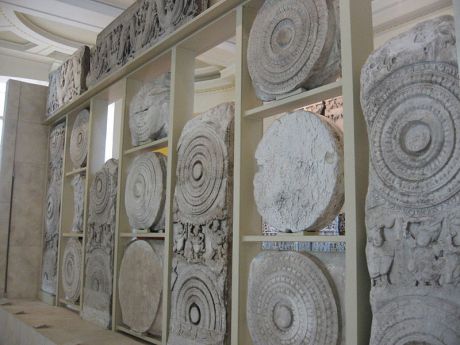
The Amaravati Stupa case is equally egregious. It was ‘discovered’ in 1797 by Colin Mackenzie, then posted in Madras with the East India Company’s army but on tour in Guntur district. He studied it in more detail from 1816 to 1820 as India’s first Surveyor General but the 3rd century BCE stupa was excavated only in 1845 by Sir Walter Elliot, and pieces were taken to Madras. After determining their artistic and historic value, many of them were sent to London in 1858.
By then, their “owner”—the East India Company—was shutting down, so instead of going to the company’s planned India Museum the Amaravati sculptures went on display at Fife House in Whitehall in 1861. When that shut down in 1869, the friezes were sent off to the India Office Stores in Lambeth as part of the EIC’s India Museum collection. Finally, after some parliamentary debates the artefacts were transferred to the BM in 1880—and displayed in the stairwell.
Removed for safekeeping during World War II, they were then housed in an air-conditioned basement in 1959 until they were relocated to a special gallery funded by the Japanese Asahi Shimbun newspaper in 1992. For over a century then, the BM really did not show much love for the friezes until that generous Japanese offer. That the friezes became EIC ‘property’ simply by the convenient colonial principle of ‘finders keepers’ also does not bother BM.
Osborne has been in talks with Greece to loan them the Parthenon marbles, presumably to get around the Act of Parliament that prevents the BM from returning anything. If the BM is amenable to these face-saving feints, India should push for a similar deal for the Amaravati friezes and other Indian treasures in the BM. And the G20 Summit in New Delhi next month is the perfect time to set up a pressure group too on this: the League of Looted Nations. – Firstpost, 26 August 2023
› Reshmi Dasgupta is a freelance writer.
Filed under: greece, india, UK | Tagged: amaravati marbles, british colonialism, british museum, elgin marbles, looted artefacts |









 BHARATA BHARATI