












 Indic texts never valorised acts of desecration as bringing glory to God – Prof. M. Rajivlochan
The latest controversies around Gyanvapi, Qutb Minar and the masjid at Mathura have given new life to the accusation that Hindus committed violence in the past against Buddhists and Jains. The evidence for such violence comes from a few stray references in the Divyavadana where Pushyamitra Sunga is said to have hounded Buddhist monks and a few references that tell us that the Huna ruler Mihirakula destroyed Buddhist monasteries and killed monks. Romila Thapar also cites references to Ajaypala in Gujarat who desecrated Jaina temples. In all of 3,000 years of recorded history, these are the only instances of evil behaviour in the name of religion in pre-Islamic India.
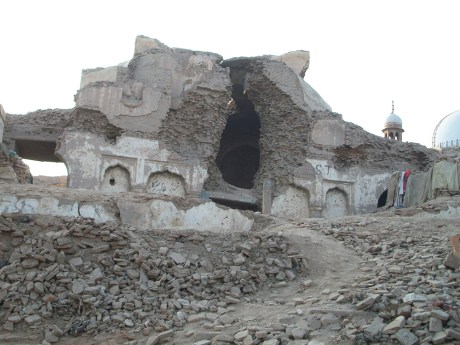
Nowhere in Indic texts were any acts of desecration valourised as bringing glory to god. Richard Eaton does refer to incidents where the idol in a temple was kidnapped by a rival king and installed in a temple elsewhere. In the early 10th century, the Pratihara king Herambapala seized a solid gold image of Vishnu Vaikuntha when he defeated the Shahi king of Kangra. By the mid-10th century the same image was seized from the Pratiharas by the Chandella king Yasovarman and installed in the Lakshmana temple of Khajuraho. However, this is very different from images being broken and used by the invaders to wipe their feet on.
Nor are there reports of mass murders in the name of religion. This is what distinguishes these acts from what India saw in the course of the Turkish and Afghan invasions starting from the 11th century till the Marathas put an end to it in the late 17th century. The contemporary Islamic chroniclers who wrote about these events, indicated clearly that murder and temple desecration was entirely justified in a religious jihad and that non-believers were a lesser category of human beings.
In her book Somanatha, Romila Thapar does not deny that the temple of Somanatha was destroyed and the Shiva lingam broken, the upper half being taken to Ghazni for people to walk on. Nor does she deny that the priests of Somanatha had earlier supported the efforts of Persian traders to set up a mosque in the vicinity of the temple. But she does her best to find what can at best be called justifications for Sultan Mahmud’s actions. Isn’t it feasible, she suggests, that the Turko-Persian chroniclers were exaggerating in order to glorify the sultan as the founder of Islamic rule in India? Besides, she points out, Mahmud desecrated mosques of Muslim minority groups like Ismailis and Shias too.
Is someone scared to acknowledge that there indeed was/is a body of people in India who imagine their religion to be the only possible truth and who think that it is alright to wage war against those who believed differently?
The idea that God takes multiple forms, that there are multiple truths, is ingrained in the Indic mind. Whatever be the text you might choose to pick up, be it any of the smritis or the Vedas or anything else, you will easily find an equal and opposite view. Even the parody of Hinduism as an Abrahamic religion that was sought to be created during British rule found little resonance among the masses. Scholars like Raja Ram Mohun Roy claimed that the Advaita philosophy of Sankaracharya, the Vedanta were living proof that Indic religious tradition had the idea of a single God. But Ram Mohun did not find any takers for what he said, even among his own family. A belief in monotheistic Hinduism remained confined to an Indian elite reeling under the impact of British rule and eager to claim that the Abrahamic benchmarks of religion also existed within Hinduism.
The Hindu reluctance to acknowledge that Muslims were willing to kill for their beliefs did not make such beliefs go away. In a survey of opinions of Muslims in 21 countries conducted between 2008 and 2012 by the Pew Research Center, support for suicide bombings against civilian targets as a justification to defend Islam against its enemies was found in 39 per cent of respondents in Afghanistan, 26 per cent in Bangladesh and 13 per cent in Pakistan. Scholar Christine Fair, who used this data set, finds a high correlation between such views and scriptural literalism—what is said in the scriptures is to be taken literally.
It does not matter whether you believe in peace or not, the Taliban have named a military contingent in Afghanistan as Panipat recently. – The Indian Express, 22 May 2022
› Prof. M. Rajivlochan teaches history at Panjab University, Chandigarh.

Filed under: india, pakistan | Tagged: dharmic religions, hinduphobia, idol-breaking, monotheistic religions, temple desecration |





 BHARATA BHARATI
Did Hindu rulers destroy Buddhist sites? The question is about politics, not history – Badri Narayan – The Indian Express – 1 August 2023
History can serve as a balm to heal old wounds or it can be used as a blade to open up scars in communities and nations. In India, for three decades, the national imagination was occupied with the Ram Janmabhoomi temple-Babri Masjid debate. No sooner was it resolved and people were beginning to emerge from its consequences, the Gyanvapi issue came to the fore. At Gyanvapi, too, there are claims and counter-claims before the judiciary over whether the site is “originally” a temple or a mosque.
Apart from these claims, there is another aspect to such disputes, which was recently put forward by Samajwadi Party leader Swami Prasad Maurya. Maurya was first with the BSP, moved to the BJP before finally joining the SP. His claim is centred on an argument made by many Buddhist Ambedkarites viz. that many Hindu temples, and mosques have been built on grounds that once housed Buddhist sites of worship, and that these structures too were demolished—often by Hindu rulers. Citing this, Maurya accused the BJP of raising the Gyanvapi issue to polarise Hindus ahead of the 2024 Lok Sabha elections.
Maurya’s statements can be understood as trying to give a message to the minority community that his party is trying to counter Hindutva politics. By doing so, he may hope to capture the minority vote. He also seems to be working to gain the support of neo-Buddhists and Ambedkarite opinion-makers, in whose good books he has not been since he left the BSP for the BJP.
However, Maurya’s statement is at odds with ideas hitherto expressed by the SP. By taking such a radical position, he might be trying to carve out a unique space for himself within the party. This statement, then, may just be a way for him to gain some bargaining space within the SP.
My reason for believing so is that the idea of Buddhist sites being destroyed has been deployed many times in the past in Uttar Pradesh politics. Years ago, some BSP leaders too tried to rake up the issue. When it did not yield any political dividends, they sidelined it. This is likely because among both SCs and OBCs, most people believe in and practise Hinduism. Travelling across Dalit bastis in UP, it is clear that the dominant “panthic” way—people who follow the Kabir Panth or Ravidas Panth, among others—see these traditions as associated with their “Hinduness”.
Another question that emerges is whether the BJP will be discomfited by Maurya’s attack. In my view, since the BJP sets or controls most political grand narratives in UP and beyond — such as Ram temple construction, welfare schemes, “suraksha” against criminals and lawbreakers—it faces little challenge from micro-narratives like the one put forth by Maurya. The party likely realises that such ideas will have little electoral impact. There are few neo-Buddhists in UP. And it is often the case that even those who believe in the Buddha worship Hindu deities such as Shiva and Ganesha alongside.
As a BJP supporter in Lucknow said, Swami Prasad Maurya’s statement seems like a political gimmick. Paraphrasing the eminent Hindi poet Dhoomil, he argued that the leader is neither the “maker of bread, nor one who eats it”. He just plays with bread.
However, the lack of electoral impact notwithstanding, the issue may have resonance with a small but important section of people. Without proper excavation and research, these ideas about history may even gain traction outside India, in other parts of the Buddhist world.
> Badri Narayan is professor, Govind Ballabh Pant Social Science Institute, Allahabad
LikeLike