














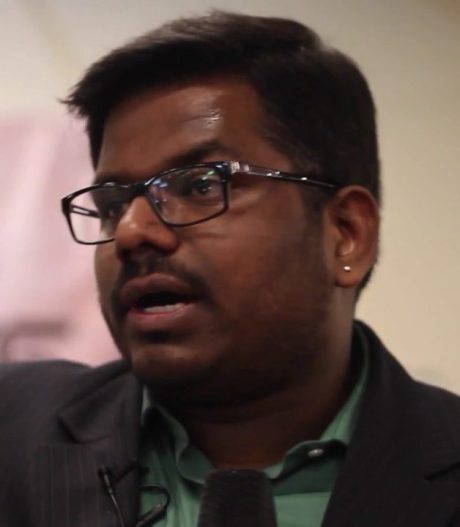
 The petitioner cannot claim that its rights under Article 25(1) must prevail over the rights of the deity along with the rights of devotees, men and women, who observe the tradition. … A worshipper cannot claim to have a greater right to worship than the rights of the deity whom he or she claims to worship and whose traditions he or she has no respect for. – J. Sai Deepak
The petition in the Supreme Court of India seeking entry of women of all ages in the Sabarimala Temple is in the final stages of its hearing.
The petitioners have argued that not allowing all women inside the temple amounts to discrimination based on gender and is thus violating of the Indian Constitution. A series of respondents has contested the claims of the petitioners in the case.
On 26 July, lawyer J. Sai Deepak appeared on behalf of a non-profit organisation called People for Dharma, one of the respondents in the case. His forceful arguments in the court took social media by storm, where he was hailed for greatly strengthening the case of the defence.
Sai said that from the language of Article 25(1), it is evident that the rights of any worshipper under the said Article are subject to the rights of religious institutions under Article 26 and, therefore, the former cannot claim to have better rights than the latter.
The lawyer submitted that while the petitioner, temple, and devotees have been asserting their rights under Articles 25(1), 21, and 26 respectively, no one has pointed out that deity also has rights under Articles 25 (1), 21, and 26.
Sai then referred to various judgments of the Privy Council and the Supreme Court of India establishing that a deity has juristic character and is thus a legal person and, therefore, can enjoy rights under Articles 21, 25(1), and 26.
Sai submitted that the deity has rights to practise and preserve its Dharma, including its vow of Naishtika Brahmacharya under Article 25(1) and has the right to expect the privacy of that character under Article 21. He further stated that it is the vow of the deity that is implemented as the tradition of the Sabarimala Temple, which, therefore, brings into the picture rights under Article 26(b).
The lawyer then argued that the petitioner cannot claim that its rights under Article 25(1) must prevail over the rights of the deity along with the rights of devotees, men and women, who observe the tradition. He also submitted that a worshipper cannot claim to have a greater right to worship than the rights of the deity whom he or she claims to worship and whose traditions he or she has no respect for.
Sai argued that the issue in the petition was not about “temple vs women” or “men vs women”, but “men vs men” and “women vs women”. If the petitioner’s contention were allowed, then men who don’t observe the 41-day vow can also claim right of entry into Sabarimala Temple citing Article 25(1). A Hindu might say that he wants to offer chicken to Lord Ganesha citing Article 25(1) and so on.
While arguing for the temple’s right to preserve its denomination under Article 26, Sai was asked by the Chief Justice how Ayyappa devotees constituted a religious denomination when there was no specific “Ayyappa sect”. Sai pointed out to the Chief Justice’s observation that the status of a religious denomination is not bestowed by the court but is something that comes from within the community. Since Ayyappa devotees share a common faith in Lord Ayyappa, and respect the practices associated with the worship of Lord Ayyappa, they would qualify as a religious denomination.
The Chief Justice then asked that since Ayyappa devotees come from other faiths, would it still be possible to call them a religious denomination. To this, Sai responded that Hinduism differs from other faiths on this aspect and Anglican/Christian definition or understanding of religious denomination cannot be applied to Hinduism.
On the charge of discriminating against menstruating women, Sai submitted that the primary object of the religious practice was to preserve the celibate form of the deity and not exclusion of menstruating women. The latter follows from the former. Sai put evidence from the religious texts before the bench, establishing the celibate nature of the deity.
Sai stated that the discrimination charge would’ve been justified had the entire focus of the temple and its practices was to keep “all women” out, but that’s not the case. All exclusion is not discrimination, especially when the object of the rule has nothing to do with misogyny or impurity of menstruation, he said.
On the issue of whether the Sabarimala Temple was being maintained out of the funds drawn from the Consolidated Fund of India, Sai placed before the court the 1922 proclamation of the erstwhile Maharaja of Travancore, where, in return for taking over the lands of the temples in Travancore, he had declared to pay an annuity of Rs 16 lakh for the running of the temples in the Travancore Devaswom. This obligation was inherited by the Indian state since it took over the temple lands from the Princely state. Therefore, it’s incorrect to state that the Sabarimala Temple was being run by state funds and, therefore, were state bodies.
Sai was granted 10-15 minutes’ time in the forenoon to put forth his submissions. However, he argued for more than one and a half hours without being asked by any of the judges to stop. This is a testament to the quality of his argument and rhetoric.
Justice Nariman observed that Sai Deepak’s submission was instructive. The Chief Justice commented that not only was it instructive but was an impressive articulation with both rhetoric and logic. “Your arguments are impressive, I must admit that”, he said. – Swarajya, 27 July 2018

Filed under: india | Tagged: ayyappa, sabarimala pilgrimage, supreme court of india, temple rituals, women's rights |












The issue is politically motivated 2006 when the issue was highlighted it was election year for Kerala and now there are national election in less than 8 months.
This verdict is going to be used in the cases like Ram Mandir and Uniform Civil Code.
Also, there are temples like Chakkulathukavu Temple where the male priests wash the feet of women devotees and the ritual is called “naari puja” or women worship. Just imagine the uproar feminists would have created if the genders were interchanged. The Bhagati Maa temple in Kanya Kumari, Kerala entertains only women. Men are prohibited there. Are men impure? Kamrup Kamakhya Temple in Assam permits only women to enter its premises during their menstrual cycle. Only female priests or sanyasis serve the temple where the menstrual cloth of Maa Sati is considered highly auspicious and is distributed to the devotees. There is a Lord Brahma temple at Pushkar in Rajasthan where married men are not allowed i.e. only unmarried men are allowed. If you are something like feminist or a new age intellectual you could replace unmarried by “virgin” and cry your lungs out. No, this is not a far-fetched theory or a work of imagination. The feminists did something like that already:
Lord Ayyappa, the presiding deity was naishtika brahmachari (one practicing celibacy). A person who practices celibacy tries to avoid distractions by staying away from opposite sex. Can this be the reason for women of certain ages not entertained in the temple? Only certain age groups are allowed because you don’t get attracted to them with a sexual desire unless you are a pedophile or a sick pervert. At least in Hinduism young girls aged 9 or 7 are looked at as kids and not wives. It is considered as an evil task if you trick somebody into breaking his solemn promise or a vow(the celibacy vow). Maybe this is why the women in Kerala are protesting. There is a second story about this also; Lord Ayyappa was not suppose to marry until the last of the kanni swamis (first-time pilgrims) had visited him. So, the female who wanted to marry him had to wait for a long time, and the menstruating women themselves decided not to visit the temple out of respect for her love.
Where did impurity come from? It was a tactic to defame temples and Hindu traditions
LikeLike
Finally somebody has made the right argument!
This Abrahamic attack too will fail!
LikeLike