








 “Commenting on his victory, a newspaper said in a front-page edit that symbolisms of Narendra Modi were an expression of the cultural nationalism of the BJP which, it contended, was not consistent with secular polity. Over years, there is a rising opinion in and outside politics that the distorted meaning that secularism has acquired over decades needs to be debated and corrected. The mainline media has so far swept this other and the correct view under the carpet and perpetuated the distortion. Result, the Indian secularism is neither Indian in the sense of equal protection to all faiths nor Western in the sense of equal repugnance to all religions.” – S. Gurumurthy
 When Narendra Modi performed Ganga Aarati on his return to Varanasi to thank the voters who had elected him some “secular” intellectuals began asking whether Modi’s Aarati was in tune with secular politics. Given the drift in the Indian secular discourse, they might not have asked this question if Modi had carried a chaddar to Ajmer Dargah—a ritual in Ajmer. Ganga Aarati is a ritual which every believing Hindu going to the holy town does. Modi, a believing Hindu, performed the Aarati which he was banned from doing before the elections. The Modi Aarati would have gone off as a private event had the media not telecast the event live and had newspapers not written about it. Assuming Narendra Modi did it so that the media is forced to cover it because of its news value, is he at fault? Had the media treated the event as a personal and private religious act, no one would have seen Modi’s Ganga Aarati. On one side, the electronic media shows Modi performing Ganga Aarati for competitive TRP rating and the print media publishes the news and photos of the event for sales, and on the other debate starts on whether Modi’s act of personal faith was secular! The real question, therefore, is not whether it was proper for Modi to have done Ganga Aarati but whether the “secular” media was right in telecasting and publishing a private religious event and then turn around to debate whether Modi’s Aarati was secular. How does a permitted private religious act become forbidden because it is publicised?
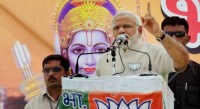 Even earlier, during the campaign when, at Faizabad, Modi addressed a public rally with Sri Rama’s picture and the Ayodhya temple forming the backdrop, the “secularists” raised a hue and cry charging that it was a religious appeal. And the Election Commission even issued a show cause notice on the issue. See what happens when illiterates expound on secularism. Everyone fell into silence when the BJP cited the great Urdu poet Allama Iqbal, the author of the famous song “Sare Jahan Se Acha Hindustan Hamara”, who said that Rama was not possession of Hindus but equally an Imam of Muslims! The Indian secular discourse, forged as a vote-catching device, has always become increasingly perverse. It is likely to intensify even after the electorate massively voted and elected Modi. Commenting on his victory, a newspaper said in a front-page edit that symbolisms of Narendra Modi were an expression of the cultural nationalism of the BJP which, it contended, was not consistent with secular polity. Over years, there is a rising opinion in and outside politics that the distorted meaning that secularism has acquired over decades needs to be debated and corrected. The mainline media has so far swept this other and the correct view under the carpet and perpetuated the distortion. Result, the Indian secularism is neither Indian in the sense of equal protection to all faiths nor Western in the sense of equal repugnance to all religions. Now, Modi’s symbolism seems to have revived the debate which L. K. Advani so powerfully initiated in the 1990s marking out genuine secularism from the fake and the pseudo. The monumental effort to have the idea of secularism redefined in the Indian context got suspended after the NDA came to power. But now with Narendra Modi the bete noire of the self-certifying “secularists” leading the nation, the debate is being revived.
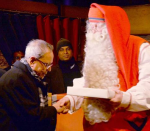
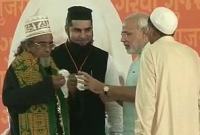 Narendra Modi had already set the stage and suggested the rules for the debate when he held his Sadbhavana fasts in Gujarat last year. His clarity on the issue of what is secularism was astounding. When a Muslim from the audience gave him a skullcap—an Arabic symbol which Indian Muslims have begun using in the last couple of decades as a mark of their identity—Modi instinctively accepted it and put it, not on his head as his secular colleagues in politics would have done, but in his pocket. This reflex action could only have emanated from deeper clarity inside. But his action became a huge issue. Modi was debated in media for days as offending the minorities. Modi was questioned on it during the campaign. His response was profound and exposed the hollowness of today’s secularism. He said he follows his tradition but respects others’. If following others’ tradition is symbolic of secularism, then Muslims would need to wear tikha to qualify to be secular.
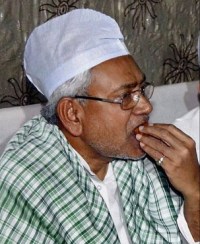 See how secularism wrongly defined at the start degenerated as it was bound to. Jawaharlal Nehru mixed his personal agnosticism with secularism and distorted the very definition of secularism. Normatively, Hindu leaders publicly forsaking or privatising their own tradition came to be regarded as symbolic of secularism. The issue arose in a daylong seminar in Chennai in the 1980s in which many including Arun Shourie, Cho Ramaswami, N. Ram and also I participated, when Mani Shankar Aiyar in his characteristic style cited not wearing the sacred thread of a Brahmin and eating beef as symbolic demonstration of his secular credentials. Immediately, the question arose whether only Muslims shaving off their beard and eating pork would be symbolic of their secular credentials. But later far from Hindus disowning their own tradition, following other’s tradition like wearing skullcap and sipping Ramzan porridge became symbolic of secularism—something far beyond the Nehruvian secular norms. The agnostic Nehru would never have worn skullcaps nor eaten Ramzan porridge. Had there been mutuality in this between Hindus and Muslims also, that would have been meaningful. The seculars could not persuade the Muslim leaders to join the colourful fun of Holi for instance. This made secularism practised in Indian politics a mockery. That is why, in his excellent book India’s Muslim Spring: Why is Nobody Talking about It? Hasan Suroor pointed out to how the current brand of secularism is mocked by many educated Indians as Sickularism and the secularists as Sickularists!
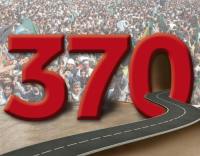 Worse, thanks to the perverted secularism, gradually even national and nationalist issues have become communal symbols. When the BJP released its manifesto in which it had mentioned its three distinct issues—the common civil code, Article 370 and Ram Mandir—many in the secular media headlined “the three Hindutva issues back”. Meaning that these issues are Hindu religious issues and against secularism. Now, test the distorted logic. Take Article 370. The chapter [Chapter XXI] in which the Article figures was originally titled as Temporary and Transitional Provisions—meaning that the Article was temporary in nature. Article 370 was specifically sub-headed “Temporary provisions with respect to the State of Jammu and Kashmir”. This was in 1950. Pundit Nehru told the Lok Sabha on November 23, 1963, that Art 370 would be eroded away. All other articles from Art 371 A to 371 H in the chapter are titled “special provisions”. Art 370 is not. It still remains as a temporary and transitional provision. How come the demand that the temporary and transitional provision of Art 370 be deleted become a Hindutva issue or communal issue? Whether it is to be done or not is a different issue for debate. Take common civil code. Art 44 of the Constitution says that the government “shall endeavour to secure for the citizens a uniform civil code throughout the territory of India”. How come the demand that the constitutional mandate of uniform civil code should be implemented be a Hindutva issue or against secularism? Whether it is advisable to do it or not is a different issue to be debated. And yet, the media clubs these two political and constitutional issues as part of Hindutva issues and turns them against secularism.
So much for the perversion of the secular discourse. Correcting this distortion is the greatest challenge to Indian secularism which is founded on equal protection to all faiths. Modi’s symbolism seems to have revived the debate which Advani started and which got suspended since 1998. Will he continue the debate and restore the real meaning to secularism? – The New Indian Express, 21 May 2014
» S. Gurumurthy is a well-known commentator on political and economic issues. Email: comment@gurumurthy.net

Filed under: india | Tagged: ganga arati, ganga river, hindu, india, india elections 2014, indian politics, indian secularism, narendra modi, nehruism, politics, religion, religious symbols, secularism, secularism-nehruism |



 BHARATA BHARATI
Secularism was introduced purposefully in India only to bolster up vote bank politics and to marginalize the majority community. The term was deliberately abused only to brand the majority community communal and introduce in India a manipulative democracy. Girilal Jain pointed out in his the Hindu Phenomenon, while the British disarmed India from 1818 to 1858, the Nehruvian India enforced a wrong concept of secularism and completed moral disarmament of the majority community.
LikeLike
This problem is peculiar to the Hindus. A Muslim or a Christian can follow his faith and its symbols and make an open show of it–they are secular. But a Hindu following his faith and displaying its symbols is not. As the nominally educated Hindus are fed and raised on the diet of govt. sponsored text-books and media-interpreted and enforced secularism, this is accepted as the norm, followed from the top levels downward.
Modi’s participation in Ganga Aarti was only the second occasion in Independent India when a top Hindu political leader openly associated with a ritual function of his faith, which had deep significance–second after President Rajendra Prasad’s participation in the Somnath celebrations, in the teeth of opposition from Nehru. Similarly, Modi calling Ganga ‘mother’ is also deeply symbolic. The Gow, the Ganga and the Gayatri–these are the universal mothers of all Hindus. One fails to understand how a Hindu following his faith becomes non-secular.
But the problem is how this wrong interpretation of secularism can be corrected. The mainstream media like The Hindu or Times of India will not give space for the views of Hindus. They will not even publish letters, questioning their reporting or stand on issues of secularism. Hindus are forced to voice their views elsewhere, which will be easily dubbed pro-Hindu.
For more than ten years, the mainstream English media has been consistently writing and spreading falsehood about Modi. Not a single one of his good works in Gujarat was reported in full. (It is only recently that a factual account detailing his achievements has appeared even in book form: ‘Modi, Muslims and Media’ by Madhu Kishwar, Manushi, 2014). It is the social media network that served to spread the correct idea and image of Modi. The social media was also prompt in pointing out the kinks in the accounts of his detractors. This has had a salutary effect on the educated young, who have no time or inclination for the learned discourse of a Ram Swarup or Sitaram Goel or Koenraad Elst. Perhaps, here lies a way to meet the challenge.
However, informed articles by serious writers like Gurumurthy appearing in odd newpapers/periodicals should be gathered, edited and published (at reasonable price) for circulation among serious readers, as this is the only way to build up a strong base of serious information and committed, informed supporters. In the long run. (I came across Gurumurthy’s writing on the economic strengths of pre-British India and its invaluable reference to Paul Bairoch and Angus Maddison in–off all places–the Annual Number, 2012, of The Vedanta Kesari, a publication of the RK Math, Chennai). Who knows how many such gems lie scattered elsewere?
LikeLike
brief but excellent ! made me wiser !!
LikeLike