







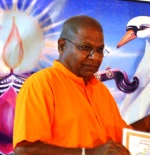





 “Non-interference of state in religious affairs is sound, as it recognises an important fact of human existence. Though universal values, which form the basis for equality before law, are connected to religion, there is another dimension of the religious life of a human being, so intimate, so sacred, that interference of any kind, by the state or other faiths, is experienced as violence. This consists in one’s understanding of and relationship to the Lord. It is here that protection is required.” – Swami Dayananda Saraswati
The aspiration of those who amended the Constitution to call India a secular nation is a noble one. Secularism, as originally conceived, embodies basic principles that implement and nurture universal values. Thereby, it fosters a state that is harmonious and, in harmony with the Lord. However, one may know or is taught that the Lord and ethical behaviour are inextricable. The essence of such behaviour is captured in a single guideline that is found in all religions—the ethic of reciprocity. Popularly known as the golden rule, it mandates, “Do to others as you would want them to do to you.” This maxim that guided humans throughout history is traceable to ancient religious traditions all over the world. It is so pervasive because it is based on a special human endowment, empathy. Empathy is the capacity to sense the pain of another being and act appropriately. And the extent to which this empathy is honed is a mark of one’s evolution as a human being seeking harmony with the Lord.
The principle of reciprocity based on empathy is the key component of a secular state—all citizens are equal, including before the law. Nothing helps to bring about the stability, growth and unity of a nation more than the implementation of this single idea. It instills in each and every individual a basic sense of security and confidence that there is order, justice in this world. You can go ahead; the laws will protect you and guide you. Equality also extends to religion. Each individual in a secular state is granted freedom to practise his or her religion. Though the Constitution now mandates so, it was originally part of the fabric of this country. The proximity of religious structures of different traditions, such as the Ellora caves, the long history of vigorous, public debate of different views, the Ashoka edicts, and the religiously persecuted communities who found refuge in India all testify to this.
This two-fold promise of secularism—equal citizenship and religious freedom for all—depends on the fulfilment of a condition that is the most defining feature of secularism. The separation of the sphere of influence and operation of the state and religion, which means there is neither interference of the state in religious matters, nor the influence of religion in the affairs of state. The prohibition of religious interference in matters of state is a corollary of equality before the law and equal citizenship. If separation of faith from state is not achieved, it will be impossible to avoid state interference in religion, inevitably violating the religious freedom of individuals and groups. And there will also inevitably be discrimination by the state against the individual’s rights and privileges as a citizen. The result can only be a discordant, fragmented nation, or nations. If there is to be real equality, one group cannot be privileged over another by the state.
The Constitution ensures this required separation by the prohibition of religious instruction in state schools, and of taxes to support any particular religion. But it also mandates to ensure religious freedom breaks down in the constitutional sanction for state interference in religious affairs. The trouble is the unequal application of this sanction. This sanction is used for state administration of temples and maths, state appropriation of temple land and donations, even legislation of who should be admitted into the temples. On the other hand, in dealing with minority religions, there are political constraints, which restrict the interference. But in respect of the majority, there is no political constraint. As a result, the state has taken over places of worship and collection of revenue from offerings of the majority religion, but not others. Moreover, such revenue can be redistributed for other purposes, including maintenance of institutions of other religions, even those which are opposed to the majority religion. It has also led to the discriminatory modification of personal religious laws. The religious laws of some minority religions supersede parliamentary laws, while for the majority religion, parliamentary law has been enacted to supersede religious laws. This unequal treatment of religions by the state has created legitimate grounds for discord. And different civil or criminal laws for different groups, religious or otherwise, is the antithesis of secularism. If secularism is the aim, it is, therefore, necessary to find an alternative to the current relationship between state and religion. And whether it is called secularism or something else, such change is necessary if there is to be unity, and at the same time, religious freedom in this country.
Non-interference of state in religious affairs is sound, as it recognises an important fact of human existence. Though universal values, which form the basis for equality before law, are connected to religion, there is another dimension of the religious life of a human being, so intimate, so sacred, that interference of any kind, by the state or other faiths, is experienced as violence. This consists in one’s understanding of and relationship to the Lord. It is here that protection is required. It is the state’s responsibility to ensure no individual or group, including the state, interferes in religious expression of another group, by conversion or otherwise. To do so is to violate sacred space, individual and collective, and sow the seeds for dissent and fragmentation. If national unity and harmony are to be secured, the jurisdiction of the state has to be limited to framing and enforcing criminal and civil laws. Conventions, religious or otherwise, are outside its scope, unless they transgress the criminal and civil laws. Because of this, framing the laws is a matter of great responsibility and complexity in a religiously and culturally diverse society. There are unique realities in any society. India is no exception. The issue, for a governing body, is being in touch with all those realities and responding appropriately. This is sane. What is sanity but being in touch with reality? If we are to function as a homeland for every Indian citizen, and as a contributor in a global era, we must be sane. And to be sane, we must be united and fair. We cannot afford to marginalise or privilege any group, religious or otherwise. If sanity is being in touch with reality, our religious traditions have something more to say about this. In all traditions, that reality is the Lord, and the ethical laws are intrinsic. Thus, the more ethical one is, the more one is in touch with the sacred reality, and, whether as an individual or a nation, the more sane one is—free of conflict, productive, in harmony with the universal order. This is our heritage. Together we can claim this heritage. It is our duty to do so—our duty to our ancestors, to our neighbours, local and global, our children and their children, and to our own integrity. – The New Indian Express, 22 April 2014
» Swami Dayananda is a renowned traditional teacher of Advaita Vedanta and founder of the Arsha Vidya Gurukulam.
Filed under: india | Tagged: advaita vedanta, conversion, conversion is violence, dayananda saraswati, hindu gurus, hinduism, india, indian secularism, religion, religious conversion, religious freedom, secularism, vedanta |







 BHARATA BHARATI
Separation of state and Church was originally in Europe fought for not because the state interfered with religion, but because religion interfered with the state, or rather, both were intertwined. Religion demanded that the state enacts heresy laws, etc., because it knew that blind belief in dogmas could not stand on its own and people would drop this belief, if it is not enforced. This fear was not unfounded. Ever since people are free to leave the Church (in Germany for example only since 1847), there is a steady stream leaving it.
LikeLike
Religion, Region, Language, Sect and even subsect and Money are dear to most; in spite of deep knowledge of Science and Social behaviours; practically, none is able to behave ‘Secular’ and as ‘Universally acceptable’! The Christians and Jews of the developed nations feel closer to Islam and to a lesser extent even to Budhdhism; no body can explain why in spite of vast tracts of land and resources they are keen to ‘convert’ people and what sort of insecurity they feel in the existence of other religions, particularly Hinduism in its own country!! In the same way, even within Hinduism, in the final, the Saivaites and Vaishnavites, the subsects within the Vaishnavites are unable to tolerate the others!! Knowledge itself appears to be an ‘enemy’! The State can not afford to have the same laws for every body; only after lots of experimentations and applications of mind, the forefathers in India offered the Sanatana Dharma; for any reason, we have lost the people, who can interpret it correctly and guide us in the modern days; the people, who write articles in the media and the media reporters are by and large young and trained to think in the western way, which offers the obvious comforts; we have also lost people like Vasishta, Agasthya, Valmiki, Karikal Chozha, Vikramadhithya, Sankaracharya, Ramanuja……But, whenever some scientific studies are presented by the Western people, we respond by saying that all those had been mentioned in ‘OUR SCRIPTURES’!! Today we are a weak society, weak in all senses. Let us try to rebuild India, Hinduism and the Sanatana Dharma.
LikeLike